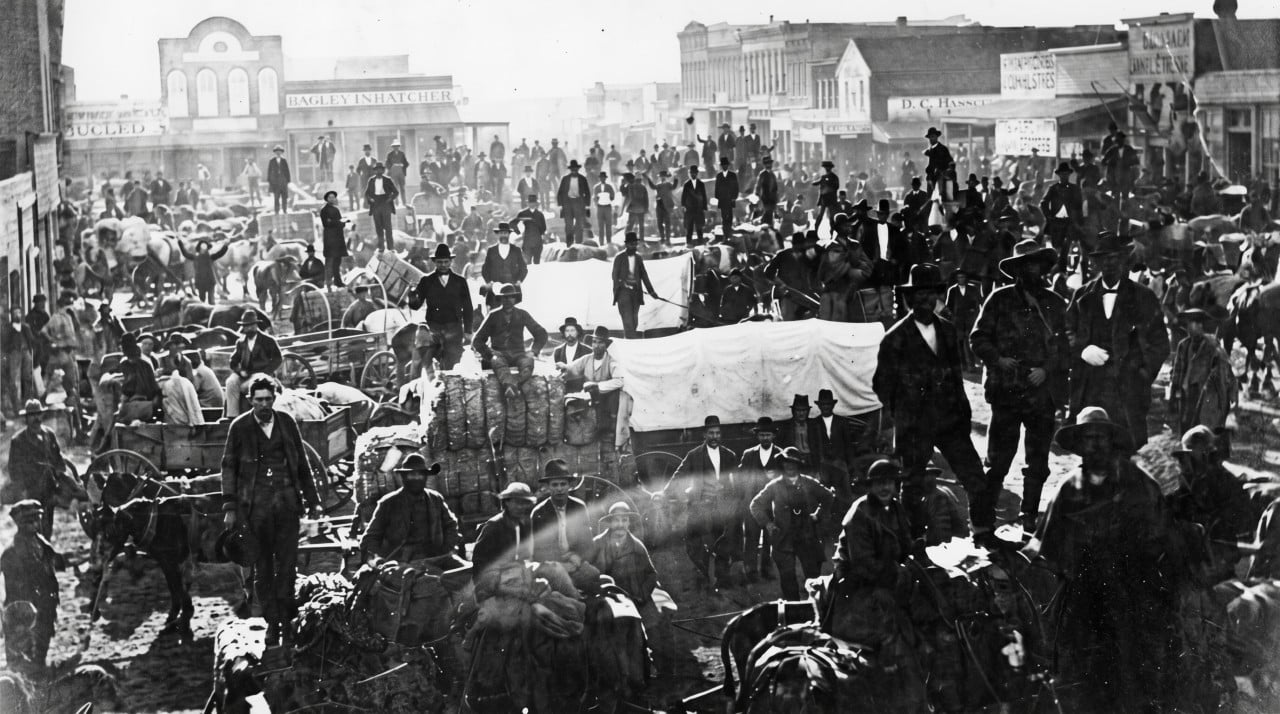
In Fort Worth’s early days, market day was one of the most important events of the year. Local farmers and cattle traders would come to town to sell their goods. Market day was held once a month on the public square. One of the few surviving photographs of Fort Worth from the 1870s depicts a typical market day, when the square was filled with wagons and plainly dressed people.
Fort Worth was more than just the seat of Tarrant County. It served as a distribution center for the vast rural areas to the south and west. At the time, there was no urban sprawl into the surrounding area. Beyond the city limits lay open countryside dotted with farms and ranches, inhabited by “country folk,” meaning rural residents, not Americans as such, as we understand the term today.
By the early 1890s, Saturday market days had ceased to dominate the public square. Shopkeepers protested, and the market disrupted the normal operations of the courthouse. Moreover, plans were under way to build a large new city hall that would occupy much of the original square. Although it was not completed until 1895, market days on the square ended before the bonds were issued and the plans were drawn up. There was also talk of fencing off the square during construction, which the Fort Worth Gazette described as a “serious inconvenience” for the farmers and cattlemen who had sold their products there since time immemorial. No one wanted to drive away the honest, hardworking people who depended on this location to sell their goods. After all, city residents also bought fresh vegetables and meat directly from local farmers coming into town. Despite its metropolitan image, Fort Worth still resembled a small country town in many respects.
In 1892, the Fort Worth Gazette advocated the establishment of a “spacious public market” where ordinary people could buy meat and vegetables at reasonable prices. A farmers’ market offered a cheaper alternative to local grocery retailers and butchers. The question was where to put it. When city officials began planning a new city hall in 1891, one female member of the building committee proposed placing the public market on the ground floor of the building, the police court and offices on the next floor, and the council chamber on the third floor. Revenue from the market was intended to help cover construction costs, while the market itself would serve the public interest. It would also make it easier for the city to “regulate and control the sale of meat, agricultural produce, and other goods.”
When the more sensible council members prevailed and the new city hall, completed in 1893, did not include a farmers’ market on the ground floor, Fort Worth residents had to find another solution. Attention turned to nearby vacant lots in the Jennings Addition. The city’s business district effectively ended around Eighth or Ninth Street, both east and west of Main Street. The only notable buildings south of that point, as far as the Railroad Reservation, were St. Patrick’s Church, the 1893 city hall, and the 1896 federal building. Several “public-spirited” property owners offered two locations: several vacant blocks between the city hall and the federal building, or one block bounded by Tenth and Eleventh Streets and Houston and Throckmorton Streets. It all depended on how much space the market required. In either case, rural vendors could arrive with their wagons without having to pass through downtown, and city residents could easily get there as well. All that was needed to begin operations were a few hitching posts and a watering trough. It was quite astonishing that no one mentioned installing toilets. Presumably, people were expected to use the toilets in the city hall or federal building, or else step behind a wagon. The Fort Worth Gazette urged that the market be opened as quickly as possible and suggested that a large covered market house might one day be built on the site.
The debate became surprisingly heated, demonstrating that despite its growing skyline, electrical lines, streetcar tracks, and other signs of urbanization, Fort Worth still retained its rural way of life. No one could open a public market without the permission of the city council, whose members faced pressure from several sides. They argued over the location of the market, whether to establish an open-air market or a covered market house, and how it should be regulated. One group of businessmen strongly opposed both sites in the Jennings Addition. They were not opposed to a farmers’ market as such, but because their businesses were located on the northern edge of the city, they feared that a public market in the south would hurt them financially. They therefore offered an alternative proposal involving the construction of a market house on four vacant lots on the north side of the courthouse square. One reader writing to the Gazette complained that until a market was established, city residents would continue to pay exorbitant prices for meat and vegetables.
The two-block site in the Jennings Addition prevailed. A covered building was erected and licensed by the council. The discussions leading to this decision also revealed other reasons for moving the public market to the southern edge of the city, away from its center: to rid the public square of peddlers and “wood sellers.” The former were particularly troublesome, obstructing sidewalks and aggressively accosting passersby. The police could now move them far from the business district or, if they refused, stop them altogether. Over the following years, the market on Jennings Street “near Thirteenth” flourished. Instead of holding market day once a month, it was open six days a week, except Sundays. It became as popular a place as the old market on the bluff. A reporter from the Fort Worth Morning Register visited it and described the “cosmopolitan crowd” he saw there. Vendors offered everything from melons and pumpkins to firewood and patent medicines. Absolutely everything was for sale, including livestock, farm implements, and furniture. Owners did not even have to sell in person, as auctioneers were available for that purpose. Every day except Sunday, the place took on the atmosphere of a county fair, just a few blocks from city hall.
The market’s success aroused the envy of uptown merchants, who coveted the customers taking their business to the public market. A group of them joined forces and bought a vacant lot between Belknap and Bluff Streets, immediately east of the courthouse, to revive the original open-air market. The venture proved so profitable that it drove the Jennings market into decline. The city’s expansion into the Jennings Addition also contributed to its demise. As land in this part of the city increased in value, a farmers’ market or flea market no longer seemed the best use for it. The last remnant of the market was its shelter, which was demolished after all the vendors left in 1906. The site was cleared for new development, and Fort Worth’s first Majestic Theater was eventually built there. Meanwhile, the vendors did not go far; they simply returned downtown.
The city council recognized the civic value of a public market to such an extent that in 1906 it supported a $35,000 bond issue for its construction. Although Fort Worth could by then rightly consider itself a regional metropolis with more than 50,000 residents, local farmers and cattlemen still sold directly to the public. Nor were rural residents the only ones who wanted a public market. Business interests also saw it as an opportunity to make money. A group of retailers organized as the Market House Company believed they could earn a tidy profit by building a public market and renting stalls to vendors instead of allowing them to use a vacant lot for free. The group obtained clear title to two lots at the corner of Houston and Belknap Streets, across from the county jail, and then offered one of them to the city in exchange for the city constructing a covered building on it and allowing them to use it free of charge. The agreement also required the city to purchase the second lot for an open-air market. Farmers had been coming into town to “sell and exchange their produce” since time immemorial and had used these lots without paying a cent in rent. As the city grew around the site, the land increased in value by about a thousand dollars each year, yet the farmers paid no taxes and did not have to purchase licenses. On every weekday, ten to fifty wagons were parked there. Farmers practiced the world’s oldest trade, fed the city, and sold their crops directly to the public. This convenient arrangement was disrupted in 1906 when the Market House Co. purchased the lots. If it succeeded, free enterprise would no longer be free of charge. The city council voted to accept the agreement. It helped that one of the Market House investors, Ben L. Waggoman, was also a council member, guaranteeing at least one vote in favor of the deal.
These corner lots were historically significant because they were the last undeveloped land on which the 1849 fort had stood. On the western side of the property, a small grove of trees that had been growing there when the first soldiers arrived still remained. Some residents vocally advocated turning it into a historic park. Others saw only its commercial potential. A bitter, years-long battle was waged over this corner lot, pitting preservationists, county commissioners, and developers against one another, with none able to reach any agreement.
When neither the Market House investors nor the city did anything with their piece of property, the county reentered the picture and bought it for $20,000 in 1912. For the first time in history, the county thus obtained “clear and unrestricted title” to all the land from the public square to the river. Neither city nor county elected officials wanted to abandon the idea of a downtown farmers’ market entirely, demonstrating that Fort Worth was far less urbanized than people liked to think. In 1912, city officials proposed a joint project that would build the long-promised covered market on the bluff together with a much-needed public auditorium. The county commissioners, however, had lost interest in farmers’ markets in any form. They had another plan for the site: a new county jail. Tax Collector Robert M. Davis supported relocating the jail and urged the commissioners to turn its original site into a “resting place for farmers coming into town,” namely a farmers’ market. To avoid alienating any group of voters, the commissioners promised that the vacant lot at the corner of Houston and Belknap Streets would continue to be used exclusively as a “market square and nothing else.”
In reality, by 1917 the decision to move the jail across the street was irreversible. The county owned the property, a new jail was essential, and for operational and security reasons it had to stand in close proximity to the courthouse. No arguments in favor of a farmers’ market or historic park could alter that decision. Business owners around Belknap objected that a jail in their neighborhood would significantly reduce commercial property values, but their opposition was nothing compared with that of the Federation of Women’s Clubs, whose members descended on the commissioners court like angry wasps. They declared that the “only historic site” remaining on the bluff must not be turned into a prison. Their spokeswoman, Mrs. J. J. Jarvis, threatened: “If they start building it, I personally will favor tearing it down, and I had an axe in my hands before Carrie Nation did!” The commissioners eventually placated the women by promising to give them the site of the old jail as a public park once it had been vacated. This finally happened in 1921. Amid the tug-of-war between the commissioners and preservationists, it was overlooked that regardless of who prevailed, the farmers were the greatest losers. There was no longer any place for them in the heart of Fort Worth.
The new county jail at 200 W. Belknap took nearly two years to build. In 1918, the county moved into the grandly named Tarrant County Criminal Courts Building. It still stands there today, on the ground where soldiers once drilled and farmers spread out their goods.
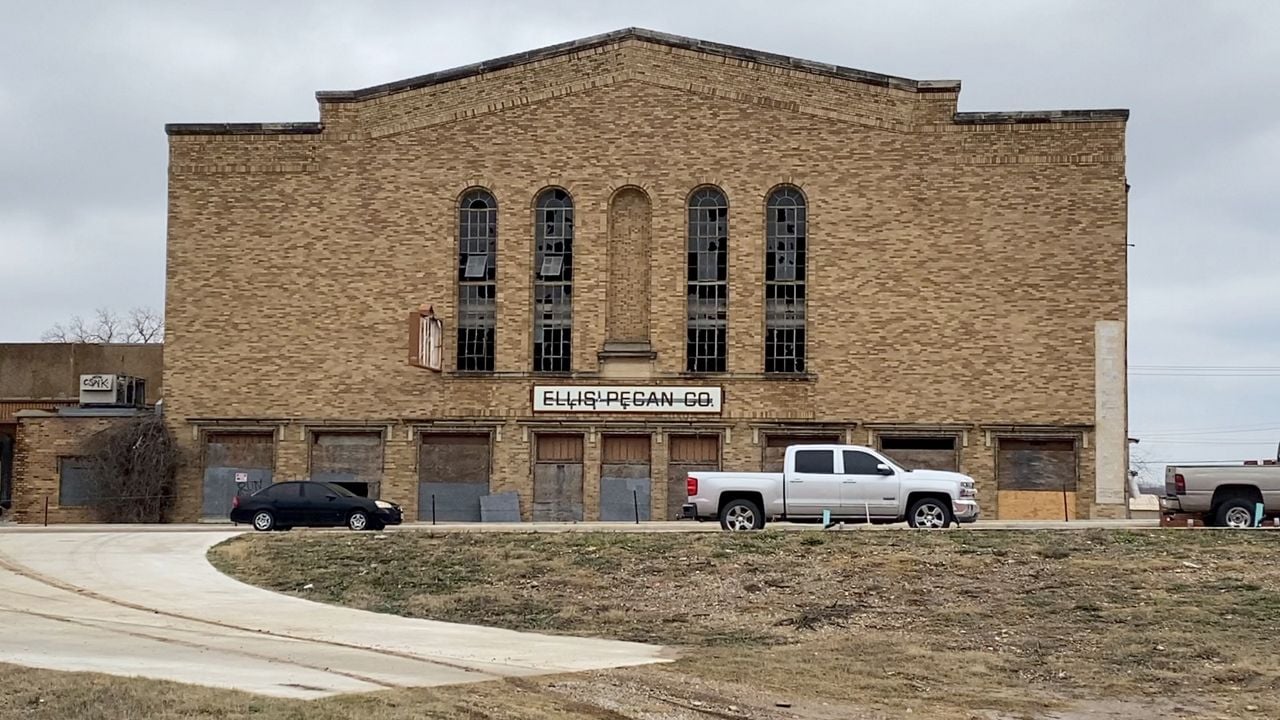
The idea of a public market, however, did not simply die. Decades after suburban development had spread in every direction to the horizon, and long after the last farmer’s wagon had been seen downtown, the old idea was revived. In 1930, developer John Harden opened a new public market in a magnificent Art Deco and Spanish Colonial Revival building at 1400 Henderson. It closed in 1944 and changed hands repeatedly over the following seventy-plus years until it appeared on Historic Fort Worth’s list of “most endangered properties” in 2008. It still stands vacant today, awaiting the right owner as a monument to Fort Worth’s rural roots. Yet the public market continues to find its place even in the 21st century. The very name evokes images of the freshest goods, reasonable prices, and knowledgeable vendors, even if the building may look like any ordinary supermarket.