

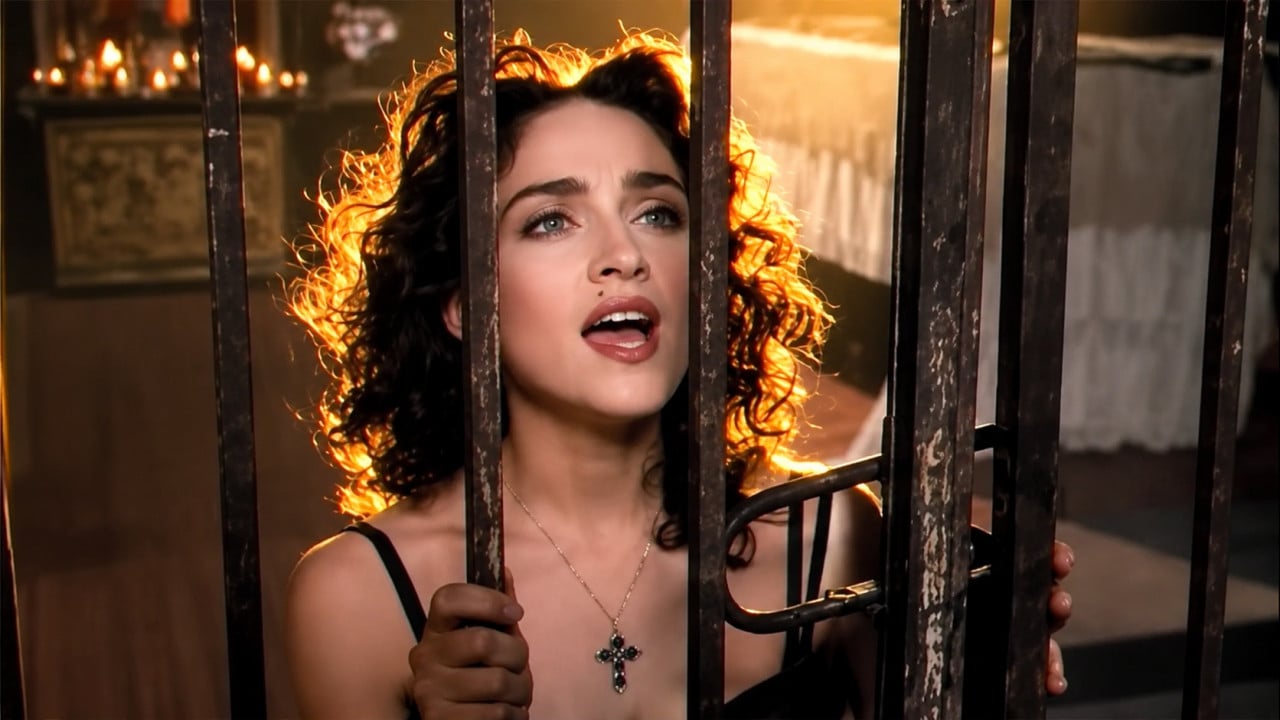
Since April, Australian radio stations have been playing a dance remake of Madonna’s hit Like a Prayer on repeat. It was released by Queensland DJ Josh Fawaz, holds the top spot on the radio airplay chart, and has thirty-five million streams on Spotify. But some in the industry claim that generative artificial intelligence is behind its success. Since then, Australia has been debating whether we can even tell who actually created the music.
Madonna vs. an unknown producer
The singer has the acclaimed album Confessions II to her name, but not a single track from it has yet entered the Australian charts. Samantha Bennett, a professor of music at the Australian National University and chair of the International Association for the Study of Popular Music, sees irony in this. Madonna released material with depth, while a four-decade-old melody performed by someone else is racking up plays. That version has fourteen million views on YouTube.
Fawaz’s track tops the Australian radio airplay chart. On the ARIA charts, which combine physical sales, digital purchases, and streaming, it ranks fourth among Australian singles.
Fawaz has been releasing music since 2015, when he debuted with the track Bubble Goose. For years, he put out club music and nothing remarkable happened. This year, he ventured into covers with vocals, releasing Like a Prayer in April, followed by the eighteen-track album Dance Like Nobody's Watching, full of dance versions of well-known hits by artists including Oasis and Cyndi Lauper.
He describes it as a moment when he was ready to quit. In a social media video, he wrote that he gave it one last try, recorded Like a Prayer, went to sleep, and woke up the next morning to a different life.
Artifacts in the vocals
Producer Mitch Thomas, who performs as Needs No Sleep, has been the most vocal in drawing attention to the track. After fifteen years in the industry, he says he can recognize the typical hallmarks of machine-made music. He points to sloppily assembled drums, strange artifacts in the vocals, and the suspiciously low quality of the file he received by email from a promotional service for DJs.
Sam Whiting from RMIT University’s School of Media and Communication hears it similarly. According to him, the recording bears the hallmarks of output from generators such as Suno, especially heavy compression. If a human sang those vocals, it is a remarkable performance. If not, it raises the question of what we still value in human art at all.
For Thomas, it is not just about the sound. Generators learned from something, namely music whose creators never gave their permission. He summed up his rejection with a comparison to sports. We hate it when someone takes steroids and competes unfairly, and the same applies to music. The best books he has ever read were written by people. The paintings in the Louvre were painted by people.
Fawaz responded only in Instagram comments. He wrote that he uses AI as a tool, that he was releasing music long before it arrived, and that the main point is to give listeners good songs. He dismissed the criticism by saying it was not such a big deal.
Madonna will get paid either way
APRA AMCOS, the organization that collects royalties in Australasia, confirmed that Fawaz has been a member since 2021. At the same time, it made clear that the way the recording was made has no effect on payments to the original songwriters. Like a Prayer was written by Madonna Louise Ciccone and Patrick Leonard, so they receive money for every play as usual. A recorded song has two layers of rights, one covering the composition and the other the recording itself, and the uncertainty begins only with the latter.
Toby Walsh, chief scientist at UNSW’s AI Institute, agrees with the musicians. Making a living from music is difficult even without generated tracks taking over the charts. According to him, companies took the work of thousands of artists, fed it into their models, and no one bothered to reach an agreement with the creators.
Bennett proposes a simple solution. When a radio station plays a track created by software, it should say so, allowing listeners to decide for themselves whom they want to support. Since July 1, Australian commercial radio stations have followed a new code requiring them to disclose generated voices on air. But it does not apply to music.
Bennett also points out that machine assistance in music is nothing new. Automated mixing and mastering modules have existed for years, and as far back as the late 1970s, the Eventide Harmonizer could make one voice sound like three.
What is legal and what is not?
Anyone can try out the generators. On Suno, Udio, or Google-developed Lyria 3, all it takes is a few words about genre and mood. A New York Times reporter used this method to create a summer dance track about drinking margaritas in two minutes, then had it turned into an orchestral version and a polka. According to him, the rhymes suggest that Bob Dylan has nothing to fear for now.
The courts are only beginning to decide what is legal in all of this. Major record companies sued Suno and Udio as early as 2024 for training on their catalogues of protected works, while both startups have defended themselves by invoking the principle of fair use. Google, which was sued over Lyria 3 by a group of independent musicians, offered a different defense: it claims that anyone who uploaded a track to YouTube and accepted the terms of service gave it permission themselves. The case is still ongoing.
Personality rights are also at stake, meaning the protection of a person’s name, likeness, and voice. When asked for a ballad in the style of Neil Young, Suno therefore replied that it does not use artists’ names and replaced the prompt with a more general description. Warner Music, whose catalogue includes Madonna, Bruno Mars, and the aforementioned Young, nevertheless reached an agreement with Suno. Artists will be able to opt in themselves and authorize the use of their music.
French streaming service Deezer said that around ninety thousand generated recordings arrive on its servers every day. Most go unnoticed. Among the minority that do attract some clicks, Deezer says fraud is involved in as many as 85 percent of cases. The formula is always the same: create a huge number of tracks and send bots to play them. Because platforms distribute money according to each track’s share of total streams, every penny paid to such a factory takes money away from real musicians.
Sources: gvwire.com and abc.net.au


