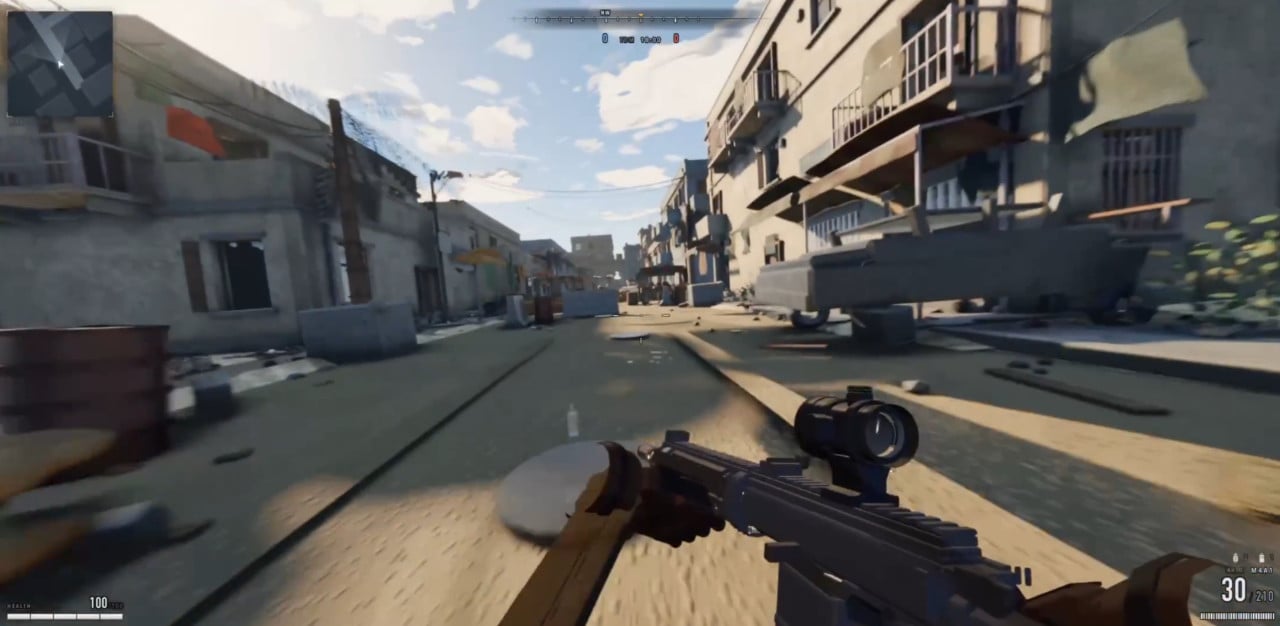
A first-person shooter that runs directly in the browser has its own physics and eleven separate code components. Altogether, it contains about 55,000 lines divided into eleven subsystems, built on Three.js r180 and WebGL2. Not a single texture or audio file was uploaded to it. The entire codebase was written by Claude Opus 5 from a single prompt by Matt Shumer, who named the project Claude of Duty and published both it and the complete prompt on GitHub.
The shooter prompt
Shumer asked the model to create a shooter on par with the latest Call of Duty games, with uncompromising quality from textures to physics. The instructions also told the model to divide the work among subordinate agents, repeatedly revisit the result of each component, and have it evaluated by a dedicated, ruthless critic. The work was to end only when this critic concluded, in a blind comparison with the real game, that it looked just as good.
That is precisely why the phrase "one shot" is somewhat misleading. It means one prompt entered by a human, not one model pass without loops, critics, and auxiliary tools. When people on X began challenging Shumer’s post, arguing that several days of manual work must have gone into it, he published both the repository and the prompt.
Textures and sounds are generated only when the game loads
You will not find any art assets in the project. Every texture, model, animation, and sound is generated procedurally when the game loads, and the only dependency is the three package. Audio is synthesized through Web Audio, meaning that gunshots, reverberation, and spatial positioning are produced through computation rather than by playing recordings.
The model wrote the physics system from scratch, without a library. It supports bullets penetrating multiple materials, rigid bodies with continuous collision detection, and ragdolls upon death. The map measures approximately 120 by 120 meters and depicts a market street with enterable buildings and several hundred objects placed throughout it.
Auxiliary tools played an important role here. They revealed two problems that had invalidated earlier measurements. A test with a static camera reported 94 frames per second, while actual gameplay on a Retina display ran at 12 to 17 frames per second and stalled for 728 to 1,236 milliseconds because more than thirty GPU programs were not compiled until the middle of a frame. The second problem lay in the screenshots. A single page used for all eleven shots carried over the state of particles, reflections, and exposure, so two identically configured runs differed in ten out of eleven shots.
Optimization was then carried out under the strict rule that the image could not change by even a single pixel, as verified by an image comparison tool. The result increased performance from 12–17 to 28–30 frames per second, reduced the worst frame time from more than a second to 66–82 milliseconds, and cut loading time from nine to twelve seconds to less than five.
The game failed to match Call of Duty
Shumer writes that the game failed to achieve its goal of matching a modern Call of Duty title. Eleven independent critics progressively awarded the shots scores of 3.59, then 4.14, then 4.05, and finally 5.05 out of ten. Two shots received a rating of "close," while the others remained amateurish, and in blind comparisons every critic chose the real game in every round.
The game has weaknesses. The hands look like angular chunks that do not hold the weapon convincingly, surfaces viewed up close reveal that they are made from generated noise, and enemies at a distance resemble store mannequins. The visual improvements also doubled the triangle count from 5.9 to 11.3 million, while optimization recovered only about half of the lost performance.
Deploying agents in parallel resulted in worse visuals
The notes documenting the development process may be more valuable to other developers than the game itself. Three rounds involving six agents, each managing one folder, increased the score by only 0.46 points, while the number of visual defects ultimately rose from sixty to 66 because tone mapping, the sky, and indirect lighting form a single interconnected whole, and the separate agents undermined one another’s assumptions. A single sequential pass in which one owner was responsible for each interconnected area delivered a full-point improvement and reduced the number of defects from 66 to 26.
The most valuable breakthrough came when one of the agents rejected its own instructions. For three consecutive rounds, the critics claimed that the weapon lacked texture, when in fact it was merely dominated by reflections and its diffuse component was far below the final value. Previous rounds had reduced the surface brightness, suppressing the diffuse lighting and only making the complaint worse. The solution was exactly the opposite of what the critics had requested.
Source: explainx.ai