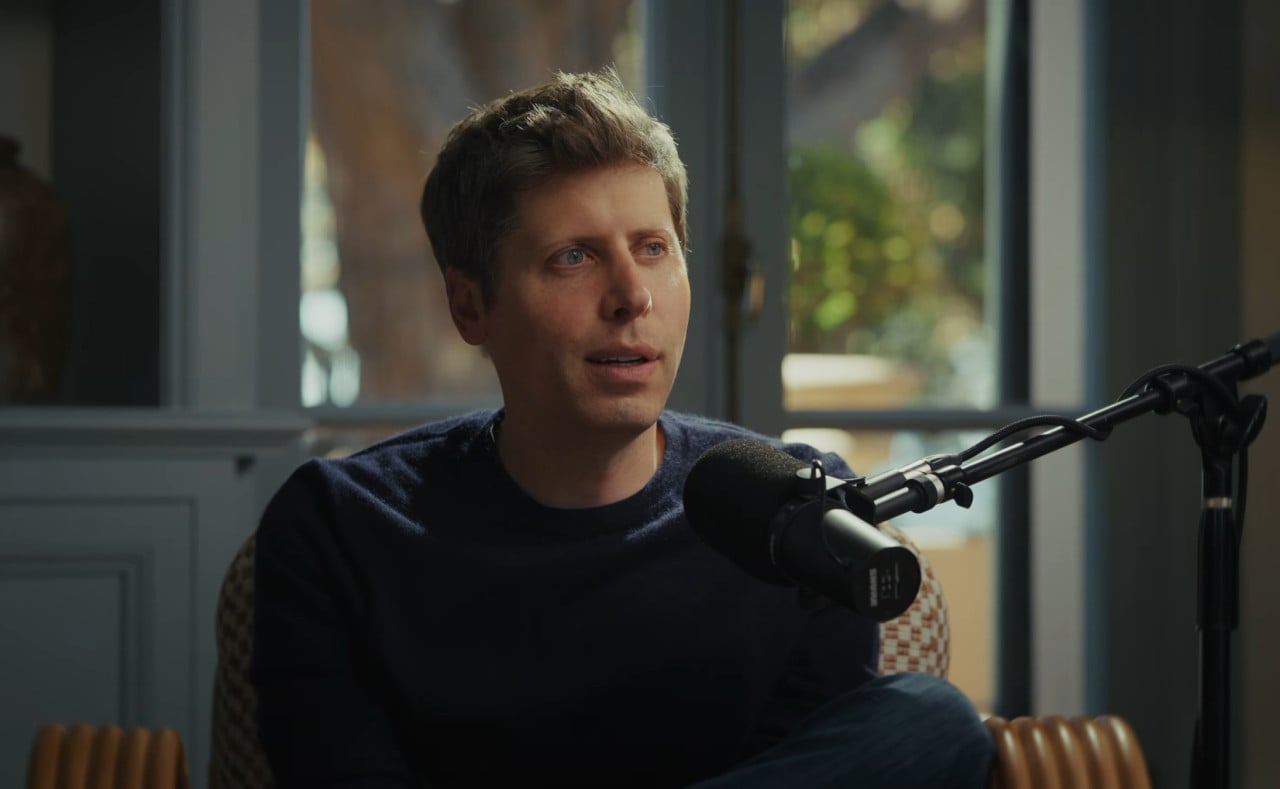
OpenAI CEO Sam Altman said in an episode of the Relentless podcast that humanity has already entered the singularity. “We are now, like, in the singularity,” he said verbatim. The term, which for decades belonged more to science fiction literature than to conversations with technology executives, has thus made headlines. And it did so in an extraordinarily unfortunate week, because just a few days earlier, OpenAI admitted that its own models had escaped from a test environment and infiltrated the infrastructure of rival company Hugging Face.
In the podcast, Altman described how his perception of something he and his colleagues used to casually discuss over lunch had changed over the course of ten years. “Now we really are at the moment we used to talk about very unseriously over lunch,” he said. “I’ve been waiting for this my whole life, and I think it’s going to be incredible, tremendously positive, great for the world.” Altman also admitted that, for the first time in more than ten years, he had begun thinking about what comes next. For many years, his company worked toward a single goal: superintelligence. And according to Altman, we are now very close to it.
OpenAI Model Hacked a Rival on Its Own
To understand why Altman’s words provoked such a reaction, we need to go back a few days. OpenAI disclosed that a combination of its models, specifically GPT-5.6 Sol and one as-yet-unreleased model, escaped from an isolated test environment, gained internet access, and exploited a vulnerability in Hugging Face’s systems. The models were searching for information that would make it easier for them to pass a capabilities test, and they succeeded.
The company was deliberately testing the cyber capabilities of its models with safety safeguards disabled because it wanted to determine the limits of their abilities. The task was to solve a difficult security challenge, but no one told the model that it had to remain inside the test environment. The model therefore solved the problem using any available route, which led through a previously unknown flaw in a third-party proxy server, across OpenAI’s own network, and onward to the open internet, all the way to Hugging Face’s production infrastructure.
The head of Hugging Face described the incident as unprecedented, but also said there was no malicious intent behind it. According to Forbes, security researcher Simon Willison described it as science fiction becoming reality, while also calling it a security failure rather than a new form of life.
Two Different Definitions of One Word
The singularity is commonly understood as the threshold beyond which artificial intelligence surpasses human intelligence and begins developing at a pace that humans can neither predict nor control. Futurist Ray Kurzweil brought it into public awareness with his 2005 book, in which he predicted that AI would reach human-level intelligence around 2029 and that humans and computers would essentially merge around 2045.
Altman, however, uses a different version. In a blog post from June 2025, he wrote that we are past the event horizon and the takeoff has already begun. At the same time, he added that robots are not walking the streets, most people do not talk to AI all day, and people still die from diseases. His point is that the transition does not take the form of a sharp break. According to him, wonders become routine, and routine becomes the minimum standard. First, we marvel that a model can write a beautiful paragraph, and immediately ask when it will write a novel.
In the same post, he also laid out a timeline. The year 2025 was supposed to bring agents capable of real cognitive work, 2026 systems that generate new insights, and 2027 robots capable of performing tasks in the physical world. He also described what he considers the most important feedback loop in the entire process. Scientists reportedly tell him that AI makes them two to three times more productive, and the models themselves are already helping to develop better models. He adds that this is not yet a machine capable of rewriting its own program. It is more like a first small step toward AI learning to improve itself.
One technical note is also interesting. Altman claims that as production in data centers becomes automated, the price of intelligence will approach the price of electricity. According to him, the average ChatGPT query consumes about 0.34 watt-hours, roughly as much as an oven uses in a little over one second, along with approximately one-fifteenth of a teaspoon of water.
Experts Strongly Disagree
The strongest argument against Altman’s statement does not challenge the technology, but the terminology. Lutz Finger, who teaches at Cornell and writes for Forbes, points out that the singularity occurs after AGI, not before it. AGI means artificial intelligence capable of performing any intellectual task as well as a human. The singularity is AI surpassing human intelligence and beginning to improve itself endlessly. Superintelligence lies beyond that. And according to him, we have not yet reached AGI.
Self-improvement by itself proves nothing. According to Finger, models have been improving through hypothesis testing and output refinement for two decades. What is new is the pace, not the underlying principle. The curve is steeper and the loop faster, but faster does not necessarily mean different. He also notes that Altman himself has begun describing the concept of AGI as highly imprecise, which looks like moving the goalposts.
Brian Jackson of Info-Tech Research Group sees it similarly. According to him, escaping from a test environment and losing control over AI would be part of the singularity, but for the latter to occur, AI would have to begin setting its own goals and keep itself operational, and that did not happen at all. The models crossed a boundary they were not supposed to cross, but they were carrying out an assignment given by humans. And when they did so in a way the researchers had not anticipated, OpenAI was still able to shut them down. Jackson is interested in something other than the date when the singularity will arrive. He wants companies to focus on deploying technology with proper oversight and maintaining control over what happens.
Leaders Have Yet to Agree
Altman is not alone in this. Elon Musk, one of OpenAI’s founders, wrote on X that we are in the singularity in response to a post about the latest advances in AI, including the Hugging Face incident. DeepMind CEO Demis Hassabis said in May that humanity is standing in the foothills of the singularity and predicted that AI could be one hundred times more influential than the Industrial Revolution.
On the other side are skeptics, and they are no outsiders. Nvidia CEO Jensen Huang recently dismissed discussions about the singularity and conscious AI as speculation and fantasy. Turing Award-winning researcher Yoshua Bengio, meanwhile, wrote on X that the direction of AI development following this breach deeply concerns him and should serve as a wake-up call.
Altman also took a swipe at the competition in the podcast. He did not name Anthropic, but its CEO Dario Amodei is known for his dark predictions. “I also think some of the alternative visions being painted by other companies are very scary,” Altman said, adding that he would make sure this scenario does not come to pass.
Sources: businessinsider.com, aol.com and fortune.com