

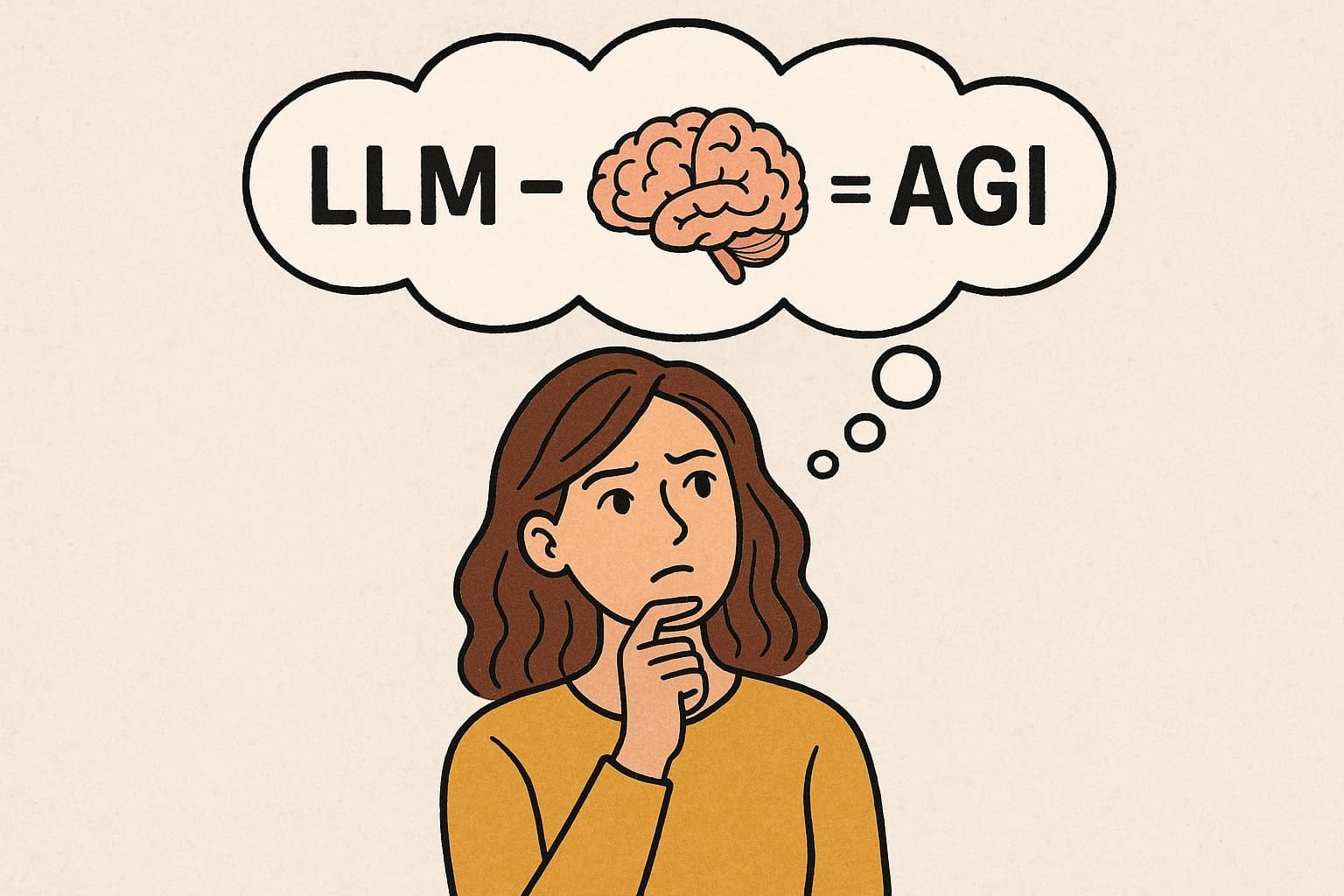
Leaders in the field of artificial intelligence (AI) are promising us a revolution. Meta’s Mark Zuckerberg says that the development of superintelligence is within reach and will bring new things that we cannot imagine today. Dario Amodei of Anthropic claims that powerful AI could arrive as early as 2026 and will be smarter than Nobel Prize winners in many fields. He even talks about doubling the human lifespan or escaping death itself. Sam Altman of OpenAI is convinced that we know how to create artificial general intelligence (AGI) and that superintelligent AI will soon accelerate scientific discoveries far beyond what we can achieve on our own.
These promises sound amazing, but should we believe them? If we look at the science of human intelligence and at what these companies have created so far, the answer is probably no.
What Are Large Language Models?
All these systems—such as ChatGPT from OpenAI, Claude from Anthropic, Gemini from Google, or whatever Meta currently offers—share a common foundation. They are primarily large language models (LLMs). They work by collecting vast amounts of language data, often from the internet. They look for relationships between words—more precisely, between subwords called tokens. Then, based on an input prompt, they predict what output should follow.
Although there is much talk about the complexity of generative AI, at their core these are really just language models. They collect data, identify patterns, and generate text that appears natural.
The Problem with Intelligence According to Neuroscience
This is where the key problem arises. According to current neuroscience, human thought is largely independent of language. We have no reason to believe that more sophisticated language modeling will create intelligence that matches or surpasses our own.
Human thought does not operate solely on the basis of words and sentences. We can plan, make decisions, or solve problems even without language. AI systems based on language data lack this foundation. Instead of genuine understanding, they merely imitate patterns they have found in the data.
The Threat of an AI Bubble
The entire AI boom rests on the assumption that better language models equal better intelligence. But if neuroscience is right, this approach is a dead end. Companies such as OpenAI, Anthropic, and Meta are investing billions in systems that are essentially just advanced text predictors.
Nevertheless, leaders such as Sam Altman talk about AGI that could accelerate scientific innovation. Dario Amodei promises longer lifespans. Mark Zuckerberg envisions new discoveries. These visions sound appealing, but they ignore the fundamental difference between language and genuine thought.
Potential Future Impacts
If AI developers focus solely on language, they may create systems that appear intelligent but in reality merely repeat learned patterns. Neuroscience suggests that genuine intelligence requires more than just words—it requires the ability to think beyond linguistic structures.
This perspective, presented by Benjamin Riley in an article from November 25, warns against inflated expectations. AI can be useful, but it is not the path to superintelligence that many believe it to be.


