

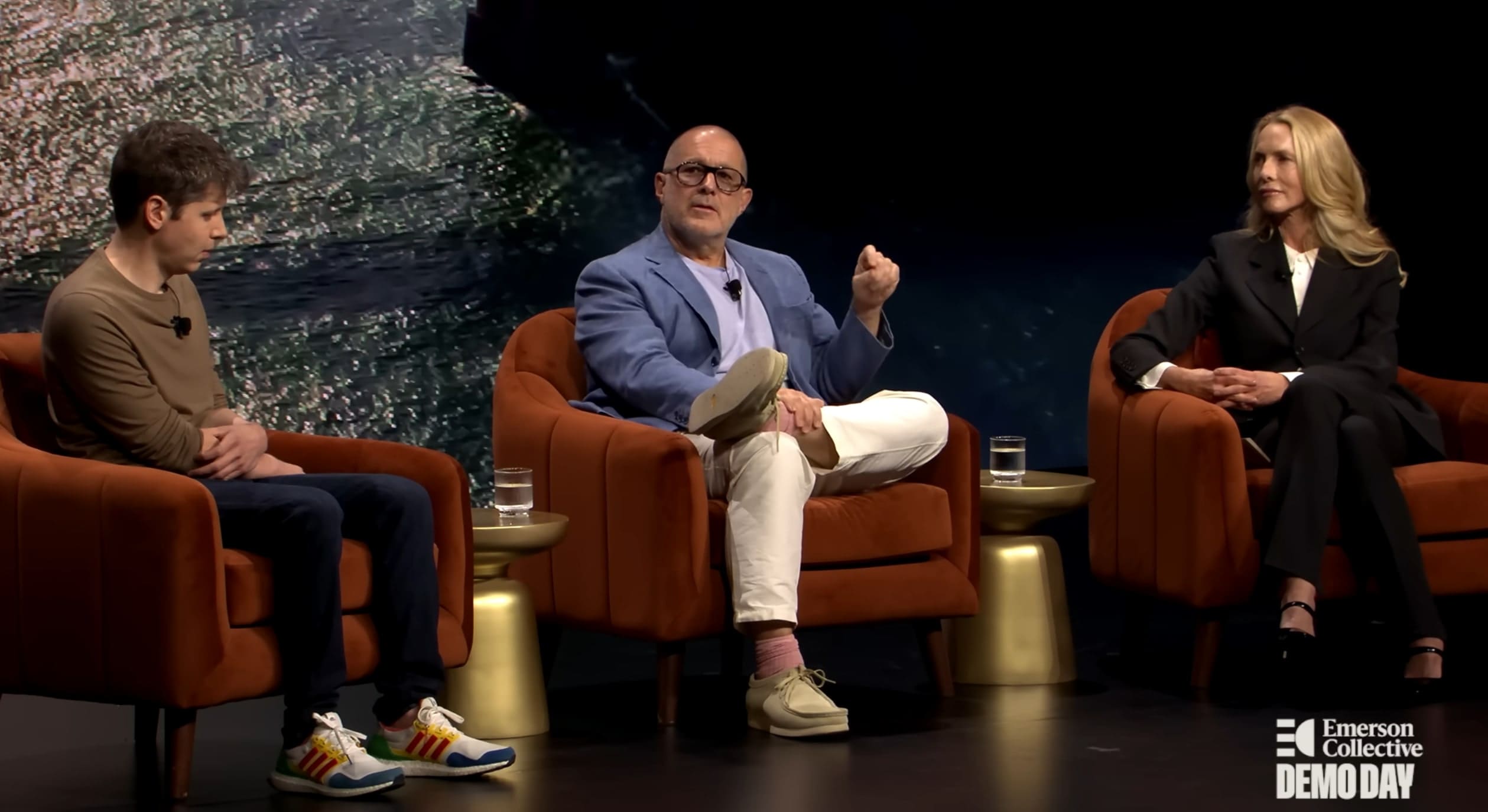
Sam Altman, CEO of OpenAI, announced that his company has finally completed the first prototypes of its hardware device. He spoke about it in an interview conducted by Laurene Powell Jobs, wife of the late Apple co-founder Steve Jobs and founder of Emerson Collective. Altman said: "We finally have the first prototypes." He added that he was amazed by how incredible the work is and how exciting the entire project is. The interview took place at Emerson Collective's 2025 Demo Day.
In May, OpenAI acquired Jony Ive's startup, called io, for $6.4 billion, equivalent to approximately 150 billion Czech crowns. Ive, a former Apple designer, took charge of the project's design. Since then, OpenAI and io have been relatively quiet about exactly what they are developing. Ive has now said that he expects the device to be unveiled within two years or sooner. He noted that developing new hardware is often unpredictable, especially at large companies, where people do not like uncertainty.
Altman declined to reveal specific details about what OpenAI is building, but explained that they want to create a calmer atmosphere than smartphones provide. He compared phones to walking through Times Square, where everything distracts you and competes for your attention. Instead, the new device should feel like sitting in a beautiful cabin by a mountain lake, where everything is calm and peaceful. He said that the smart AI device will be able to do things for users over long periods, filter out unnecessary information, and understand when something is important enough to notify them about. In addition, it should know everything you have ever thought, read, or said.
Ive emphasized the simplicity and playfulness of the design. He said that he loves solutions that appear almost naively simple but are intelligent and sophisticated. He wants people to want to touch the device, not feel intimidated by it, and use it almost without thinking, like an ordinary tool. Altman described the design as simple, beautiful, and playful. He mentioned an earlier prototype that excited them, but said that only the current one is so appealing that you would want to take a bite out of it.
What we know about the device and its development
According to available information, the device has no screen and is roughly the size of a smartphone. It is designed to filter out digital noise rather than amplify it and should create a calmer experience. Ive and Altman speak of ambient intelligence, in which the device understands context and displays information only at the right moment, remaining unobtrusive otherwise. The expected user reaction should be: "That's it? It's that simple."
OpenAI's hardware plans are being watched by rivals such as Amazon, Google, and Meta, which have already released AI-focused devices, such as smart glasses or speakers. However, none of them has dramatically changed the market so far. Startups are experimenting with new formats, such as pendants or AI with a personality. A successful product from OpenAI, which has the most widely used chatbot, ChatGPT, could break this stalemate and even threaten Apple. Apple has yet to release any specific AI-focused design and announced in March that it was postponing Siri improvements until 2026.
Last week, OpenAI signed an agreement with Foxconn, which manufactures consumer electronics, including products for Apple. However, this agreement focuses on building AI infrastructure in the US, not on manufacturing the device. Ive and Altman agree that the development process is full of uncertainty, but they are excited about the progress.
Additional sources: theverge.com


