

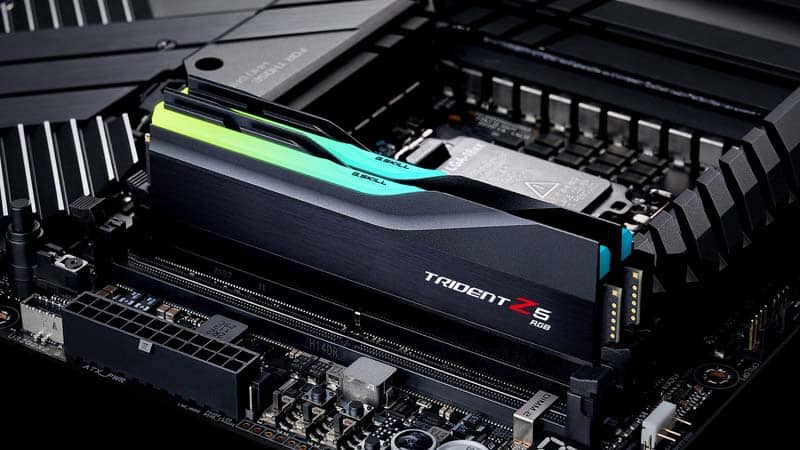
Imagine going to a store to buy computer memory and, instead of a fixed price, the salesperson tells you: "Check the market; this is how much it costs today." That is exactly what is now happening in some stores in the US. For example, at Central Computers in the San Francisco Bay Area, a sign in the display case explains that prices fluctuate daily due to limited supply and high demand. Salespeople there cannot list fixed prices because they change like those of fresh seafood. The same applies to Micro Center, where customers see a sign saying: "Due to market volatility, please ask a salesperson for the price."
Customer Steve Lin noticed this change at Central Computers and shared it online. Similarly, Redditor CassTexas captured the situation at Micro Center, where the sign appeared on November 23. RAM prices have gone crazy so quickly that it is affecting the entire computer market.
Sharp rise in prices
Just three months ago, you could buy 32 GB of DDR5 memory for approximately CZK 2,713 (USD 130). Now the same kit from Corsair costs around CZK 9,180 (USD 440). That is more than triple! Another version of the same kit jumped from CZK 2,190 (USD 105) to CZK 8,348 (USD 400). Some 32 GB kits cost around CZK 4,799 (USD 230), but if you want 64 GB of DDR5, be prepared to pay CZK 14,600 (USD 700), CZK 16,696 (USD 800), or even CZK 18,792 (USD 900).
This increase is not limited to a single manufacturer. Since October, prices have doubled for many models. This shortage does not only affect gaming computers—gaming consoles, smartphones, and other devices also need memory. For example, Xiaomi warns that phone prices will rise in 2026 due to the memory shortage, while Samsung is facing pressure regarding memory for its products.
Prices are also high in the Czech Republic
In the Czech Republic, RAM prices are rising dramatically despite the strong Czech koruna against the dollar, which has so far softened the impact of global price increases. For example, a typical Kingston FURY Beast DDR4 32 GB kit (2x 16 GB) with a frequency of 3200 MHz and CL16 cost around CZK 1,600 at the beginning of the year, while it now sells for around CZK 3,200—twice as much. The increase is even more pronounced for higher capacities: the Kingston FURY 64 GB KIT DDR4 3200 MHz CL16 (2x 32 GB) jumped from CZK 3,000 to CZK 6,300. DDR5 modules have not been spared either—the Kingston FURY 32 GB KIT DDR5 6000 MT/s CL36 (2x 16 GB) rose from CZK 2,800 to almost CZK 4,000, while the 64 GB version (2x 32 GB) increased from CZK 5,500 to nearly CZK 7,000.
Prices are expected to increase by at least 20% in Q4 2025, and the situation could be even worse next year as inventories dwindle and orders are halted. Prices were at their lowest in mid-2025; now is the time to buy if you do not want to pay even more.
Why are prices rising so much?
The industry claims that high demand for artificial intelligence (AI), which has significant memory requirements, is behind the increase. Tim Sweeney, head of Epic Games, said that factories are shifting DRAM production to meet the needs of data centers, which pay higher prices than consumer electronics manufacturers. According to him, it could take years for the situation to stabilize, and high-performance gaming will suffer as a result.
But not everyone believes this. In an article on XDA Developers, the author asks whether the industry's explanations are merely excuses. DRAM prices are rising, but skeptics suggest that manufacturers may be artificially restricting supply to maintain their profits. For example, Nvidia and AMD plan to raise graphics card prices by 10% because every card requires a large amount of VRAM (video memory). Digital Foundry advises buying cards with 10 GB of VRAM or more now, while they are still available at their original prices.
This shortage is also affecting new products. Valve cannot promise a fixed price for its Steam Machine due to memory prices. Leaker Moore’s Law Is Dead claims that Microsoft may raise Xbox prices, while Sony has several months' worth of PS5 inventory.
For an ordinary person who wants to build a computer or upgrade a phone, this means higher expenses. Graphics card prices had been falling until recently, but now there is a risk that they will rise again due to expensive memory. If you are planning a purchase, keep an eye on the market—prices change daily. In the US, stores such as Central Computers and Micro Center are dealing with this by using market prices, which resembles an auction. This trend could also reach us if the situation does not improve.
Additional sources: theverge.com


