It was another Howard Peak story that fit perfectly into the frontier image Fort Worth had created for itself—and so no one questioned it. Moreover, by the time Peak began telling it, none of his contemporaries were still alive to expose his lie.
Howard Peak was the son of Dr. Carroll M. Peak, the town’s first physician. Howard claimed that he was the first (white) boy born in Fort Worth—on June 14, 1856, to be precise. This claim was somehow “verified” in 1899 by a vote of the members of the Old Settlers’ Association at their regular meeting. In his later reminiscences, Peak embellished the story a little further, declaring that he was the only boy born at the military post—except that no post existed at the time of his birth, because the army had abandoned Fort Worth in 1853. After studying at the United States Naval Academy and the University of Kentucky, Peak became a traveling salesman who sold hardware to merchants throughout West Texas. In those days, traveling salesmen rode in horse-drawn wagons along marked trails and dirt roads from settlement to settlement. He eventually retired and became a respected authority on Fort Worth history. This role made him a regular lecturer on the city’s early history at schools and an honored guest at many public events. It also earned him a regular column in the Fort Worth Star-Telegram during the 1920s. In 1929, he published A Ranger of Commerce, or 52 Years on the Road, in which he collected and expanded upon many of his stories. One of them was “The Fight with the Comanches in 1850”—one of his favorites.
In the book, Peak revealed the source of this story for the first time—an important fact, since he obviously could not have witnessed the events himself. He stated that the story came from his “father’s old notes,” his father having died in 1885. According to this account, the Comanches posed a threat to Fort Worth from their “stronghold” in the Palo Pinto County area. Chief Jim Ned, the tribe’s alleged leader, was determined to “raze Fort Worth to the ground” and prepared his warriors with a traditional war dance. He divided them into two groups of approximately one hundred men each, who were to approach Fort Worth from two different directions and meet several miles from the post.
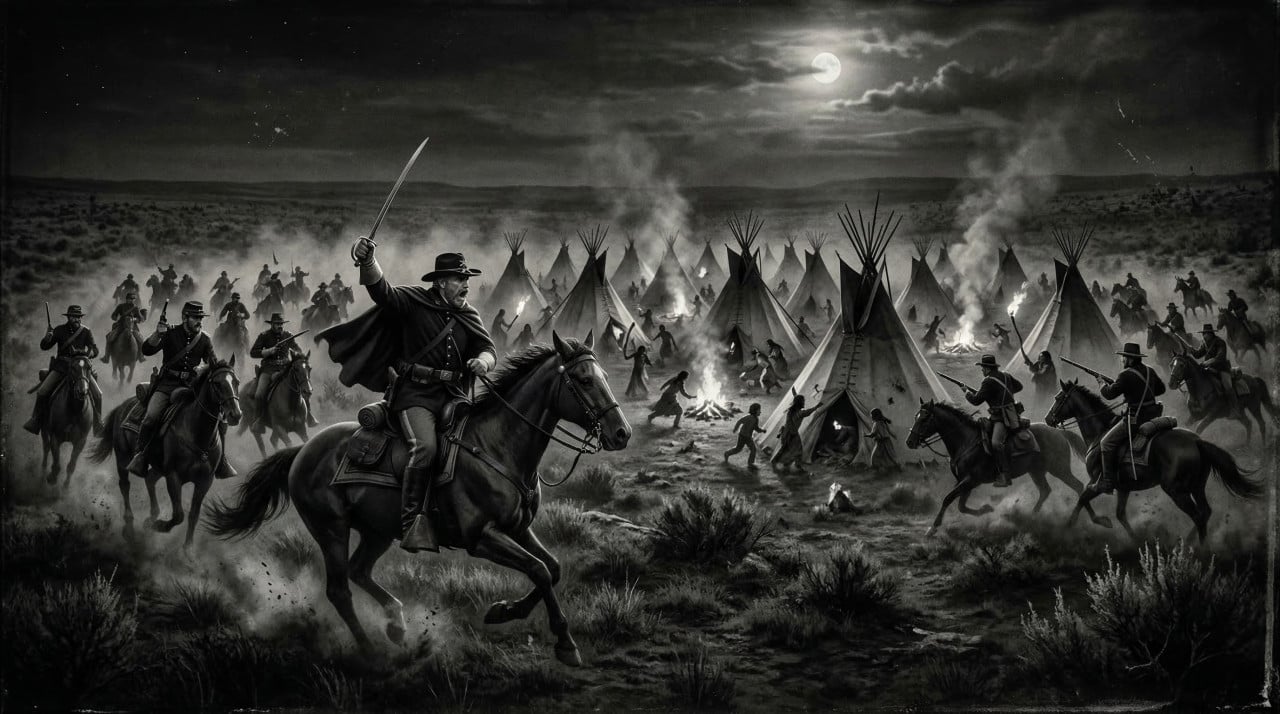
When the two groups met at the agreed location, they were spotted by a fur trapper named Cockerell, who immediately headed for Fort Worth to warn the garrison. Within an hour, all forty men of the garrison were ready to march. In addition to the mounted dragoons, the detachment also included “ambulances and supply wagons.” They reached the Indian encampment late at night and quietly surrounded it. Major Arnold divided the soldiers into three groups under his own command, Captain Robert Maclay, and Lieutenant Washington Street, which were to attack the camp from three sides. At the agreed signal, the dragoons charged and wreaked havoc on the sleeping Comanches—killing thirty-seven and seriously wounding another fifteen. On Arnold’s orders, the wounded Indians were “finished off,” because this was “necessary under the circumstances.” Not a single soldier suffered so much as a scratch.
The soldiers then set out to find the second group of Indians under Chief Feathertail, which had not yet joined Jim Ned. Scouts tracked it down and discovered that Jim Ned had joined it and that the entire group was retreating back into the “Palo Pinto Mountains.” By forced march, they reached the Comanche war village, but stopped before attacking to rest and regroup. Arnold convened a council of war with his officers and ordered an attack on foot at dawn. At the appointed hour the next morning, they advanced through a ravine toward the village, where the enemy ambushed them. Only their “repeating carbines” saved them. The fighting lasted several hours. According to Howard Peak, “the deafening roar of firearms, the groans of the wounded, and the wailing of women and children were terrible.” When Chief Feathertail was struck down, his warriors retreated, and Chief Jim Ned was forced to do the same. Major Arnold ordered his men to advance and “destroy the wavering enemy”—the Indians fled “into the mountains.” It was over.
After the battle, Arnold counted the casualties and prepared to return to Fort Worth. Five dragoons had been killed and another fifteen wounded. He also counted forty-five dead Indians. “Surgeons Halliday and Standifer” treated the wounded and loaded them into the “ambulances.” The dead were buried “where they fell.”
But the story did not end there. According to Peak, Chief Jim Ned was determined to take revenge and launched another attack on Fort Worth “about six months later.” Under cover of night, he approached from the southwest and halted on a hillside. Major Arnold, however, was not caught by surprise. Warned by scouts of the approaching war party, he aimed his six-pounder howitzer and fired directly into the middle of the enemy formation. The explosion scattered them in all directions. Arnold ordered a pursuit in which several of the attackers were killed and the rest were driven back to their territory. “They never again ventured upon such bold hostilities.” Chief Jim Ned eventually surrendered, accepted amnesty, and lived in peace until his death several years later.
That is the story of the only clash the Fort Worth garrison allegedly had with hostile Native Americans during its four-year existence (1849–1853). Reviewer Mary Daggett Lake called it one of Howard Peak’s many “thrilling stories.” It is undoubtedly thrilling—but it contains so many historical inconsistencies that one hardly knows where to begin.
One might begin with the fact that another respected source on early Fort Worth history, Abe Harris, told B. B. Paddock: “The Indians never attacked Fort Worth.” And Peak’s own father, Dr. Carroll M. Peak, told a completely different story at the laying of the courthouse cornerstone in 1877. According to him, word once reached Lancaster (sixteen miles south of Dallas) that Fort Worth was “under siege” by Indians and that “the situation was critical.” A sixty-man detachment immediately set out to help—only to be greeted upon arrival by a surprised Major Arnold, who informed them that everything was fine.
The details of the story themselves are also problematic. To begin with, “fur trapping” on the North Texas plains would have been modest at best, given the local fauna. Fur trappers stayed in the mountains, not on the plains. Then there is the fact that Jim Ned was not a Comanche – he was not even fully Native American. He was of mixed ancestry, half Delaware Indian and half Black. There is no record of him ever riding with the Comanches, much less serving as a war chief. When he was not stealing horses, he worked for white settlers as an interpreter and scout. In 1853, Major Hamilton Merrill, Ripley Arnold’s successor at Fort Worth, asked his superiors for permission to pay Jim Ned for his services as a “guide, etc.” It is difficult to imagine Merrill hiring as a scout the same Indian who had supposedly attempted to annihilate his garrison just three years earlier. The real Jim Ned entered Texas history as one of the “good Indians”—Taylor County even honored him by naming its school district after him. It seems likely that Jim Ned was the only “chief” whose name Howard Peak or his father knew, and so he became the leader of the Comanche war party.
Nor do the officers’ names given by Peak correspond to the time or place. Captain Robert Maclay was an officer in the 8th Infantry Regiment, not the 2nd Dragoons. It was Maclay who brought infantry reinforcements to Fort Worth in October 1849. Neither he nor his men could have participated in Arnold’s expedition against the Indians because they were not mounted troops. Lieutenant Washington Street was likewise a member of the 8th Infantry Regiment and did not serve at Fort Worth at the same time as Arnold. During Arnold’s command, he had only one lieutenant at his disposal—Jonas P. Holliday, who was on sick leave for most of that time. Peak mentions two garrison surgeons, which in itself is further proof that he did not know what he was talking about. No frontier post ever had more than one assigned military physician. In Fort Worth’s case, Dr. Jesse M. Standifer was a civilian contract physician who served at the post only from June to October 1849. As for “Halliday,” Peak may have confused him with Lieutenant Jonas Holliday, who was never a doctor—or he may simply have invented the name. Either way, the names of the principal figures in Peak’s story do not correspond to the post’s actual personnel.
The weapons Peak describes either were not part of Fort Worth’s armament at all or had not yet been invented in 1850. Peak identifies the artillery piece with which Arnold allegedly dispersed the Indian attack as a six-pounder (meaning it fired a six-pound projectile). The garrison did have a cannon, but it was a twelve-pounder, not a six-pounder—and there is no record that it was ever used in combat. As for Peak’s “repeating carbines,” which saved the day during the Indian ambush—no such weapon existed in 1850. The first repeating rifle used by the U.S. Army was the seven-shot Spencer carbine, developed between 1854 and 1860 and adopted in 1863. In 1850, the dragoons would have been as surprised by the presence of a repeating carbine as the Indians were.
The decisive evidence is the complete absence of any mention of a clash with the Comanches in the official records. During his official inspection of Fort Worth in September 1853, Major William G. Freeman stated: “No Indians have visited the post... except a small party of Caddos and Ionis,” both of which were peaceful tribes. The same report contains a letter from Major H. W. Merrill, Fort Worth’s last commander, listing all the Indian tribes in the state, including “500 to 600 Comanches” in far West Texas, and stating that only about 250 of them were “capable of bearing arms.” This was only two or three years after Peak’s fictional attack, so it is unlikely that the situation had changed significantly. Moreover, the post’s monthly reports make no mention anywhere of five soldiers killed in action. Such a report would have been absolutely mandatory for any military post commander. Fort Worth’s records from 1849–1853 mention no hostile action whatsoever, much less combat casualties. And those same reports also do not indicate that Fort Worth ever possessed an ambulance. That was a luxury no frontier post could afford. The nearest army ambulance would have been in San Antonio.
Peak’s story bears a striking resemblance to an account by Abe Harris, another popular teller of frontier tales. His credibility rested on the fact that he was not merely an old settler, but an original member of the Fort Worth garrison. In Harris’s version, it was a war party of 300 Comanches and Caddos led by Chief Towash that threatened the post in 1850. They were pursuing a group of Tonkawas who sought the garrison’s protection. When Towash sent a messenger demanding that the garrison hand over the Tonkawas, Major Arnold replied that “he was not in the habit of serving his guests for breakfast”—a response every bit as magnificent as Xerxes’ answer to the Persians at Thermopylae or Travis’s answer to the Mexicans at the Alamo. Arnold reinforced his reply by ordering the howitzer fired “just over the heads” of the war party, “without hitting anyone,” and the well-aimed shot sent them fleeing. According to Harris, this was the only occasion on which the garrison faced a serious Indian threat. Like Peak’s story, this one also has a number of historical problems—but what matters is that both old settlers told similar stories unsupported by the historical record, even though the army kept fairly detailed records at the time, including for frontier posts.
Finally, there is a remark by B. B. Paddock, himself a skilled storyteller, about the credibility of traveling salesmen. Over the years, he interviewed many eyewitnesses for his own writings. He may have had Howard Peak specifically in mind when he wrote in his final work (1922) that practical jokes and tall tales were a way of life in Texas, especially among “traveling salesmen.” He goes on to tell the story of a group of such men who greatly amused themselves by telling a group of “greenhorns” about wild Indians roaming West Texas. Paddock enjoyed Texas tall tales as much as anyone.
A popular legend is hard to kill. It acquires new embellishments and changes in its details, but it lives on—told again and again. Various versions of the fictional Comanche attack were recounted by other old-timers six decades later. In 1913, E. B. “Bud” Daggett, a descendant of another prominent family, gave an interview in which he “vividly described the Indian massacre, the last in Fort Worth.” He told a Fort Worth Record reporter that it had taken place just west of the northern stockyards sometime “in the fifties.” Mrs. Margaret Ann Holloway, who had lived there since 1849, told a similar story to the same newspaper, also around 1913. According to her, the Comanches pursued a group of Tonkawas all the way to the fort, where they sought the garrison’s protection. When Ripley Arnold organized a peace conference, the Comanches attacked the peaceful Tonkawas with knives. They were driven off only after Arnold fired the fort’s cannon in their direction. The common elements of Holloway’s and Peak’s stories are the hostile Comanches and the cannon shot. Peak’s story loses credibility compared with both Daggett’s and Holloway’s versions precisely because of its abundance of unsupported details. The lesson is this: if you want to retain credibility, it pays to keep the details modest. And so the Comanche attack, in one form or another, passed from generation to generation. No one could challenge the old settlers’ memories because there were no archival records or visual evidence to refute them—and who would want to call a beloved elderly citizen a liar?
The most frequently repeated versions of the story remain those of Abe Harris and Howard Peak. Harris’s version never received the same attention as Peak’s because Harris never published it in book form and died before Peak. Peak’s longevity—he lived until 1939—and the publication of A Ranger of Commerce cemented his place in Fort Worth history as a first-rate primary source. Two generations of Fort Worth schoolchildren grew up with his stories, which he personally recounted to them in their classrooms, and their parents read his book. That was enough for a monument to be erected to the Comanche raid that never happened: a small concrete obelisk raised in 1923 by the Diamond Jubilee Committee on a shaded lawn on Summit Avenue, just west of downtown. The monument stood there until recently, when it was removed to make way for new development. It was saved from ending up in a landfill by an alert local historian and is currently awaiting a new location in his garage. It deserves to be preserved—not so much for the history it seeks to commemorate, but rather for what it reveals about the fickleness of collective memory.