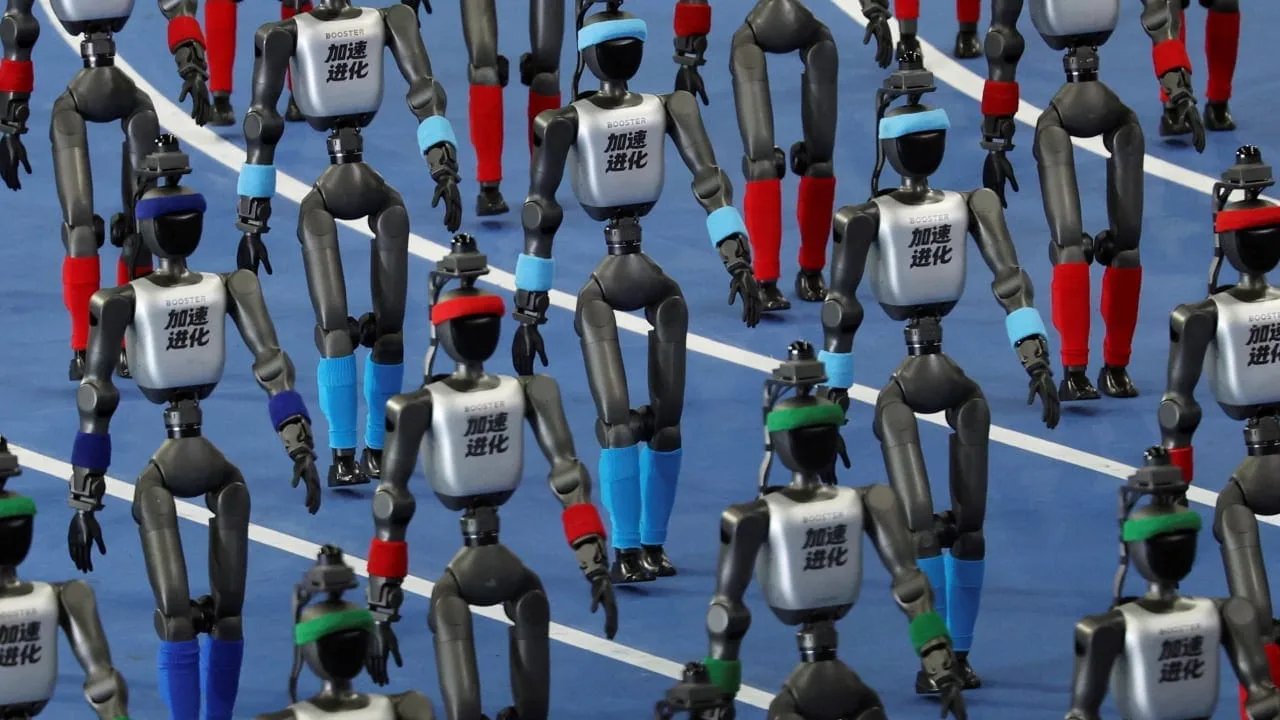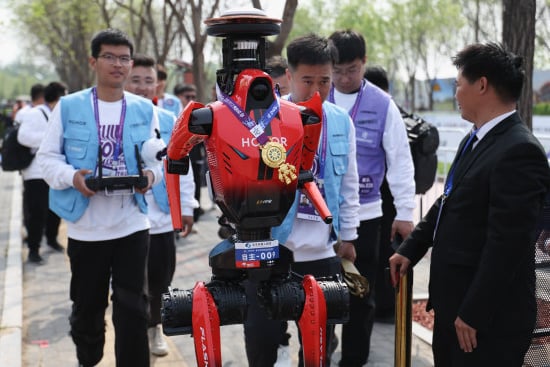
A bright red humanoid named Lightning raced through the streets of Beijing and literally flew across the finish line. Not only did it beat all its human rivals, but it also broke the world record. The second annual humanoid robot half marathon was held in the Beijing E-Town industrial park. More than a hundred machines lined up at the start. Alongside them, more than 12,000 human runners competed in an adjacent lane to prevent collisions. The result was that the machines stole the entire show.
50 minutes and 26 seconds
Lightning, developed by the Chinese company Honor, originally known for making smartphones, completed 21 kilometers in 50 minutes and 26 seconds. Ugandan long-distance runner Jacob Kiplimo holds the human world record for the same distance: 57 minutes, set this March in Lisbon. Lightning beat him by almost seven minutes.
The details made the result even more remarkable. State media outlet Global Times reported that another Honor robot, operated by remote control, was the first to cross the finish line in 48 minutes and 19 seconds. Lightning, however, navigated autonomously during the race, which is why it was declared the winner under the competition rules. The second and third robots from the Honor team finished in approximately 51 and 53 minutes.
Du Xiaodi, a testing and development engineer at Honor, explained the machine’s secret. The robot was designed after elite human athletes. Its legs are approximately 95 centimeters long, and it is equipped with a powerful liquid-cooling system developed largely in-house. “Looking ahead, some of these technologies could find applications elsewhere,” Du said. “The reliability of the design and liquid cooling could be used in industrial facilities.”
A moment of fear, but triumph in the end
The race was not without a fall: shortly before the finish, Lightning crashed into a railing. Technicians quickly got it back on its feet, and the machine completed the race. Fans could hardly have wished for a more dramatic ending.
The fastest human competitor, 29-year-old Zhao Haijie, completed the course in 1 hour, 7 minutes and 47 seconds. He also had something to say about the robots. “I felt it was running pretty fast,” he told NBC News after the race. “Whoosh, and it was gone.”
Anyone who watched the inaugural race in 2025 will remember the chaos. Of the 21 robots that started, only six crossed the finish line. The winner completed the half marathon in 2 hours, 40 minutes and 42 seconds. Other robots fell, veered off course, or simply remained lying at the starting line. This year, everything was different. At least four robots completed the course in under an hour. There were significantly fewer malfunctions. And yet... not everything went smoothly.
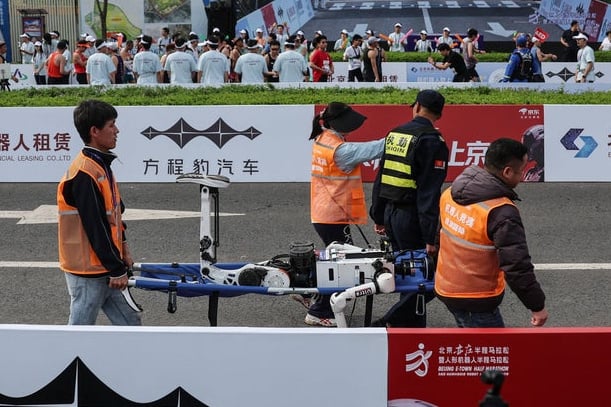
One robot fell face-first approximately 60 meters from the start and continued the race with its upper body held together by packing tape. Another veered off course after crossing the finish line and ended up in a bush. One was so badly damaged that technicians carried it away on a stretcher. And Xiao Pai, an adorable 60-centimeter companion robot, cheerfully bounced along the course with a baby bottle in its hand.
Xue Qingheng, founder of the startup Intercity Technology, whose robot Xiao Cheng successfully completed the race, summed it up this way: “Today’s robots have Mike Tyson’s body, but they still lack Stephen Hawking’s brain.”
Why does China organize robot races?
Speed is not the primary goal. It is about testing in a real-world environment, outside laboratory conditions. Balance, endurance, terrain navigation, and the ability to respond to obstacles. The racecourse tests all of these in a way that no testing facility can replicate.
The British technology research institute Omdia recently ranked three Chinese companies—specifically AGIBOT, Unitree Robotics, and UBTech Robotics—in the top tier of the global market for general-purpose humanoid robots. Each delivered more than 1,000 robots last year, while the first two companies surpassed 5,000 units.
China has more than 150 companies and research laboratories focused on manufacturing humanoid robots. The state provides both subsidies and demand. Beijing’s plan for 2026 to 2030 explicitly names humanoid robots as a national priority, alongside brain chips and quantum computers.
The race winner receives contracts worth more than one million yuan, or approximately 146,500 dollars. And perhaps even more valuable is the attention of hundreds of millions of people who watched the race live on various platforms. Sun Zhigang, a spectator who also attended last year, brought his son this time. “I feel there has been an enormous change since last year,” he said. “For the first time, robots have surpassed humans. I never imagined that.”