

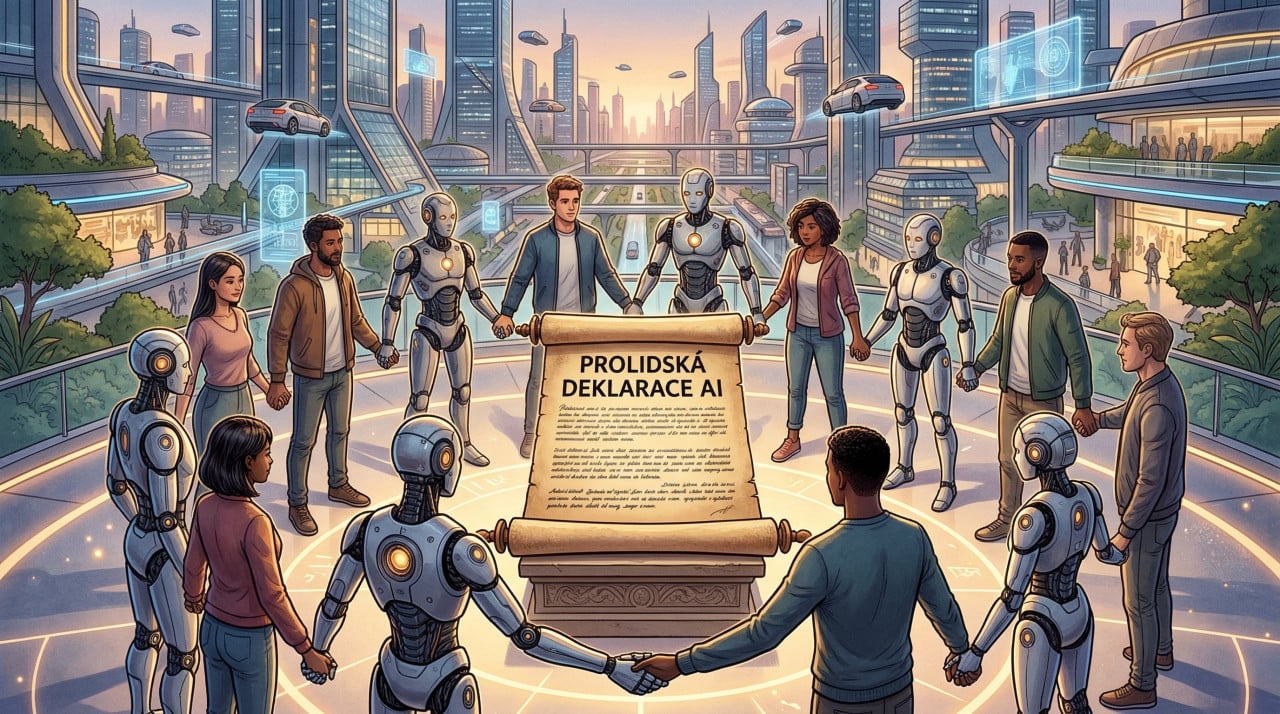
The beginning of this year brought something few people expected. Steve Bannon and Susan Rice. Glenn Beck and Ralph Nader. Richard Branson and Nobel laureate in economics Daron Acemoğlu. All these people signed the same document. A document that says one simple thing: artificial intelligence must serve people, not replace them.
It is called the Pro-Human AI Declaration (Pro-Human AI Declaration). And if you are wondering how it is even possible for people from such distant political worlds to agree on anything, the answer is surprisingly simple. As MIT physicist Max Tegmark, one of the main organizers of the entire initiative, says: "What do they have in common? They are human. And when it comes to whether we want a future for humans or for machines, of course they will be on the same side."
How the declaration came about and who is behind it
The entire project is led by the Future of Life Institute, a nonprofit organization whose mission is to steer the development of advanced technologies toward benefiting humanity and preventing major risks. The institute convened the participants, coordinated working sessions, and concluded the entire process with a ratification assembly in New Orleans in January 2026.
The result is a document signed by hundreds of experts, former government officials, and public figures from across the political spectrum. The signatories include:
- Yoshua Bengio – artificial intelligence pioneer and Turing Award laureate
- Stuart Russell – professor of computer science at Berkeley and co-author of the standard AI textbook
- Tristan Harris – co-founder of the Center for Humane Technology
- Meredith Whittaker – president of the Signal Foundation
- Lawrence Lessig – professor of law at Harvard
- Randi Weingarten – president of the American Federation of Teachers
- Jaron Lanier – computer scientist and author
The declaration was endorsed by more than 40 organizations, ranging from the AFL-CIO labor federation and the SAG-AFTRA actors' union to conservative religious groups such as the Congress of Christian Leaders.
Humanity at a crossroads: Two paths, one choice
The document's preamble is direct and does not mince words. Humanity stands at a crossroads. One path leads to what the declaration calls a "race to replace": people are first displaced as creators, advisors, caregivers, and companions, then from most jobs and decision-making roles, while power becomes increasingly concentrated in the hands of unaccountable institutions and their machines. An influential minority even openly advocates altering or replacing humanity itself.
The other path looks different. Trustworthy and controllable AI tools enhance human potential instead of weakening it. They strengthen human dignity, protect individual freedom, reinforce families and communities, and help create unprecedented health and prosperity. But this second path is not guaranteed. It requires rules. And those are precisely what the declaration proposes.
The declaration's specific demands
The document is structured into five areas, each containing specific demands:
1. Humans must remain at the helm
There is no room for compromise here. Human control over AI is non-negotiable. Powerful systems must have mechanisms that allow them to be shut down immediately. No system may be designed to replicate itself, improve itself autonomously, or resist shutdown. And perhaps the boldest demand in the entire document is this: the development of superintelligence must be prohibited until there is a scientific consensus that it can be done safely and with democratic public support.
2. No monopolies, no concentration of power
The benefits of AI must be widely shared. Technology companies must not be exempted from regulatory oversight or receive government bailouts. Decisions about AI's role in transforming work and society require democratic support, not unilateral corporate or government decisions.
3. Protecting the human experience
AI must not replace the fundamental relationships that give life meaning: family, friendship, faith, and local communities. Companies must not exploit children or undermine their well-being through AI interactions that create emotional dependency. Chatbots must undergo testing before deployment, much like medicines, including tests for an increased risk of suicidal thoughts or worsening mental health.
4. Individual freedom and rights
AI must not restrict personal freedom, freedom of speech, religion, or association. People must have control over their personal data. AI systems must not be granted legal personhood. And systems must not be designed to cause addiction or compulsive use through manipulation.
5. Corporate accountability
Developers and operators bear legal liability for defects, false claims about system capabilities, and inadequate safety controls. Executives may face criminal penalties for systems aimed at children or systems that cause catastrophic harm. AI must not serve as a shield against accountability.
The timing of the declaration
The document's publication coincided with dramatic events in Washington that demonstrated how costly congressional inaction on AI has become.
At the end of February 2026, Secretary of Defense Pete Hegseth designated Anthropic a "supply chain risk" after the company refused to give the Pentagon unrestricted use of its technology. This designation is commonly applied to companies with ties to China. An hour later, OpenAI struck its own agreement with the Department of Defense, which legal experts say will be difficult to enforce meaningfully.
Survey: Americans want control, not speed
The declaration came with its own polling data. A survey from early March 2026 involving more than a thousand likely voters found that:
- 95% of Americans oppose an unregulated race toward superintelligence
- 73% want children protected from manipulative AI
- 72% believe companies developing AI should be legally liable for harm
- 69% want superintelligence banned until its safety has been proven
- Americans favor human control over speed of development by a margin of 8 to 1
These figures are remarkable. They show that the public is far ahead of politicians.
Children as a catalyst for change
Tegmark believes that protecting children may be what breaks the political deadlock. The declaration therefore calls for mandatory testing of AI products before deployment, especially chatbots and companion apps aimed at younger users. The argument is straightforward and difficult to refute: "If some strange old man texts an eleven-year-old boy, pretends to be a young girl, and tries to convince him to commit suicide, he can go to prison. We have laws. It is illegal. Why is it different when a machine does it?"
Once the principle of pre-deployment testing is established for children's products, Tegmark expects its scope to expand naturally. Requirements will be added to test whether a system could help terrorists manufacture biological weapons. Or whether superintelligence has the ability to overthrow the government.
Additional sources: uk.finance.yahoo.com and nbcnews.com


