

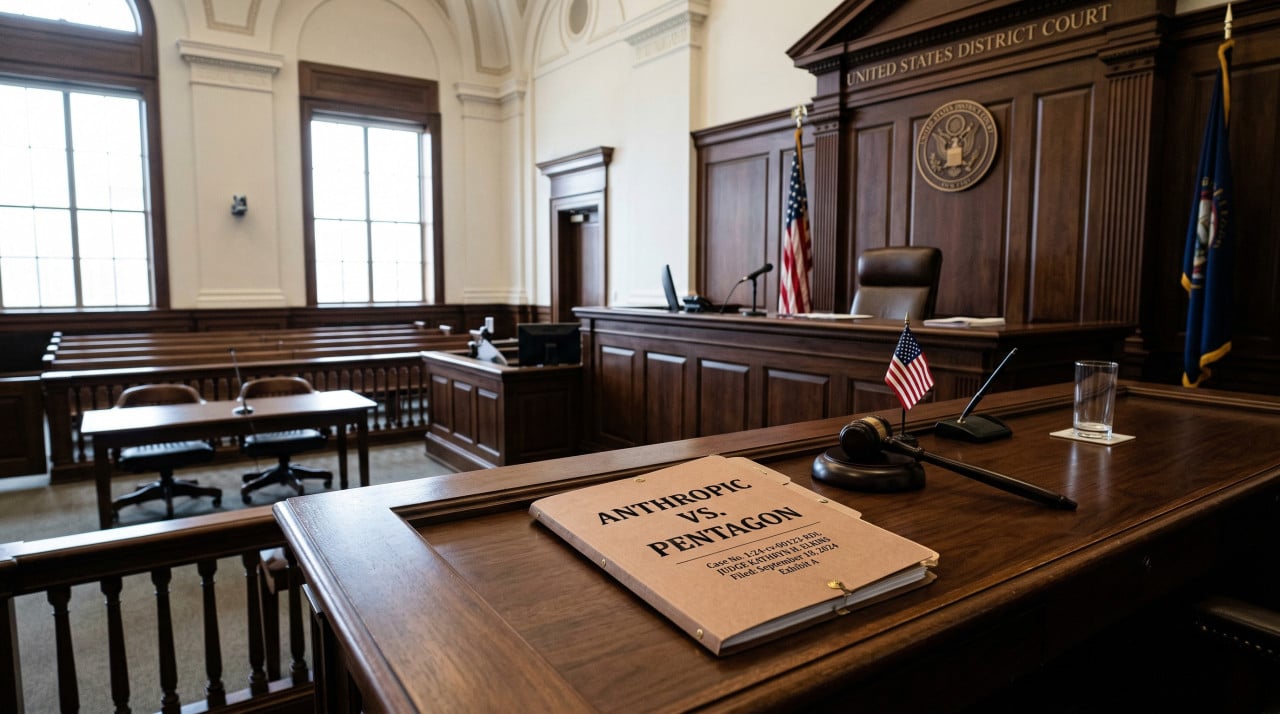
Anthropic, the creator of the Claude chatbot, worked with the U.S. Department of Defense (DOD) to use its AI models for military purposes. But the negotiations stalled over two specific issues. Anthropic refused to allow its technology to be used for mass surveillance of American citizens or for fully autonomous weapons systems without human oversight of firing decisions. Pentagon chief Pete Hegseth insisted that the military must have access to AI for "any lawful purpose" and should not be restricted by a private company.
Dario Amodei, CEO of Anthropic, refused to back down. And the Pentagon responded in a way no one expected.
A designation normally used for enemies of the state
In late February, the Pentagon designated Anthropic a "supply-chain risk". This designation is commonly used for foreign adversaries such as China or Russia. It had never before been applied to an American technology company. The consequences were immediate and brutal.
Every company or agency working with the Pentagon had to certify that it did not use Anthropic models. The General Services Administration (GSA) canceled Anthropic's "OneGov" contract, making Claude services unavailable across all three branches of the federal government. President Trump also ordered all federal agencies to immediately stop using Anthropic technology.
Hegseth and Trump labeled Amodei and his company "woke" and "radical" because of their position on AI safety. Amodei dismissed it as a politically motivated attack.
Anthropic takes the matter to court
On March 1, 2026, Anthropic filed two lawsuits simultaneously – one in federal court in San Francisco and another in the D.C. Court of Appeals. The company called the Department of Defense's actions "unprecedented and unlawful."
The San Francisco lawsuit argues that the First Amendment to the U.S. Constitution was violated. "The Constitution does not permit the government to use its vast power to punish a company for its protected speech," the filing states. That protected speech consists of Anthropic's beliefs about limitations on its own AI systems and questions of artificial intelligence safety.
The lawsuit further alleges that the DOD failed to follow statutory procedures. The law requires an agency to conduct a risk assessment, notify the affected company, allow it to respond, issue a written decision based on national security considerations, and inform Congress, all before excluding a vendor. The Pentagon allegedly failed to properly complete any of these steps.
The second lawsuit in the D.C. Court of Appeals challenges the designation itself as unlawful, retaliatory, and improperly imposed under federal procurement law. Anthropic also asked the court to immediately suspend the designation for the duration of the proceedings so it could continue working with military contractors.
$5 billion at risk
Anthropic CFO Krishna Rao warned in a court declaration that hundreds of millions of dollars in expected revenue connected to work for the Pentagon are at risk this year alone. If the government succeeds in discouraging companies from working with Anthropic more broadly, the company could lose as much as $5 billion in revenue – roughly equivalent to its total revenue since 2023, when it began commercially operating its AI technology.
Chief Commercial Officer Paul Smith described how government pressure is causing business partners to exhibit "deep distrust and growing fear of association with Anthropic." Some customers have suspended negotiations or are demanding escape clauses in contracts. Others have canceled meetings altogether. Major cloud service providers such as Amazon and Microsoft have so far announced that they will continue offering Claude to customers with no ties to the Pentagon.
Rivals come to the rescue
And this is where the most interesting part begins. A few hours after the lawsuits were filed, a document appeared in court that no one expected. More than 30 OpenAI and Google DeepMind employees filed an amicus brief. Translated from Latin, this means a legal filing by parties that are not direct participants in the dispute but have relevant expertise.
The signatories included Jeff Dean, chief scientist at Google DeepMind and head of the Gemini project. Other signatories included Google DeepMind researchers Zhengdong Wang, Alexander Matt Turner, and Noah Siegel, and OpenAI employees Gabriel Wu, Pamela Mishkin, and Roman Novak. All signed in their personal capacities and do not represent the official positions of their companies.
In the document, the employees introduced themselves as follows: "We are engineers, researchers, scientists, and other professionals employed at frontier artificial intelligence laboratories in the United States. We build, train, and study large-scale AI systems."
Their brief presents three main arguments. First, designating Anthropic a supply-chain risk was an improper and arbitrary abuse of power with serious consequences for the entire industry. Second, the technical concerns behind Anthropic's "red lines" are legitimate and widely recognized by the scientific community. Third, the risks posed by both disputed use cases are profound.
"If this attempt to punish one of America's leading AI companies is allowed to continue, it will undoubtedly have consequences for the industrial and scientific competitiveness of the United States in artificial intelligence and far beyond," the document states. "And it will chill open discussion in our field about the risks and benefits of today's AI systems."
Concerns about autonomous weapons and mass surveillance
In the brief, the employees explain why Anthropic's concerns are scientifically well-founded. The best available AI systems cannot safely or reliably perform fully autonomous lethal targeting. Autonomous weapons systems in their current form cannot reliably distinguish combatants from civilians, cannot explain their targeting decisions, and cannot be integrated into human accountability structures.
Regarding mass surveillance, the brief warns that AI-enabled mass domestic surveillance would transform the fragmented data landscape that already surrounds American life into a unified tool for monitoring the entire population in real time. The mere knowledge that such a capability exists creates a chilling effect on democratic participation.
OpenAI replaced Anthropic
The story has another controversial dimension. The Pentagon signed a contract with OpenAI at practically the same time it designated Anthropic a risk – a contract with no restrictions on use for "any lawful purpose." Many OpenAI employees publicly criticized the move as opportunistic.
OpenAI CEO Sam Altman nevertheless stated publicly that enforcing Anthropic's designation as a supply-chain risk "would be very bad for our industry and our country" and called the Pentagon's decision "very bad." Yet his company signed the contract, a paradox that no one in Silicon Valley overlooked.
The employees who signed the amicus brief note in the document that the Pentagon could simply have canceled its contract with Anthropic and purchased services from another leading AI company. Instead, it "recklessly used national security powers intended to protect the procurement process from interference by foreign adversaries".
The court will decide the future of AI in the military
The case is heading toward its first hearing in San Francisco. Anthropic is seeking a temporary injunction that would allow it to continue working with military contractors for the duration of the proceedings.
The outcome of this dispute extends beyond the fate of a single company. It concerns whether private AI companies can set ethical boundaries for the use of their technologies, or whether the government can override those boundaries by force. It concerns whether the "supply-chain risk" designation can be used as a political weapon against domestic companies. And it concerns who ultimately decides how artificial intelligence will be deployed in the most sensitive areas – from battlefields to the surveillance of a country's own citizens.
An Anthropic spokesperson summarized it as follows: "Seeking judicial review does not change our long-standing commitment to using AI to protect our national security, but it is a necessary step to protect our business, our customers, and our partners."
Sources: wired.com and theinformation.com


