

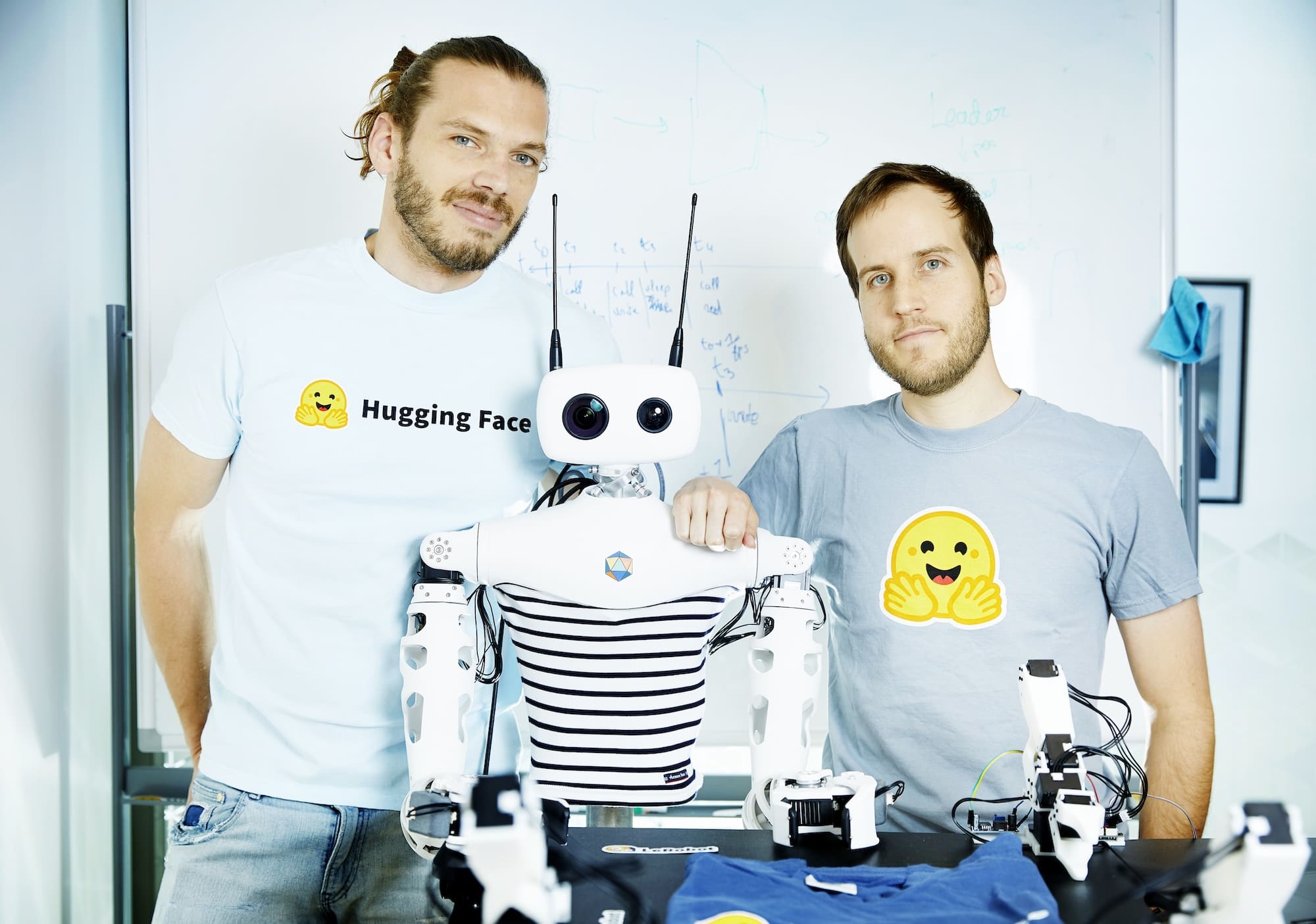
Hugging Face Acquires Robotics Company Pollen Robotics: AI Finally Gets a Body
In today's world full of software innovations, one occasionally has to ask: when will artificial intelligence finally leave the world of servers and start functioning in the real world? For Hugging Face, one of the leaders of the open-source AI revolution, that time has come right now. The company has announced the acquisition of French robotics startup Pollen Robotics, expanding its operations from the purely virtual world into physical reality.
From Code to Body: Open-Source AI Enters the World of Robotics
Hugging Face, a company many developers know thanks to its open platform for sharing AI models, has taken its first major step into the world of hardware. By acquiring Pollen Robotics, creator of the Reachy 2 humanoid, Hugging Face is clearly declaring that the future of artificial intelligence lies in a world where algorithms can interact directly with the physical environment. "We are delighted to announce the acquisition of Pollen Robotics, a pioneering open-source robotics company from France," the Hugging Face team stated in its blog post. "This acquisition will enable us to accelerate our mission of making AI accessible to everyone and expand our activities into robotics."
Who Is Pollen Robotics and What Is Reachy 2?
Pollen Robotics is no newcomer to the world of robotics. Its flagship product, Reachy 2, is a modular humanoid robot designed specifically for research, education, and experiments with embodied AI. It is not just a plastic toy – Reachy 2 offers advanced features including VR teleoperation, stereoscopic vision, spatial audio, and a mobile base with two arms equipped with grippers. Most importantly, however, Reachy 2 is fully open-source. Its entire codebase and datasets are freely available to developers, who can modify them and contribute to them. This open approach perfectly aligns with Hugging Face's philosophy, which is likewise built on open technologies and community collaboration. "Reachy 2 was designed to be as accessible and customizable as possible," explains Matthieu Lapeyre, founder of Pollen Robotics. "We believe that progress in robotics will come from the open sharing of knowledge and technology, not from closed corporate laboratories."
How Will Hugging Face Use the Robotics Technology?
The partnership between Hugging Face and Pollen Robotics has one clear goal: to make robotics the next frontier that AI opens up to everyone – from enthusiasts to large enterprises. Hugging Face plans to integrate its AI tools with Pollen Robotics' advanced hardware platform, creating an ecosystem where developers can easily experiment with embodied AI. This move builds on the success of the LeRobot project, which Hugging Face launched in 2024. LeRobot quickly became the largest open-source robotics library on the Hugging Face Hub, demonstrating that interest in the intersection of AI and robotics is enormous. "Our vision is a world where robots are not just tools for large corporations with proprietary software, but are available to anyone who has an idea and wants to bring it to life," says Rémi Cadène, a former Tesla Optimus engineer who joined the Hugging Face team last year and now leads the company's robotics division.
What Does the $70,000 Price Tag Mean?
Hugging Face has already begun selling Reachy 2 for $70,000 per unit. Although this may sound like a high amount, in the context of advanced robotic platforms it is a competitive price, especially considering the system's open-source nature and the absence of licensing fees. "It's not just hardware," explains Clément Delangue, CEO of Hugging Face. "You are buying a comprehensive development platform with support from a community of developers and access to the most advanced AI models. That is a value closed systems cannot offer."
Among the first adopters of the Reachy 2 robotic platform are prestigious institutions such as Cornell University and Carnegie Mellon University. These research institutions use the system's open nature to experiment with new machine-learning algorithms and robotic applications. "Reachy 2's open approach allows us to innovate in ways that would not be possible with commercial robots," says Dr. Amanda Chen from Carnegie Mellon's robotics laboratory. "Students can modify both the software and hardware according to the needs of their research projects."
Open Access in the Age of Proprietary Solutions
At a time when robotics is becoming the domain of major players such as Boston Dynamics, Tesla, and Figure, the partnership between Hugging Face and Pollen Robotics represents an alternative path. Instead of closed, proprietary systems, it offers an open platform where developers can share their knowledge and build on the work of others. "Most robotic systems today are designed as black boxes," notes Julien Serre, technical director of Pollen Robotics. "Developers do not have access to their inner workings, which limits innovation. We are taking the opposite approach – full transparency and collaboration."
The combination of these two companies signals an important trend: artificial intelligence is moving from a purely virtual environment into the physical world. This trend, often called "embodied AI," has the potential to transform the way we interact with technology. "Robots powered by modern AI systems will be able to understand the world around them and operate meaningfully within it," explains Thomas Wolf, co-founder of Hugging Face. "This paves the way for assistants that can physically help us in everyday life, rather than merely answering questions or generating content."
The Fifth Acquisition, the First in Hardware
For Hugging Face, Pollen Robotics represents the company's fifth acquisition in its history, following the successful purchases of companies such as Gradio and XetHub. However, it is the first acquisition focused on hardware, marking a significant expansion of the company's strategy. "Our previous acquisitions helped us build a complete ecosystem for developing and deploying AI models," says Jeff Boudier, head of Hugging Face's product team. "With Pollen Robotics, we are now expanding this ecosystem into the physical world, which was the logical next step."
Hugging Face's acquisition of Pollen Robotics represents a significant milestone not only for both companies, but for the entire AI and robotics sector. While major players such as OpenAI and Google are investing billions in developing increasingly sophisticated AI models, Hugging Face is betting on combining accessible AI technologies with an open robotics platform. In a world where there is growing discussion about the concentration of power in the hands of a few technology giants, this acquisition represents a refreshing alternative – a future where advanced technologies are not the monopoly of large corporations, but are available to anyone interested in innovating. If the current trend continues, in a few years we may wonder how we could ever have considered AI without a physical body to be complete. And thanks to companies like Hugging Face and Pollen Robotics, access to such technology could be more open than we ever imagined.


