

Apple bets on its ace: AI will improve directly on your device, without compromising privacy
While the tech world is competing in the race for the best AI solutions, Apple is taking a different path. And it is standing by it. The Cupertino giant announced on Monday a revolutionary approach to improving its artificial intelligence—it will analyze user data directly on their iPhones and other devices. In doing so, it aims to catch up with competitors such as OpenAI and Google, without having to compromise its high standards of privacy protection.
How will it work?
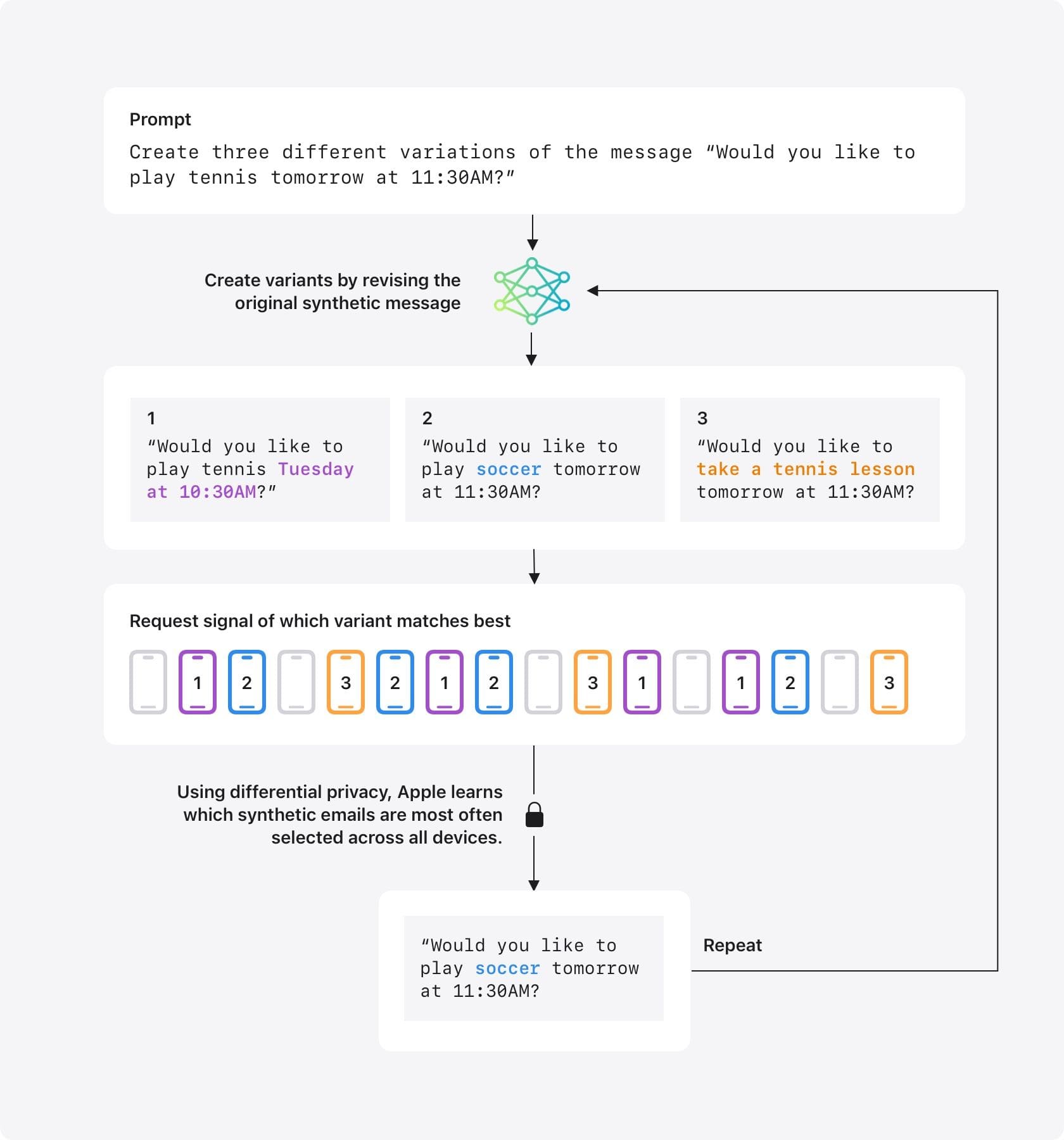
Apple's system is genuinely ingenious. Instead of simply sending your data to the cloud, the process will work quite differently. Apple will first create synthetic emails and messages—artificially generated texts that mimic the structure and style of real communication but contain no actual user content. These synthetic messages will then be converted into so-called "embeddings"—numerical representations that capture characteristics such as the topic or length of the text. Your iPhone or iPad (if you voluntarily enroll in the program) will then compare these embeddings with a small sample of your recent emails or messages—but everything takes place directly on your device. The device will subsequently send only an anonymous signal indicating which synthetic data most closely corresponds to real-world usage—without sending any actual content. "The content of the sampled emails never leaves the device... The participating device sends only a signal indicating which of the variants is the closest," Apple states in its blog post.
Why did Apple decide to do this?
If you have ever used features such as Siri or Apple Mail, you may have noticed that competing services such as Google Assistant or ChatGPT are more advanced in some respects. The reason? Data. Companies such as Google and OpenAI have access to enormous amounts of real user data, allowing them to train their AI models much more effectively. Apple has so far relied primarily on synthetic data, which often fails to capture all the nuances of real communication. "Apple's approach is like learning a language from a textbook versus living in a country where that language is spoken," says technology analyst Barry Foster. "Synthetic data will only take you so far."
Which features will improve as a result?
This approach should significantly improve a number of features that use artificial intelligence:
- Email and message summaries
- Notification summaries
- Writing tools
- Emoji generation (Genmoji)
- Image Playground and Image Wand
- Creating memories in the Photos app
Privacy first
What truly sets Apple's approach apart is its emphasis on privacy. The company uses a technique called "differential privacy"—it adds statistical noise so that individual users cannot be identified from aggregated survey results. And most importantly, the entire process is completely optional. Only users who give their explicit consent will participate. Instead of taking the path of least resistance and collecting user data like other companies, they have devised a more complex but safer approach. Technically, it is much more demanding, but it respects users.
Market and competitor reaction
While investors reacted rather lukewarmly to the announcement—Apple shares rose by just 0.2%—AI experts consider the move important. "Google and OpenAI have an advantage thanks to access to enormous amounts of data, but Apple's approach to the problem may be more sustainable in the long term," says Petr Novotný, an artificial intelligence consultant. "Once stricter personal data protection regulations come into force, Apple will have a competitive advantage."
When will we see this in practice?
Apple plans to introduce this system gradually over the next few months. Users will be explicitly asked for consent through a system notification. We could see the first results as early as the fall iOS update. This strategy may bring Apple slower progress compared with competitors that use less restrictive approaches to user data. At the same time, however, it reinforces the brand's commitment to protecting customer information—even as it tries to catch up with the competition in artificial intelligence. It is a classic example of how Apple strives to find a balance between innovation and privacy protection. And perhaps this very approach will ultimately strengthen customer trust in an era when artificial intelligence is becoming ubiquitous.


