


Google has developed DolphinGemma artificial intelligence to decode dolphin communication
A groundbreaking development is emerging in the fields of artificial intelligence and marine mammal research. Google has introduced its latest AI model, called DolphinGemma, which aims to help scientists decipher the complex communication system of dolphins. This innovative project combines advanced sound-processing technologies with state-of-the-art AI models.
How DolphinGemma works
DolphinGemma uses a so-called SoundStream tokenizer to efficiently process dolphin sounds. This technology enables the model to analyze complex sequences of whistles and pulse series that are typical of dolphin communication. With approximately 400 million parameters, DolphinGemma is designed to be powerful enough while also being resource-efficient. One of its key advantages is the ability to run this AI model directly on Pixel phones, allowing researchers from the Wild Dolphin Project (WDP) organization to use the technology directly in the field. The model was trained on an extensive labeled dataset of wild Atlantic spotted dolphins, which WDP has collected over decades. "DolphinGemma functions as an audio-in, audio-out system," Google explains. "It analyzes natural sound sequences, identifies patterns, and predicts subsequent sounds - similarly to how language models predict words in human speech."
Scientific contribution
For scientists, DolphinGemma represents a significant step forward. It enables them to:
- Identify recurring sound patterns and clusters in dolphin vocalizations.
- Reveal hidden structures that may indicate the meaning or intent of specific sounds.
- Automate pattern recognition, significantly accelerating research that previously required considerable manual effort.
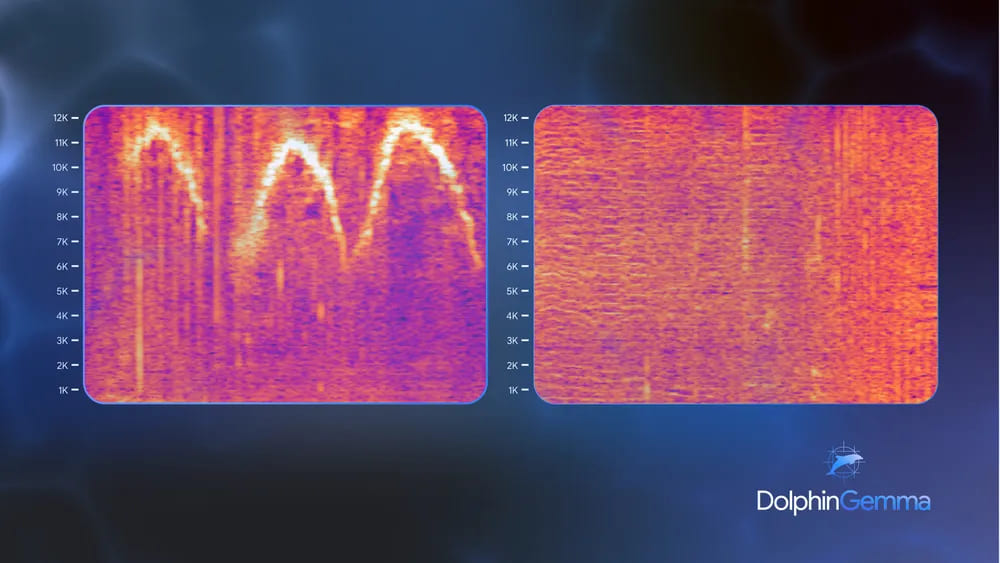
"Our ultimate goal is not just passive listening, but active understanding," the research team states. "We are trying to create a shared vocabulary between humans and dolphins using both natural and synthetic sounds."
Open science and collaboration
In accordance with the principles of open science, Google plans to release DolphinGemma as an open model during the summer of 2025. Although it was originally trained on Atlantic spotted dolphins, it can also be adapted for other cetacean species, such as bottlenose dolphins or long-beaked common dolphins. "Openness is key to accelerating research," Google emphasizes. "We want to provide marine biologists around the world with advanced tools for the acoustic analysis of various dolphin species and other mammals."

Part of the Gemma model family
DolphinGemma is based directly on Gemma technology - a family of lightweight, state-of-the-art open models inspired by Gemini (Google's largest multimodal foundation model). Like other specialized variants (e.g., CodeGemma for code generation), DolphinGemma adapts the core Gemma technology specifically for bioacoustic research.
This initiative demonstrates how advances in generative artificial intelligence are crossing the boundaries of text and entering fields such as animal behavior research. By making these tools available through the principles of open science and optimizing them for real-world deployment, Google is seeking to accelerate discoveries about nonhuman intelligence and support global collaboration among researchers. DolphinGemma represents a significant step toward bridging communication gaps between humans and animals using state-of-the-art artificial intelligence derived from the broader Google Gemma ecosystem.


