


Hierarchical Reasoning Model (HRM): 100x Faster Reasoning Than LLMs
Imagine artificial intelligence (AI) solving complex puzzles, such as extremely difficult Sudoku puzzles or mazes, faster and with less data than today's massive language models. This is the reality of a new model called the Hierarchical Reasoning Model (HRM), developed by the Singapore-based company Sapient Intelligence. Inspired by how the human brain works, this model represents a breakthrough in reasoning and could change how AI assists in medicine, climate forecasting, or robotics. Let's take a look at what it is, how it works, and why it has such potential.
What Is the Hierarchical Reasoning Model (HRM)?
The Hierarchical Reasoning Model (HRM) is a new AI architecture that Sapient Intelligence has made openly available on GitHub. The model has only 27 million parameters, a fraction of the size of today's large language models (LLMs), such as Claude 3.7 Sonnet or OpenAI o3-mini-high. Nevertheless, it achieves exceptional results on tasks that require deep reasoning, such as abstract thinking or finding optimal paths. HRM does not require vast amounts of data—it needs only 1,000 training examples without any pretraining or special techniques such as Chain-of-Thought (CoT).
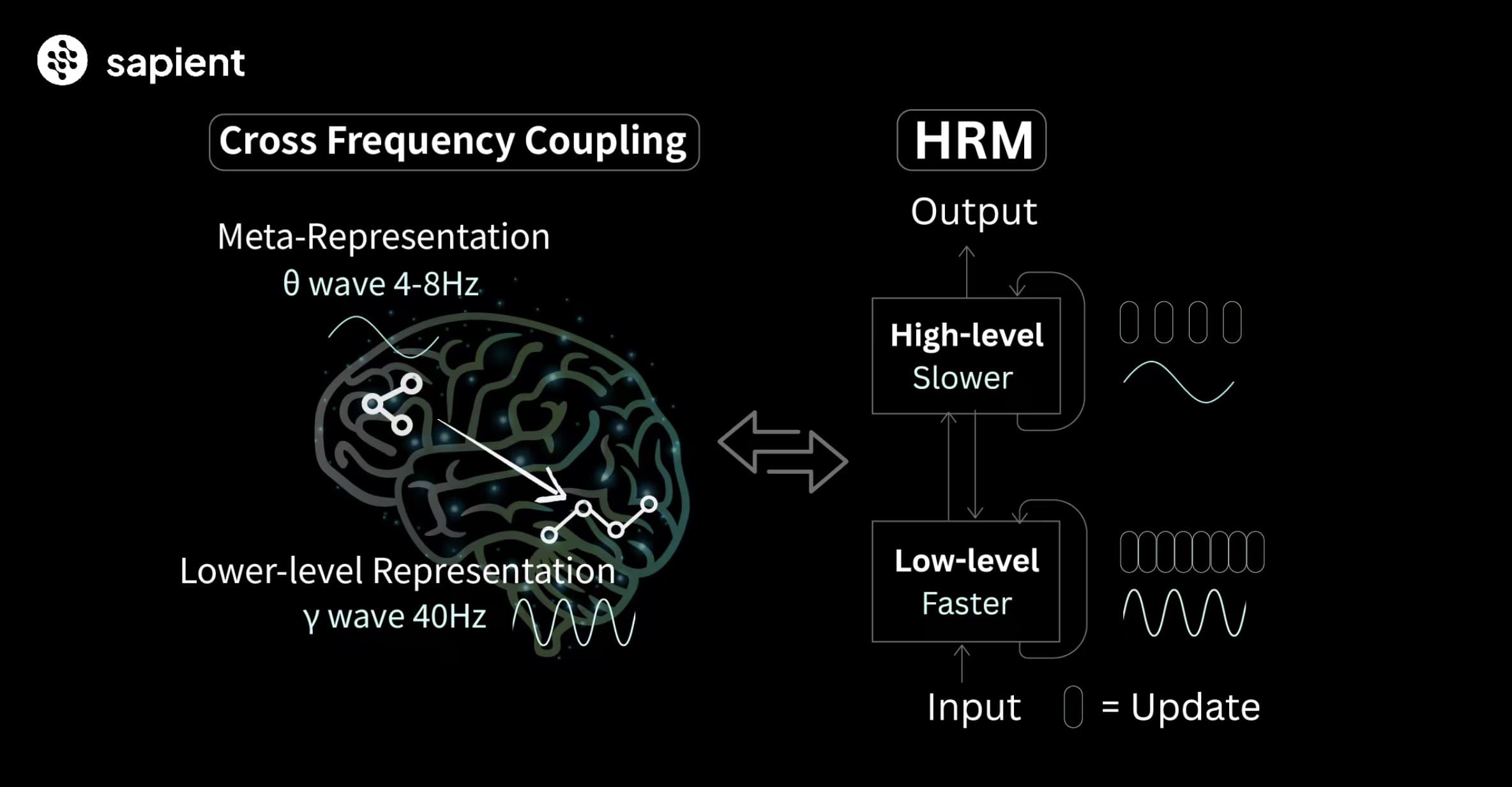
The model is designed to mimic the hierarchical structure of the human brain, where different parts operate at different levels and speeds. The authors, including Guan Wang, Jin Li, Yuhao Sun, Xing Chen, Changling Liu, Yue Wu, Meng Lu, Sen Song, and Yasin Abbasi Yadkori, describe HRM in the documentation as a system that solves complex sequential tasks in a single pass without explicit supervision of intermediate steps. Unlike LLMs, which rely on generating textual steps, HRM reasons in latent space—that is, internally, without needing to convert everything into words.
How Does HRM Work?
HRM is built on two interconnected recurrent modules that operate on different timescales, much like the brain. The high-level module (H-module) handles slow, abstract planning—as if considering the overall strategy. The low-level module (L-module), meanwhile, performs fast, detailed calculations and solves specific subtasks. These modules collaborate through a process called hierarchical convergence, in which the L-module performs several steps until it reaches a local solution, after which the H-module updates the plan and assigns a new subtask.
This approach allows the model to perform deep reasoning without issues such as vanishing gradients in deep networks or premature convergence in recurrent architectures. For example, when solving a maze, HRM gradually explores paths: the L-module quickly searches part of the maze, while the H-module adjusts the direction based on the results. The entire process takes place in a single forward pass, meaning the model does not need to generate long textual chains like CoT. According to Guan Wang, founder of Sapient Intelligence, this enables tasks to be completed up to 100x faster than with traditional LLMs because HRM processes information in parallel within latent space.
The model is trained on specific datasets, such as ARC-AGI (Abstraction and Reasoning Corpus), sudoku-extreme, or maze-30x30-hard. For Sudoku, for example, the dataset is created using the build_sudoku_dataset.py script, which generates 1,000 augmented examples. Training on a single GPU takes about 10 hours for Sudoku and around 24 hours for ARC-AGI, much less than for large models. HRM uses techniques such as FlashAttention for efficiency and is compatible with PyTorch and CUDA.
HRM Performance on Benchmarks
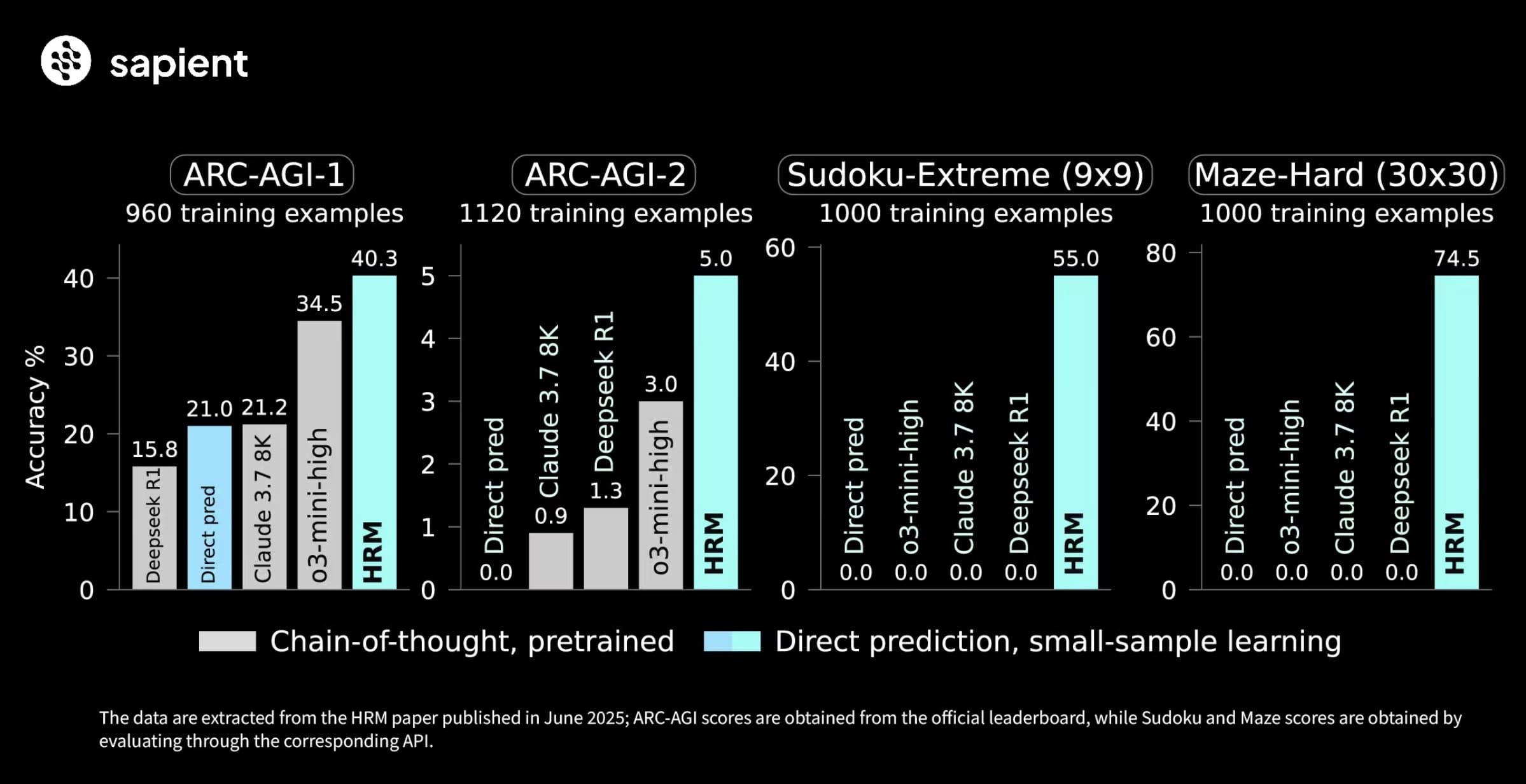
HRM excels at tasks where even advanced LLMs fail. On the ARC-AGI-2 benchmark, it achieved a score of 40.3%, outperforming OpenAI o3-mini-high (34.5%) and Claude 3.7 Sonnet (21.2%), even though these models have far more parameters and longer context windows. On extremely difficult Sudoku tasks (Sudoku-Extreme) and optimal pathfinding in 30x30 mazes (Maze-Hard), HRM achieves nearly 100% accuracy, while CoT methods fail completely (0%).
For example, in ARC-AGI, the model solves abstract tasks such as transforming colored grids using only 1,000 examples. For Sudoku, training is conducted with parameters such as epochs=20000, lr=7e-5, and global_batch_size=384, resulting in master-level performance. Similarly, only 1 hour of training on 8 GPUs is needed for mazes. These results show that HRM does not require massive amounts of data—it learns to solve problems efficiently, progressing from novice to expert while gradually using fewer steps.
HRM's Future Potential
HRM's potential extends far beyond puzzles. Sapient Intelligence is already testing the model in real-world applications, such as supporting complex medical diagnoses where data on rare diseases is limited. In climate forecasting, it increases the accuracy of subseasonal-to-seasonal forecasts (S2S) to 97%, which has a direct social and economic impact. In robotics, HRM serves as a "decision-making brain" on low-latency devices, enabling real-time operation in dynamic environments.
Guan Wang emphasizes that HRM offers an alternative to expensive, latency-burdened LLMs for deterministic tasks requiring long-term planning. With low training costs (e.g., 2 GPU hours for Sudoku and 50–200 for ARC-AGI), the model could revolutionize fields such as logistics or scientific research. Sapient plans to expand it into self-correcting models that surpass today's text-based systems. This approach, based on brain-inspired architecture rather than scaling, could lead to universal artificial general intelligence (AGI) systems in which AI surpasses human limits in reasoning.


