Before the Supreme Court decisions, new laws, and the movement known as “civil rights,” there were effectively two Americas, one white and one Black. White people ruled, while Black people got by as best they could as second-class citizens. This was true not only in the South, but throughout the country. A guide for Black motorists called The Negro Motorist Green Book (commonly known simply as the Green Book) was a practical expression of that era.
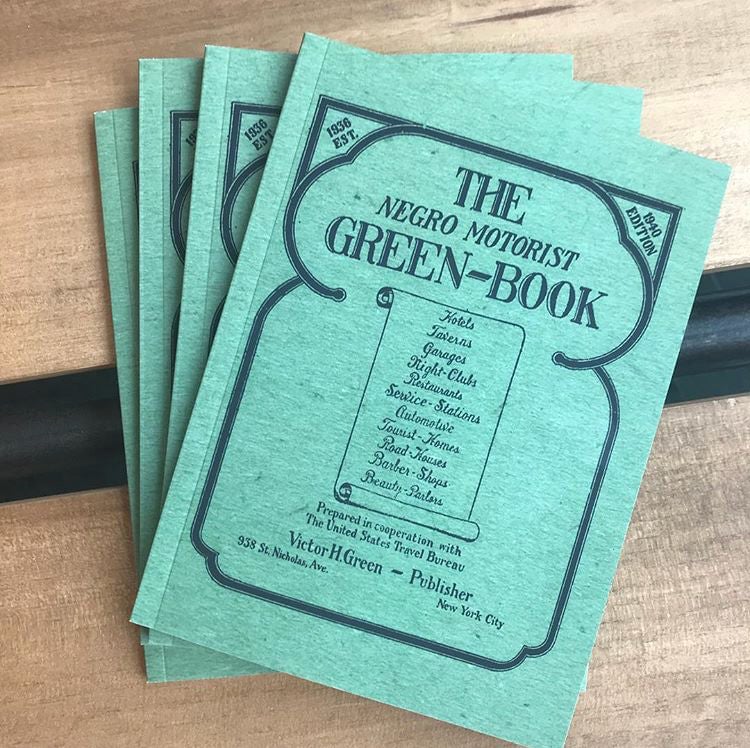
The Green Book was scarcely remembered until it was revived by the Oscar-winning 2018 film of the same name. The film Green Book was based on the inexpensive guide for Black drivers traveling across the United States during the era of so-called Jim Crowism, a time of racially segregated accommodations, dining rooms, and the like. The guide was conceived in 1936 by Harlem postal worker Victor Hugo Green. It began as a modest effort to help Black people navigate New York City's diverse neighborhoods, but in subsequent years it expanded to include neighboring states, then the South, and finally the distant West. The Green Book listed hotels, inns, restaurants, and even gas stations that welcomed African American customers. It promised to make travel “more pleasant,” if not entirely safe, by putting into print what for years had been passed along only by word of mouth. It also heralded the dawn of a new era in which Black people were no longer limited to traveling in segregated railroad cars and intercity buses. The automobile gave African Americans the freedom to take to the open road, but it did not answer the question of where to sleep, eat, and refuel. Victor Green's little booklet did. Its cover bore a simple warning: “Carry your Green Book with you. You may need it!”
The 1939 edition was the first to include Fort Worth. The modest local listings showed how deeply segregation was entrenched in North Texas and how small the African American business community was. It listed only two hotels, the Del Rey at 901 Jones St. and the Jim Hotel at 413–15 E. Fifth, both on the eastern edge of downtown, and one gas station (970 E. Humboldt). Across all four or five of Fort Worth's distinctly Black neighborhoods, these were the only public places where Black travelers could count on a friendly reception. Of course, they first had to find all three places, which in the days before navigation systems meant stopping to ask for directions. An older hotel, the Main Hotel on Rusk Street across from the Majestic Theatre, had already closed by the time the Green Book was published. There were so few public accommodations not only because few Black people traveled far from home, but also because it was customary in the Black community for Black visitors to stay with friends, relatives, or at family boardinghouses known as “tourist homes.” That is exactly what opera star Marian Anderson did when she came to the city in 1939 and 1941, and Martin Luther King did the same in 1959.
The Jim Hotel operated as a genuine hotel, although it looked more like a large house than a business: it had fifty rooms, a front desk, room service, a barbershop, and a dining room. It was built in the late 1920s by William “Gooseneck Bill” McDonald and named after his second wife, Jimmie Strickland McDonald. McDonald was a banker, not a hotelier. He sold the Jim Hotel in 1934 to Oscar and Levi Cooper, who added a wing with twenty-five rooms, space for private events, and a nightclub that proved to be the most memorable part of the entire establishment. In the years that followed, the “Varsity Club” became a major stop on the so-called chitlin' circuit (a network of venues where Black performers appeared) and a breeding ground for Black musical culture in North Texas. Aaron “T-Bone” Walker, Fats Waller, Louis Armstrong, Count Basie, and countless other African American greats played there, attracting both Black and white audiences. Walker led the house band and gained acclaim far beyond Fort Worth. In 1953, the establishment became the New Jim Hotel, a name that obscured its decline. The place ultimately fell to the wrecking ball in 1964, when desegregation opened up other, more comfortable accommodations. Today, the site is a parking lot behind the old Fort Worth Press building at the corner of Fourth and Jones Streets, which now houses a Fort Worth police station.
Oscar Cooper also operated the Green Leaf restaurant, originally at 315 E. Ninth, the only all-night dining establishment for Black people in Fort Worth. It was a gathering place for locals, who came for the home cooking, as well as for travelers, for whom it provided a welcome oasis on long journeys. All-night diners were a common feature of cities for white travelers; for Black travelers, they were a novelty.
In later editions of the Green Book, the list of accommodations in Fort Worth grew, reflecting both the increase in travel among African Americans and the opening of additional places catering to Black travelers. In 1947, two restaurants and another gas station were added to the list. One of the restaurants was part of the three-story Black YMCA at 1604 Jones. The land had been donated in 1939 by Bill McDonald in honor of his son, Bill McDonald Jr., who died in 1920. The gas station at 1151 New York St. was further recognition that Black motorists also needed to refuel while traveling.
In 1956, the Clover and Mohawk hotels were added to the list. The Clover (1901 E. Fourth) stood in the Rock Island Bottom neighborhood, a mixed commercial and residential area in the Trinity River lowlands just east of the city. The Mohawk (217 E. Fifteenth), like most other Black-owned businesses of the era, was located in the original Black business district on the eastern edge of downtown, an area stretching from Sixth Street to Sixteenth Street and from Calhoun to Jones.
In 1957 and 1958, the Monterey Hotel and the Rose Cliff restaurant were added to the list, both in the Terrell Heights neighborhood on the city's near south side. It was Fort Worth's first middle-class Black neighborhood, located at the intersection of Rosedale and Terrell Streets.
The 1966 edition included familiar names from earlier editions. But the times, as Bob Dylan sang, were changing. It was two years after the Civil Rights Act had mandated an end to segregated public accommodations. Leading the changes was Leonard's department store, which had begun removing its “Whites Only” signs as early as 1962. Construction of the North–South Freeway and the Tarrant County Convention Center destroyed many Black-owned businesses and homes, and the once-thriving Black business district along Calhoun and Jones Streets was largely transformed into industrial land and parking lots.
The book changed over the years. The title The Negro Motorist Green Book became The Negro Travelers' Green Book, and the price climbed to $1.25 in the 1950s. As a growing Black middle class took to the road, the book became not only a guide for travelers, but also a guide to “vacation destinations.” Vacations were a relatively new phenomenon in the Black community. Victor Green, the eternal optimist, predicted in the 1948 edition that the day would come when such a guide would no longer be needed because “we as a race will have equal opportunities and rights in the United States.” And then “we will be able to go wherever we please, and without humiliation.” In 1966, for the first time, the Green Book's cover made no reference to skin color and featured an image of a racially ambiguous person. It was now apparently intended for all travelers seeking a “vacation without aggravation.” Black readers knew well what was meant by that “aggravation.” All the information in the book still served the convenience of Black travelers. It was the last year the Green Book was published.
Its demise reflected the changing times. At least under the law, Black people could now eat and stay wherever they wished. The downside of their newly acquired freedom was that many familiar Black-owned businesses disappeared because they could not compete with more upscale white-owned establishments. Some had been kept alive only by racial loyalty and habit. The writing was on the wall when the Clover Motel was sold in 1963, then advertised as “colored property” with “great potential.” It was ultimately erased from history by the completion of the North–South Freeway (I-35W), which cut through the heart of the Rock Island Bottom neighborhood.
Today, the Green Book is only a film, but in its day it was the African American traveler's field guide. One of the last remnants of that era was the Green Acre Courts motel in Dallas, which in the 1940s and 1950s was a leading “motor court” for Black travelers on the east side of the Trinity River seeking an air-conditioned room and a hot shower. Long after it closed, amid some discussion of preserving the site as a historic landmark, it was demolished in 2017. By bringing the book into the spotlight, the film turned it into a collector's item. In 2019, a well-thumbed copy of the 1958 edition sold at auction for $27,500. A well-preserved copy of one of the early editions sells for many times that amount, if one can be found at all.