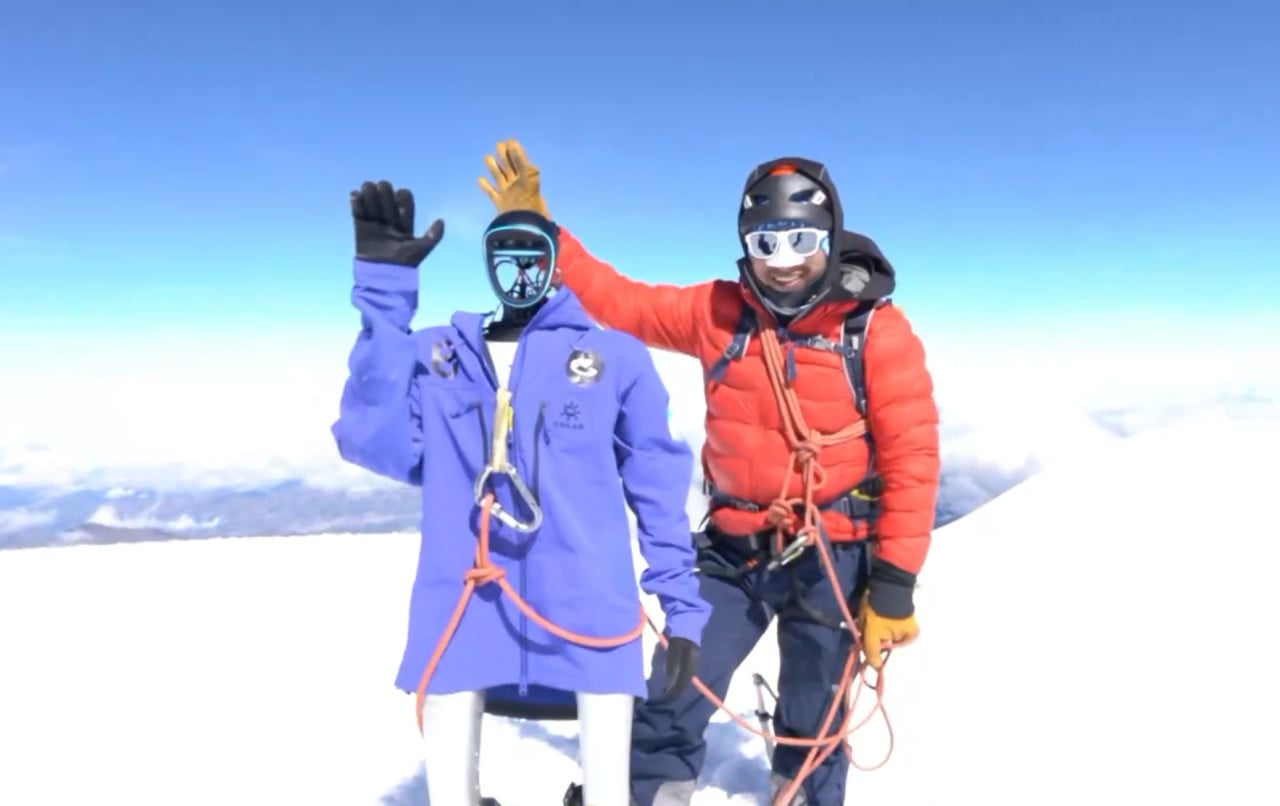
A humanoid robot has climbed to the summit of Ecuador’s Chimborazo volcano. The machine, named Pemba, spent hours walking across ash, rocks, and ice before its human team carried it through the most difficult sections. The six-thousand-meter peak thus received its first two-legged metal visitor. And this is not the end, because Everest is next.
It is a modified version of the Unitree G1 humanoid. However, the team behind the project, operating under the Geologic Dome brand, does not call it an ascent. They call it a stress test. And that makes all the difference.
Testing the robot in the Andes
Chimborazo rises to more than 6,200 meters, and it is not exactly a welcoming environment for a machine made of metal joints and sensors. These are precisely the conditions that reveal weaknesses that would never appear in a laboratory.
So what happened there? Pemba walked on its own wherever the slope allowed. It managed the gentler sections under its own power. As soon as the terrain became steeper than thirty degrees and its footing became uncertain, the solo journey was over. The human climbers lifted the robot and carried it onward, almost like a fragile piece of scientific equipment. The entire ascent took around sixteen hours, and the machine, weighing roughly 35 kilograms, spent a good part of the journey on the expedition members’ backs.
That may sound like cheating, but that was not the point. The engineers were collecting data on balance, endurance, navigation, and how the mechanics behave when the surroundings become unpredictable.
What cold and altitude do to a robot
Electronics behave differently at high altitude. Batteries discharge faster. And cooling paradoxically fails because the thin air does not dissipate heat as effectively as it should. Add to that joints stiffened by the cold and sensors whose view becomes obscured as soon as clouds roll in.
The machine was therefore equipped with special booties and a heated jacket tailored specifically for it. The engineers worked on thermal insulation and ventilation modifications because it is not just about keeping the system running. It is about keeping it stable enough to prevent a fault in one place from disrupting the robot’s entire movement.
The platform had already undergone a similar trial. In China’s Altai region in Xinjiang, the G1 endured freezing temperatures down to minus 47.4 degrees Celsius, according to Unitree itself. Chimborazo added altitude to the cold, and that is an entirely different kind of ordeal.
And how autonomous is the robot, exactly? For now, its autonomy is still experimental rather than operational. Its capabilities are developed through learning, with engineers gradually increasing the difficulty of the terrain. It is still far from fully independent.
Introducing Pemba.
— pabs (@pabloberlangab) June 7, 2026
The first humanoid to climb to 20,000ft.
Everest next. More below. pic.twitter.com/k1BHkRLYjm
The idea of sending a robot into the mountains
The project is led by French engineer Pablo Berlanga Boemare. His path to machines began not in technology, but in nature conservation. He previously worked on World Wildlife Fund projects and knows what he is talking about. Monitoring wildlife, changes in the landscape, poaching, and illegal logging requires constant surveillance. Today, that is usually handled by fixed cameras and scattered sensors.
The catch is that maintaining such a network of devices in inaccessible terrain costs a great deal of money. Instead of dozens of fixed sensors, a single mobile machine could traverse the landscape, collect data, and transmit it via satellite. That is Boemare’s vision. There has been talk of connecting it to Starlink and recharging it with solar power. For now, it is more of a vision than a finished solution, but it determines how they build the robot and where they test it.
Next stop: Everest
Attention has already shifted to a far more demanding location. As part of a series of expeditions the team calls the "triple crown," the G1 is also expected to climb the world’s highest mountain. The plan does not involve a symbolic conquest of the summit. The robot is supposed to move between Base Camp at an altitude of 5,364 meters and Camp IV at around 7,920 meters. In other words, where the limits of human endurance lie.
The team wants to test the battery, the load on the joints, mobility, and resistance to cold, wind, and weak connectivity. It could be useful for monitoring glaciers, conducting search and rescue operations, and collecting the distressingly large amount of waste on Everest.
But the biggest obstacle this time is not technical. It is paperwork. Nepal does not yet have rules for machine expeditions, and before any robot sets out for Everest, the local authorities want to determine how to handle "non-human" climbers in the first place. This has delayed the entire project. The team is now working with the authorities to finalize the conditions, and the earliest possible date for the ascent currently appears to be in the fall or winter.
Sources: interestingengineering.com and timesofindia.indiatimes.com