

Google Unveils Full Version of Gemma 3n: A New Era of Mobile AI Models
Google DeepMind officially launched the full version of Gemma 3n in June 2025, a revolutionary artificial intelligence model designed specifically for mobile devices and edge computing. Following the successful release of the preview version in May, developers now have access to the latest multimodal capabilities, bringing AI directly to mobile phones, tablets, and laptops with standard computing power.
The first Gemma model was launched in early 2024 and has since established a strong position within the developer community. Gemmaverse has surpassed 160 million downloads and includes more than a dozen specialized models for various applications—from security to medical use. Inspiring examples include the work of Roboflow, which uses Gemma for enterprise computer vision, and the Institute of Science Tokyo, which created high-performance Japanese variants of Gemma models.
Key Technical Innovations and Capabilities
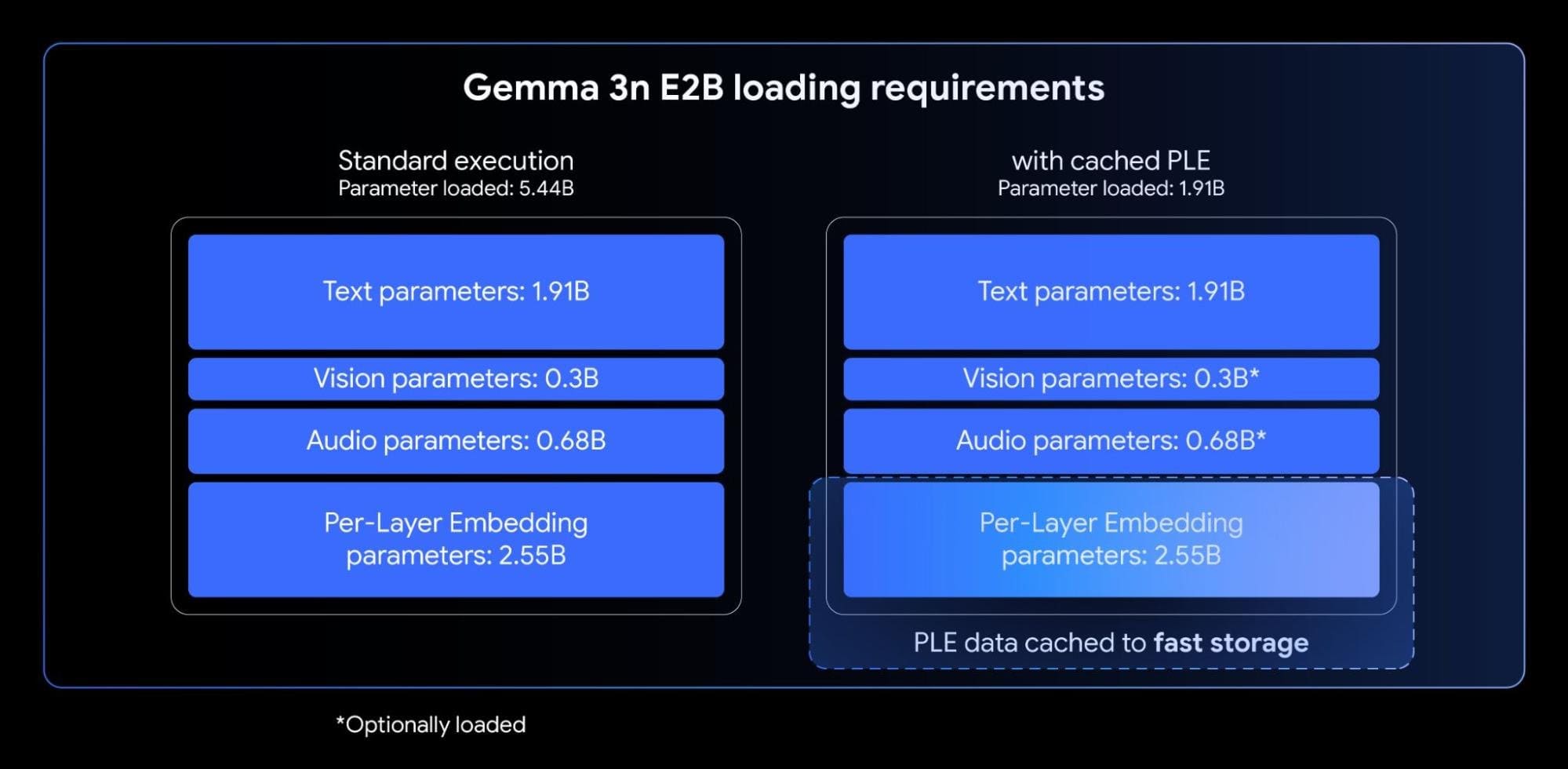
Gemma 3n natively supports image, audio, video, and text input with text output, representing a significant advancement over previous versions. The model is available in two sizes based on effective parameters: E2B and E4B. While their actual parameter counts are 5 billion and 8 billion, respectively, architectural innovations allow them to operate with a memory footprint comparable to traditional 2B and 4B models. E2B requires just 2 GB of memory, while E4B runs with 3 GB of memory.
At the core of Gemma 3n is the groundbreaking MatFormer (Matryoshka Transformer) architecture, which enables elastic inference. Like matryoshka dolls (nesting dolls), the larger model contains smaller, fully functional versions of itself. During the training of the 4B effective parameter (E4B) model, a 2B effective parameter (E2B) sub-model is optimized simultaneously, giving developers deployment flexibility based on the resources available on the device.
The model uses the innovative Per-Layer Embeddings (PLE) approach, which dramatically improves model quality without increasing high-speed accelerator memory requirements. A significant portion of the parameters can be efficiently loaded and processed on the CPU, while only the core transformer weights need to be stored in the more limited accelerator memory.
Multimodal Capabilities for Real-World Applications
For audio processing, Gemma 3n uses an advanced audio encoder based on the Universal Speech Model (USM). The encoder generates one token for every 160 milliseconds of audio (approximately 6 tokens per second), enabling automatic speech recognition (ASR) and automatic speech translation (AST) directly on the device. Google observed particularly strong results when translating between English and Spanish, French, Italian, and Portuguese.
For visual processing, Gemma 3n includes a new MobileNet-V5-300M encoder that delivers state-of-the-art performance for multimodal tasks on edge devices. It supports resolutions of 256x256, 512x512, and 768x768 pixels and processes up to 60 frames per second on Google Pixel. Compared with previous versions, it delivers a 13-fold speedup with quantization, requires 46% fewer parameters, and has a four-times smaller memory footprint.
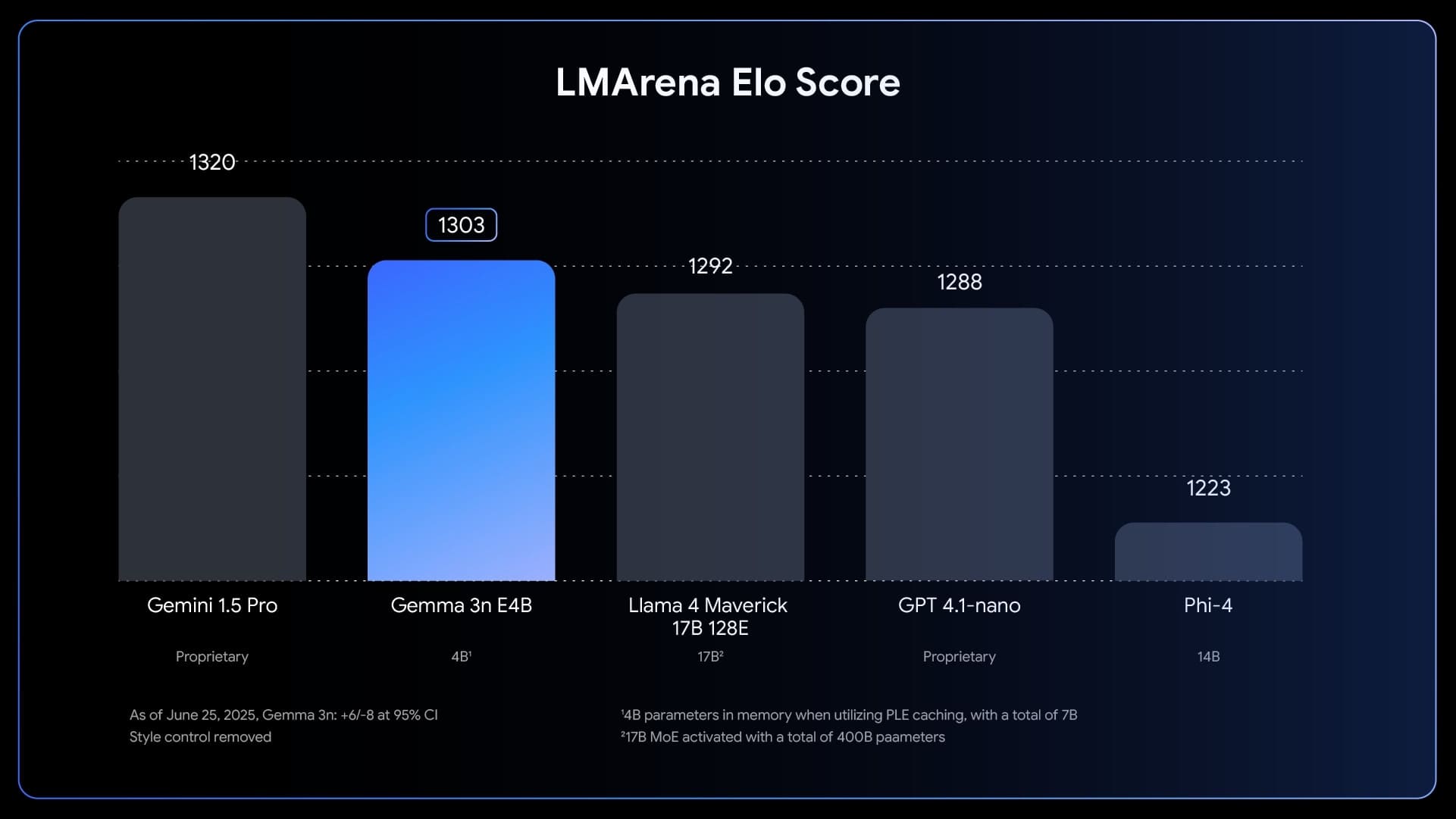
The model supports more than 140 languages for text processing and multimodal understanding in 35 languages. Gemma 3n E4B achieves an LMArena score above 1300, making it the first model with fewer than 10 billion parameters to reach this benchmark.
Availability and Developer Support
Google has ensured broad support across popular tools and platforms, including AMD, Axolotl, Docker, Hugging Face, llama.cpp, LMStudio, MLX, NVIDIA, Ollama, RedHat, SGLang, Unsloth, and vLLM. Omar Sanseviero, Staff Developer Relations Engineer, and Ian Ballantyne, Senior Developer Relations Engineer, who introduced the model, emphasize its focus on the needs of the developer community.
Gemma 3n is available through Google AI Studio for direct experimentation and through Hugging Face and Kaggle for downloading model weights, with comprehensive documentation for rapid integration. The model supports deployment through the Google GenAI API, Vertex AI, SGLang, vLLM, and the NVIDIA API Catalog.
To encourage innovation, Google launched the Gemma 3n Impact Challenge with a total prize pool of $150,000. The goal is to use Gemma 3n's unique on-device, offline, and multimodal capabilities to create a product for a better world.
Gemma 3n represents a step forward in mobile AI models, combining the performance of cloud models with the efficiency required for edge computing. With support for multimodal inputs and advanced architectural innovations, it opens up new possibilities for developers building next-generation AI applications directly on standard mobile devices.


