Google Introduces Quantized Gemma 3 Models
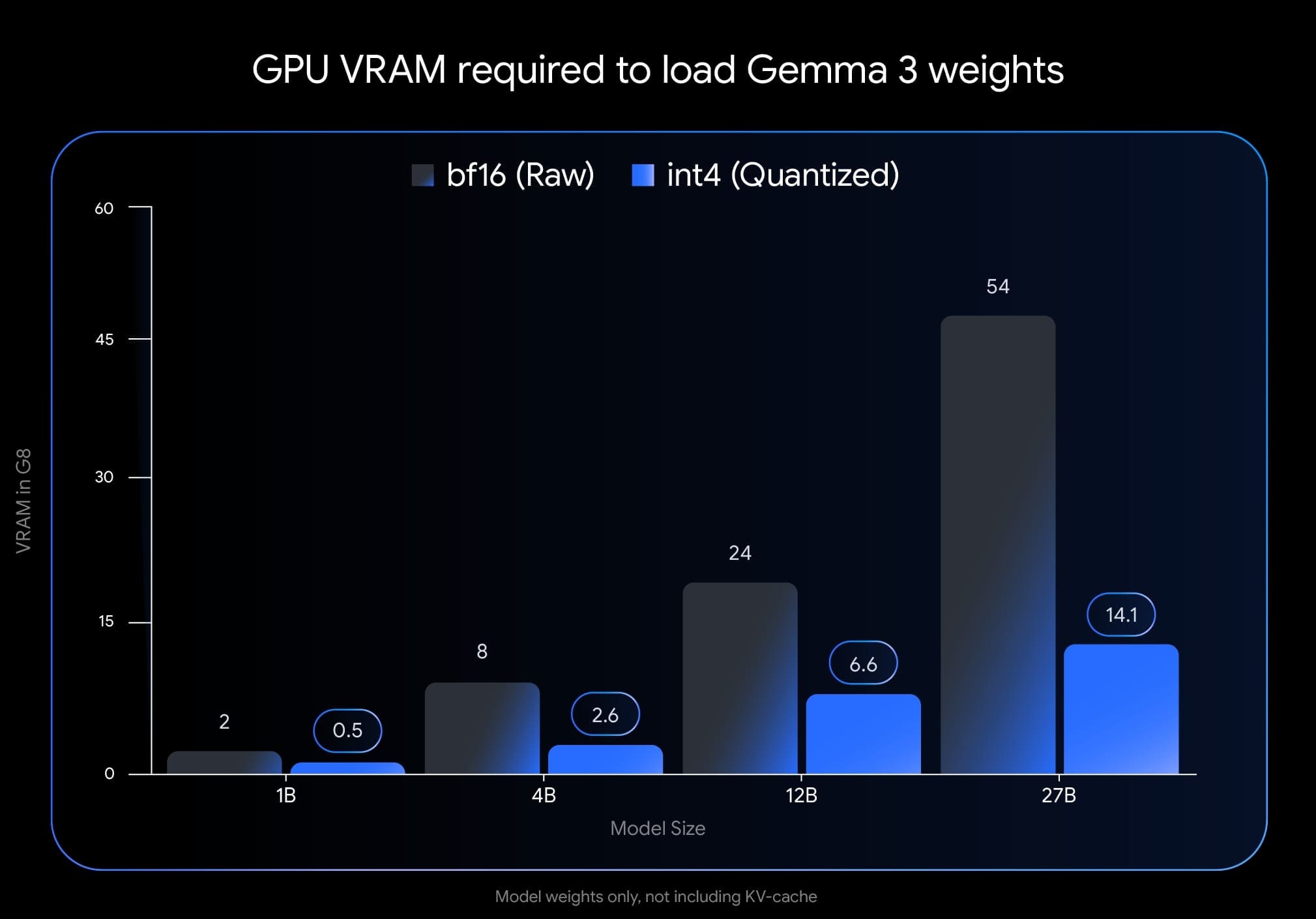
Google has introduced quantized Gemma 3 models, bringing advanced AI performance to commonly available hardware. The biggest surprise is that even a massive model with 27 billion parameters can now be run on consumer graphics cards such as the NVIDIA RTX 3090.
Quantization as the Key to Accessibility
Quantization is a technique that makes it possible to run demanding AI models on less powerful hardware by reducing the precision of the numbers used for calculations. While standard models often require 16 or 32 bits to represent each number (FP16/FP32), quantized models can work with as few as 4 or 8 bits (INT4/INT8). What is groundbreaking about the Gemma 3 models, however, is that they were trained with future quantization in mind ("quantized-aware training"). Unlike the standard approach, in which a model is first trained at full precision and only then quantized, Google included quantization in the training process from the outset. As a result, Gemma 3 models achieve excellent results even at low precision.
Gemma 3 with 27B Parameters on Your Desktop Computer
Most impressive is that even the largest 27-billion-parameter Gemma 3 model can now be run on a standard consumer graphics card such as the NVIDIA RTX 3090. Although still powerful, this card is much more affordable than specialized hardware that was previously essential for models of a similar size. According to data from Google, an RTX 3090 with 24 GB of VRAM can run the Gemma 3 27B model with 4-bit quantization at a text generation speed of 10 tokens per second. That is fast enough for most practical applications.
Performance Comparable to Much Larger Models
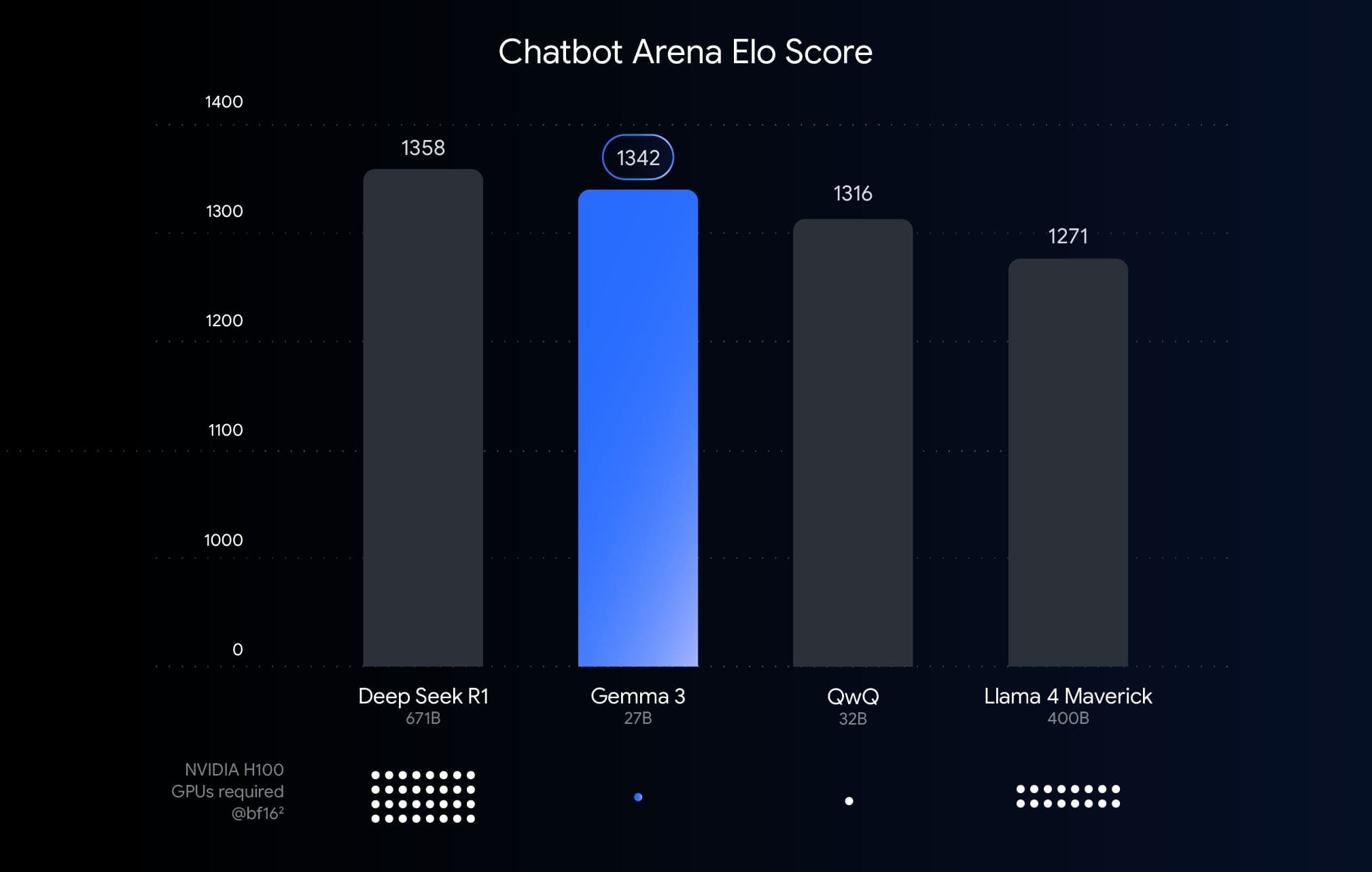
Despite their relatively modest hardware requirements, Gemma 3 models can boast impressive performance. In benchmarks such as MMLU (Massive Multitask Language Understanding), the 27B model achieves results that are competitive even with much larger models. Specifically, in tests of text comprehension, logical reasoning, and problem-solving, Gemma 3 27B achieves scores comparable to models with 70 billion parameters, but with significantly lower computational resource requirements.
Available Model Variants
Google is releasing quantized Gemma 3 models in three sizes:
- Gemma 3 2B: the smallest and fastest model, suitable for simple applications.
- Gemma 3 9B: a medium-sized model offering a good balance between performance and speed.
- Gemma 3 27B: the largest model with the highest performance, yet still runnable on an RTX 3090 GPU.
All models are available in versions optimized for 4-bit and 8-bit quantization, allowing developers to choose the appropriate variant based on the available hardware and desired performance.
What This Means for the AI Ecosystem
This move by Google is significant for the entire artificial intelligence ecosystem. Access to powerful models will allow a much broader community of developers to experiment with advanced AI technology. "Our goal is to make state-of-the-art AI accessible to the broadest possible audience," Google engineers stated on their developer blog. "Thanks to the quantization techniques used when training the Gemma 3 models, developers without access to expensive specialized hardware can now also take part in creating innovative AI applications."
How to Get Started with Gemma 3
The models are available through Hugging Face and Google Cloud. Developers can use ready-made integration tools for TensorFlow and PyTorch, which simplify implementing the models in their own applications. Google also provides detailed documentation and sample projects demonstrating practical uses of Gemma 3 models in various scenarios—from text generation and chatbots to programming assistance.