

Discover Genie 3 from Google DeepMind - The Future of AI-Powered Simulations
You enter a simple text description and suddenly find yourself in a dynamic world that you can explore in real time. This is not science fiction, but a reality made possible by Genie 3, a new model from Google DeepMind. This article will walk you through the details of this groundbreaking development, based on the official blog by authors Jack Parker-Holder and Shlomi Fruchter. Let's take a look at how Genie 3 is changing the way we view simulated environments, all in an easy-to-understand way and with a healthy dose of enthusiasm—because this is truly exciting!
The Journey Toward World Simulation
Google DeepMind has been researching simulated environments for more than ten years. It began by training agents that mastered real-time strategy games such as StarCraft II and continued with the development of open-ended environments for learning and robotics. All of this led to the creation of world models—AI systems that can simulate the world based on their understanding, predict how it will evolve, and respond to actions.
World models are crucial on the path toward artificial general intelligence (AGI), because they make it possible to train agents in an infinite number of rich simulations. Last year, they introduced Genie 1 and Genie 2, which generated new environments for agents. At the same time, they made progress in video generation with the Veo 2 and Veo 3 models, which demonstrate a deep understanding of intuitive physics. Genie 3 is the first model to enable real-time interaction while also improving consistency and realism compared with Genie 2.
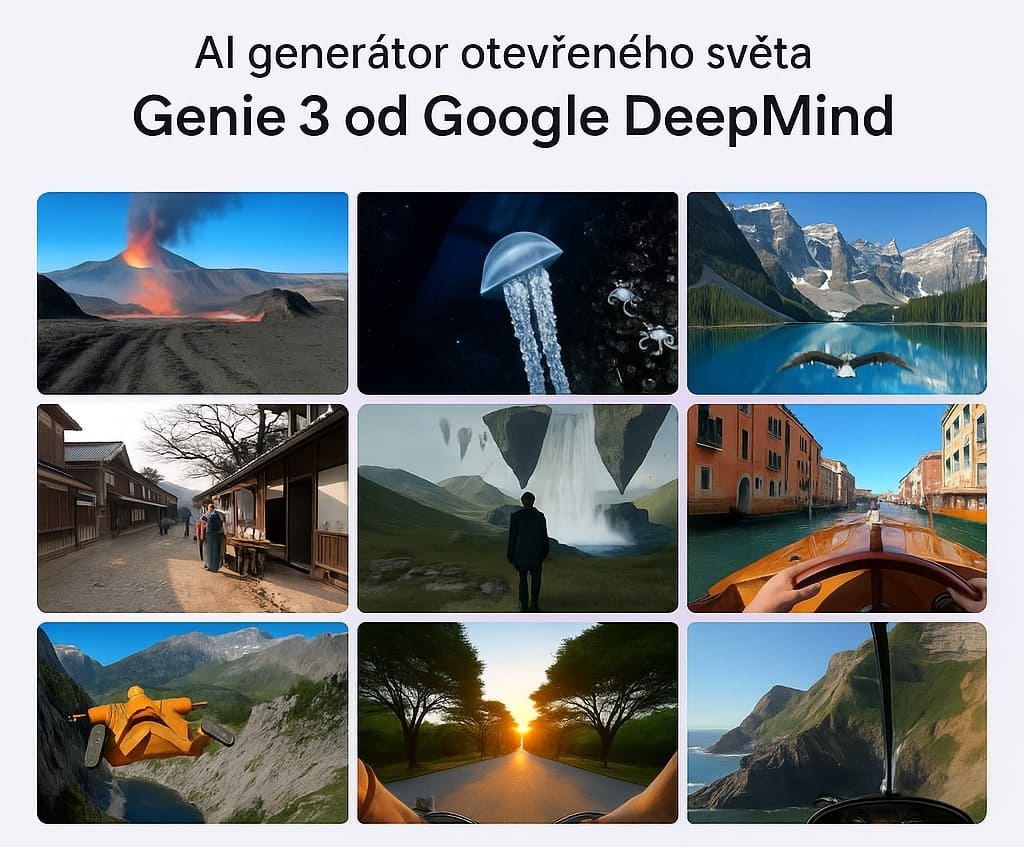
Based on a text description, Genie 3 can create a dynamic world that you can navigate in real time at 24 frames per second, maintaining consistency for several minutes at 720p resolution. That is a huge leap—imagine moving through a volcanic landscape or an underwater world, with everything responding naturally. Watch the demonstration video.
Genie 3's Capabilities
Genie 3 excels at modeling the physical properties of the world. For example, it can simulate natural phenomena such as water, lighting, or complex interactions within an environment. In one example, you take the perspective of a wheeled robot moving through difficult terrain in a volcanic area. The vehicle has rugged off-road tires that crush black rock, and the camera is egocentric, so you can see the front wheels at the bottom of the image. In the distance, smoke rises and lava flows from the volcano, with no signs of life. There are lava pools that the agent tries to avoid and random rock formations beneath a vivid blue sky.
Another example: riding a jet ski during a festival of lights. Or walking along a sidewalk in Florida beside a two-lane road and the sea as a hurricane approaches—with strong winds, waves spilling over the railing, bending palm trees, and heavy rain, while the agent wears a raincoat.
Genie 3 also simulates the natural world with rich ecosystems. Running along the shores of a glacial lake, exploring branching paths through a forest, crossing mountain streams amid snow-covered mountains and pine forests teeming with wildlife. Or swimming through a dark ocean between canyons, surrounded by schools of jellyfish and bioluminescent light.
Exploring locations and historical environments? Genie 3 takes you to the Alps, with steep cliffs and narrow passages filled with rubble; to the canals of Venice, with realistic water reflections and old buildings; or to the Palace of Knossos on Crete in its heyday. You can even take a walk through Hinsdale, Illinois, on a sunny day, with parked cars and flocks of birds overhead.
Technical Breakthrough
Significant technical innovations were required for Genie 3 to achieve a high degree of controllability and real-time interaction. When generating each frame, the model must account for the preceding trajectory, which grows longer over time. For example, if you return to a location after a minute, the model must reference information from a minute earlier. All of this must happen several times per second in response to new user inputs.
For an immersive experience, the environment must remain consistent over extended periods. Autoregressive generation is more complex than generating an entire video because inaccuracies accumulate. Even so, Genie 3 maintains consistency for several minutes, with visual memory extending up to one minute into the past. Examples include painting a house with a roller from a first-person perspective or walking down a Victorian street with a portal to the desert through which the agent can teleport.
Another innovation is promptable world events—text-based interactions that alter the world, such as changing the weather or adding objects and characters. This expands the possibilities for "what if" scenarios that are useful for training agents.
Model Comparison
For a clearer overview, here is a translated table comparing Genie 3 with previous models. This table is based on the provided image and shows the key differences.

Research Support and Limitations
Genie 3 was tested with the SIMA agent, which completes objectives in generated worlds, such as approaching a blender in a bakery or walking toward refrigerated display cases. This demonstrates its potential for training robots and autonomous systems.
Nevertheless, it has limitations: a restricted action space, complex interactions between agents, inaccurate simulations of real-world locations, issues with text, and interactions limited to a few minutes.
Google DeepMind emphasizes responsibility—they are working with the responsible development team, and Genie 3 is available only as a limited research preview for academics and creators to gather feedback.


