

OpenAI Introduces GPT-OSS: The First Open AI Model Since GPT-2
OpenAI, the company known for its advanced models such as GPT-4o and o3, is now opening the door to something truly significant. It has introduced two new open-weight models: gpt-oss-120b and gpt-oss-20b. These models are not just more pieces of code—they are designed to push the boundaries of what open models can achieve in reasoning, tool use, and efficient deployment. And the best part? They are available under the flexible Apache 2.0 license, so anyone can download, modify, and use them. Let's take a closer look, step by step.
What Are the gpt-oss Models and Why Are They Important?
These models are trained using a combination of reinforcement learning and techniques inspired by OpenAI's most advanced internal systems, including o3 and other frontier models. gpt-oss-120b has a total of 117 billion parameters but activates only 5.1 billion per token, making it efficient enough to run on a single 80 GB GPU. The smaller gpt-oss-20b has 21 billion parameters, with 3.6 billion active per token, and requires only 16 GB of memory, making it ideal for edge devices or local inference without expensive infrastructure.
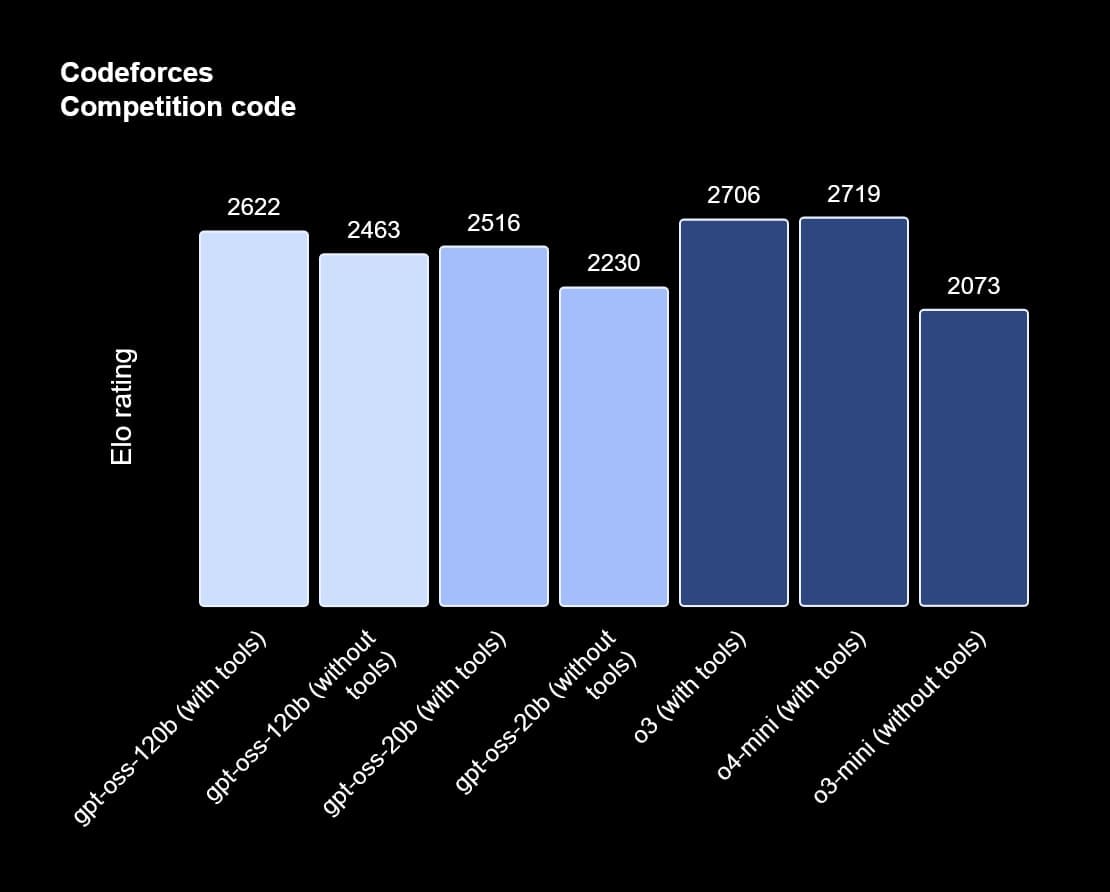
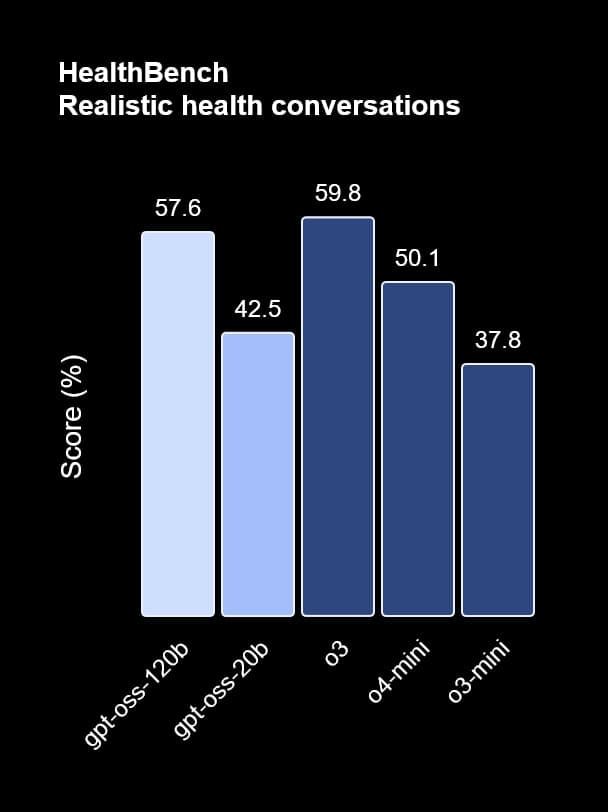
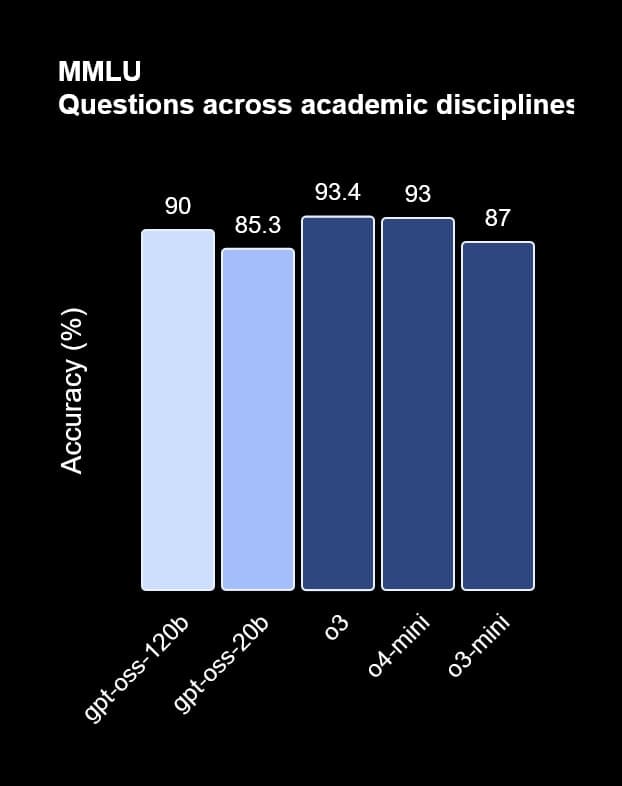
Both models excel at tasks such as chain-of-thought reasoning, using tools such as web search or running Python code, and even support Structured Outputs. They are compatible with OpenAI's Responses API and allow the reasoning level to be set to low, medium, or high, depending on latency versus performance requirements. In benchmarks such as Codeforces, MMLU, HLE, Tau-Bench, and HealthBench, they outperform or match models such as o3-mini and o4-mini, including in competitive programming, mathematics (AIME 2024 & 2025), and health-related queries.
OpenAI collaborated with partners such as AI Sweden, Orange, and Snowflake to test real-world applications—from on-premises hosting for data security to fine-tuning on specialized datasets. This means these models are not merely theoretical; they are ready for developers, businesses, and governments that want to run AI on their own infrastructure.
Architecture and Training
The models are based on a Transformer architecture with mixture-of-experts (MoE), where gpt-oss-120b has 36 layers, 128 experts, and activates 4 per token. gpt-oss-20b has 24 layers, 32 experts, and also activates 4. They use alternating attention patterns (dense and locally banded sparse), grouped multi-query attention with a group size of 8, and Rotary Positional Embedding (RoPE) for contexts of up to 128k tokens.

Training was performed on a predominantly English-language text dataset focused on STEM, coding, and general knowledge. They used the o200k_harmony tokenizer, which they also made available openly. Post-training included supervised fine-tuning and an RL phase to ensure the models followed the OpenAI Model Spec, including CoT reasoning and tool use. OpenAI emphasizes that CoT is not directly supervised, allowing for better monitoring of model behavior.
Safety First
Safety is crucial, especially for open models. OpenAI filtered harmful data during pre-training (e.g., CBRN—chemical, biological, radiological, and nuclear) and used deliberative alignment and instruction hierarchy to reject dangerous prompts. In addition, it tested an adversarially fine-tuned version of gpt-oss-120b according to the Preparedness Framework, and the results showed that even after such modifications, it did not reach high-risk levels. This methodology was reviewed by external experts, and OpenAI shares details in the research paper and model card.
To support the community, it launched a Red Teaming Challenge on Kaggle with a prize pool of $500,000 for identifying new safety risks. This demonstrates how seriously OpenAI takes open models and its commitment to contributing to a safer ecosystem.
Availability and How to Get Started
The models are available for download on Hugging Face, quantized in MXFP4 for efficiency. They support the harmony prompt format, and OpenAI has open-sourced the renderer in Python and Rust. They are optimized for platforms such as Azure, Hugging Face, vLLM, Ollama, llama.cpp, AWS, Fireworks, Together AI, Baseten, Databricks, Vercel, Cloudflare, and OpenRouter. On the hardware side, OpenAI collaborated with NVIDIA, AMD, Cerebras, and Groq. Microsoft is bringing GPU-optimized versions to Windows through ONNX Runtime.
For those who want to experiment, there is an open model playground and a guide in the cookbook. OpenAI emphasizes that these models complement its API models for those who need multimodality or built-in tools.
User Reviews: What Are People Saying?
Now let's look at what actual users are saying—based on comments and reviews from forums such as community.openai.com, G2, Slashdot, and The Algorithmic Bridge. For example, developers appreciate how the model excels at complex tasks such as coding, scientific problems, and advanced mathematics—often outperforming GPT-4 in benchmarks and practical tests. One G2 user said it was a "significant productivity booster" thanks to structured outputs such as JSON and easy availability through ChatGPT Plus or the API. Experts appreciate its performance in logical reasoning and creative problem-solving, making it ideal for professional and technical use.
On the other hand, negative comments focus on slower responses due to more thorough reasoning—some users on community.openai.com complain that it requires adjusting their workflows to accommodate longer processing times. AI newcomers often mention a steep learning curve because the advanced features can be overly complex. Other concerns involve limited access to preview versions or organizational restrictions. One reviewer on Slashdot noted that despite its performance, users need to be prepared for "greater complexity and slower speeds," which may not suit everyone.
Overall, the gpt-oss models appear to be viewed as a major step forward, though they require balancing performance and practicality. OpenAI is thus helping to democratize AI by putting tools in everyone's hands—from individual developers to large companies. What do you think? If you're curious, try them yourself on Hugging Face!


