On our way home from Cheow Lan (Ratchaprapa), we stopped at a place I had not planned to visit at all—and in the end, it turned out to be one of the most powerful experiences of the entire vacation. The Buddhist temple Wat Kongka Phimuk, also known simply as Kongka Temple, is located in the quiet town of Takua Pa in Phang Nga Province, about an hour’s drive from Khao Lak.
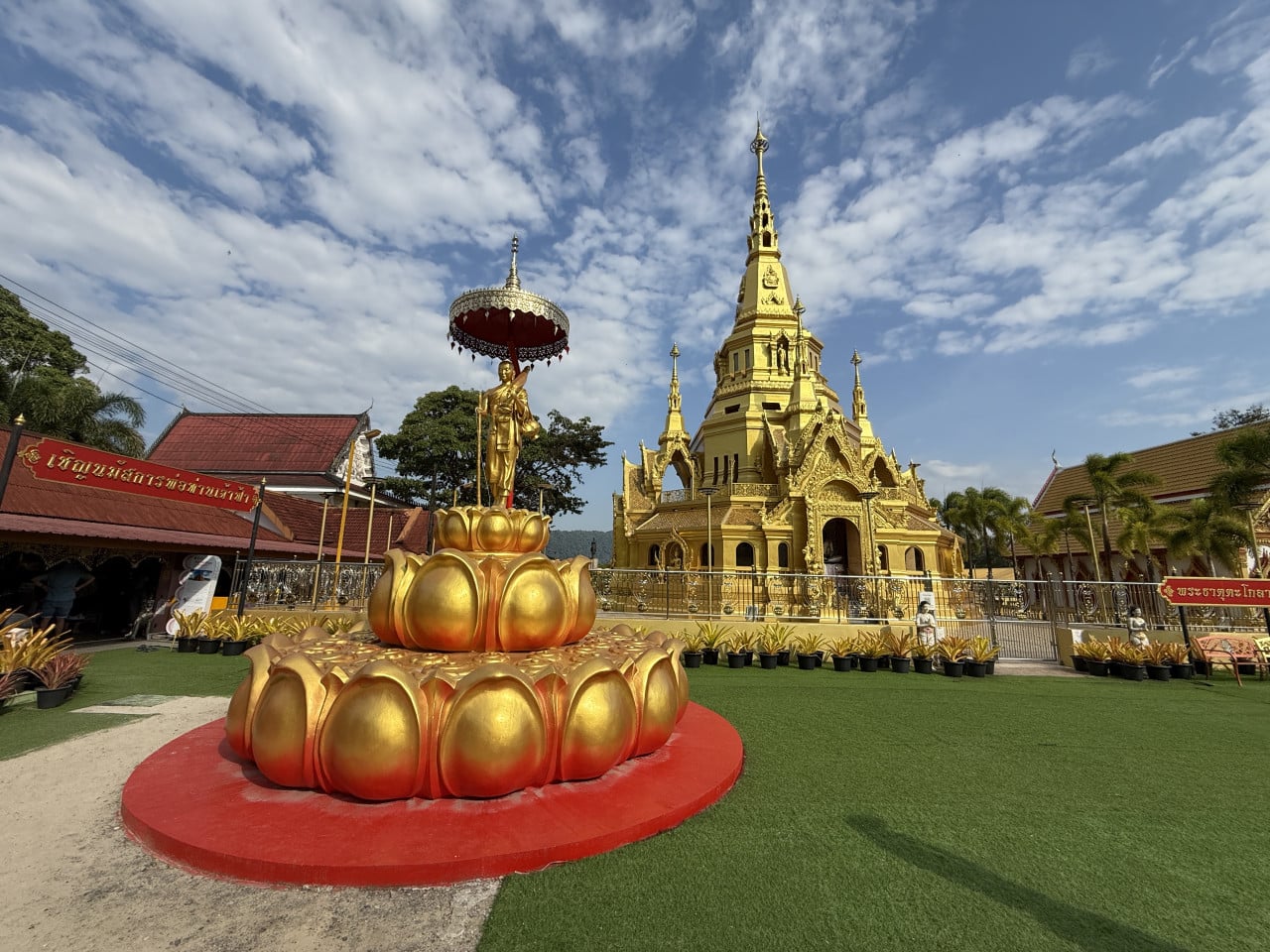
What Wat Kongka Phimuk is
Wat Kongka Phimuk is one of the oldest temples in the entire Takua Pa area. It was founded in 1762 during the Ayutthaya era, a period when Thailand was one of the most powerful empires in Southeast Asia. The temple was originally called simply Wat Kong Ka. The surrounding area used to be a floodplain that regularly suffered from flooding. The temple grounds were later modified and improved, and as part of this process, the name was changed to Wat Kongka Phimuk to better reflect the sacredness and importance of this place to the local community.
An important milestone came in 1996, when Thailand’s Fine Arts Department officially registered the temple as an archaeological monument. Inside the complex, you will find the so-called Ubosot—the main prayer hall—built in the southern Thai architectural style and beautifully restored to its full glory.
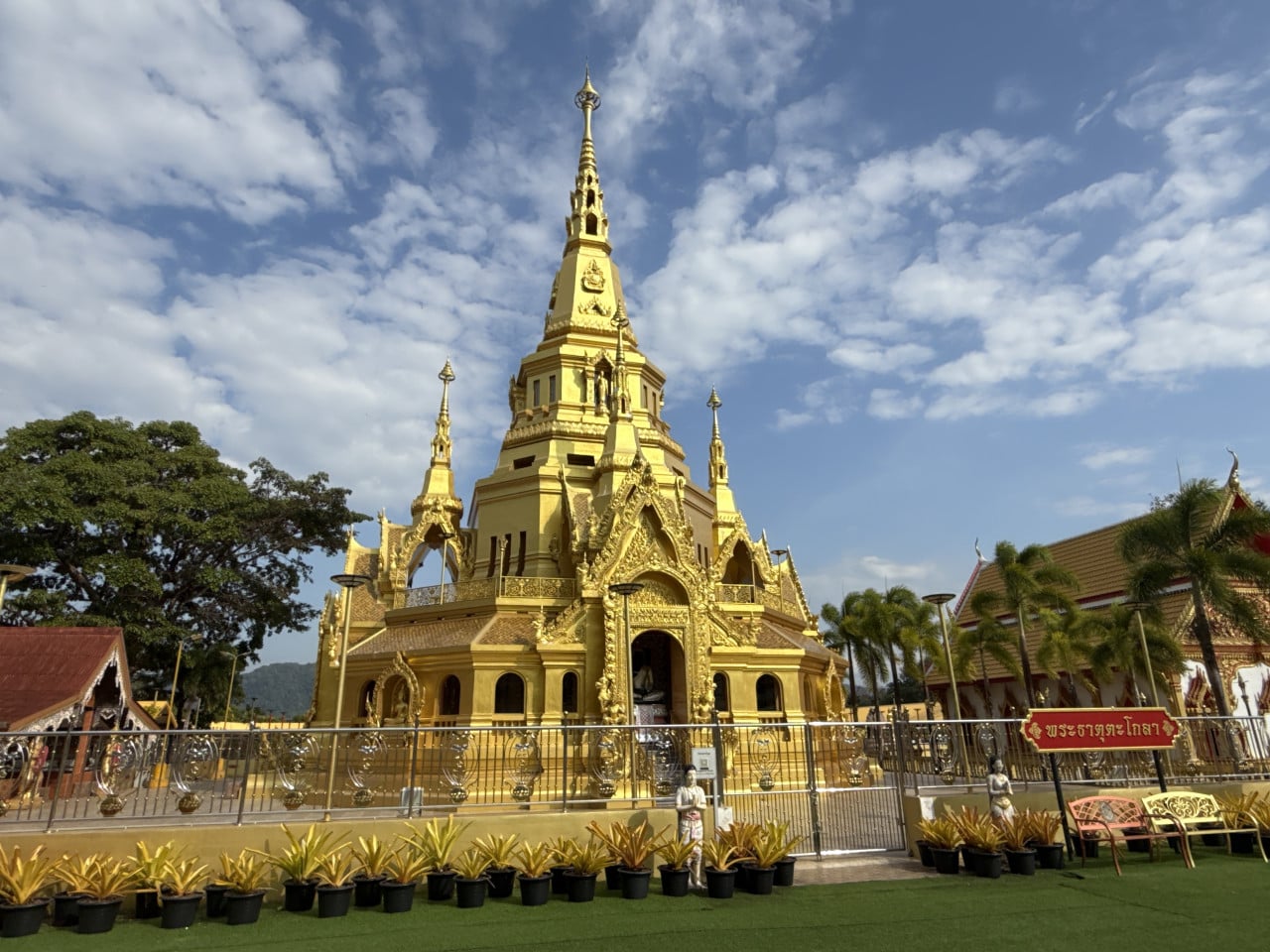
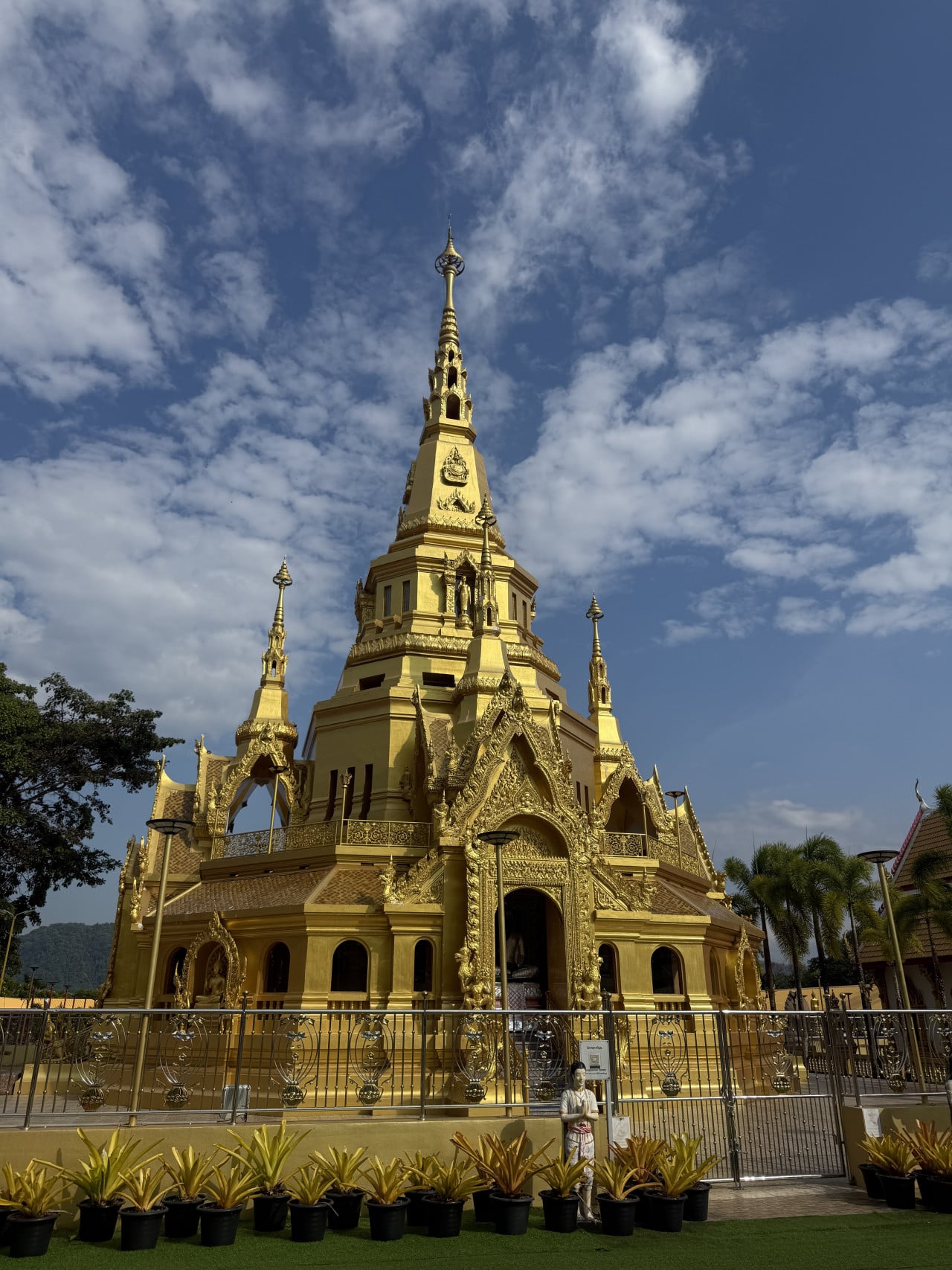
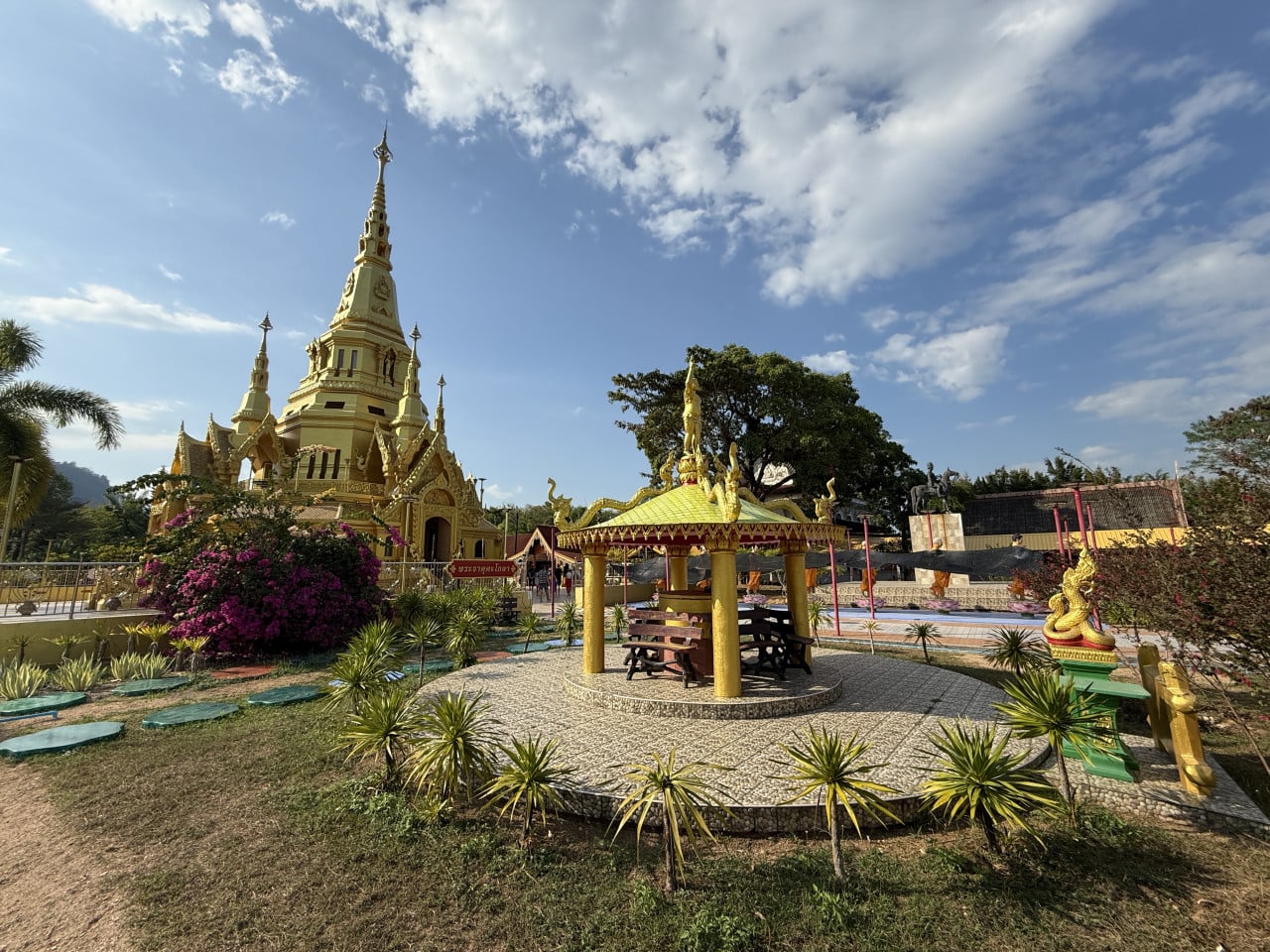
One of the most prominent landmarks in the entire complex is Phra That Takola—a stunning square-shaped golden pagoda. It was built in honor of the late King Rama IX and houses relics of the Buddha, meaning remains attributed to the Buddha himself, making it a place of extraordinary spiritual significance. Next to the pagoda is an ordination hall more than 100 years old, which houses an ancient sacred Buddha statue known locally as Pho Than Chaofa.
When it looks closed but actually isn’t
We arrived and, honestly, our first impression was that the temple was closed. There was no one around and no visible entrance. Eventually, however, we discovered that you enter the complex by going around the stalls where local women sold various souvenirs, religious objects, and trinkets. They immediately told us that the girls had to cover their knees—no shorts, only skirts or long trousers. This is standard in Thai temples, and the rule is enforced very strictly. They had fabric skirts available to borrow, so it was possible to dress appropriately right there.
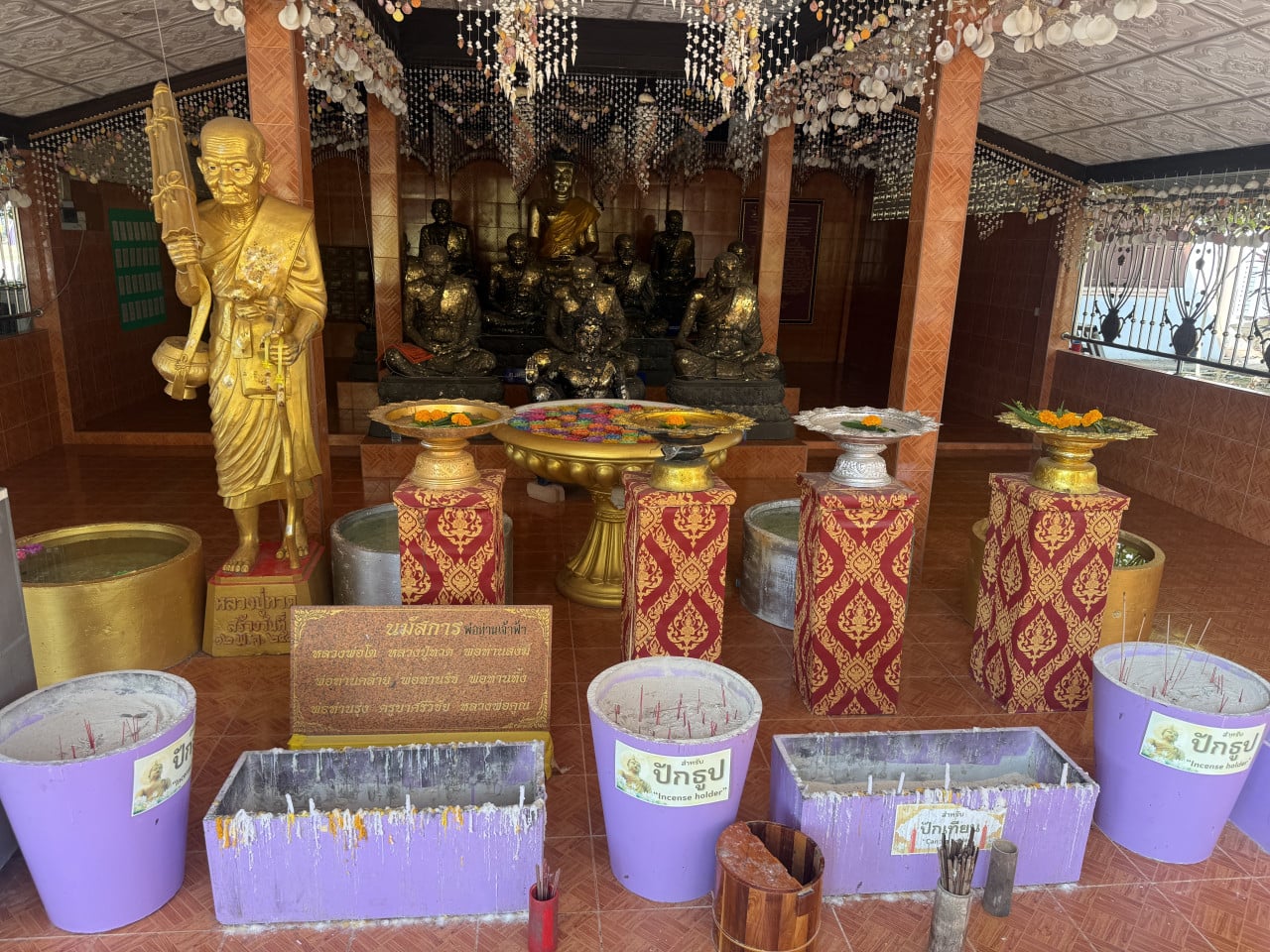
Entering past incense sticks and candles
When we entered the complex, the first thing they offered us was the chance to light incense sticks and candles. In the Buddhist tradition, this has deep symbolic meaning—the lighting of a candle represents the light of wisdom dispelling the darkness of ignorance. Incense sticks symbolize purity and devotion. Their fragrance rising upward is meant to remind us that good karma and virtuous deeds spread all around, just as a fragrance spreads through the air. The entire ritual is a way to pay respect to the Buddha while also reflecting on his teachings.
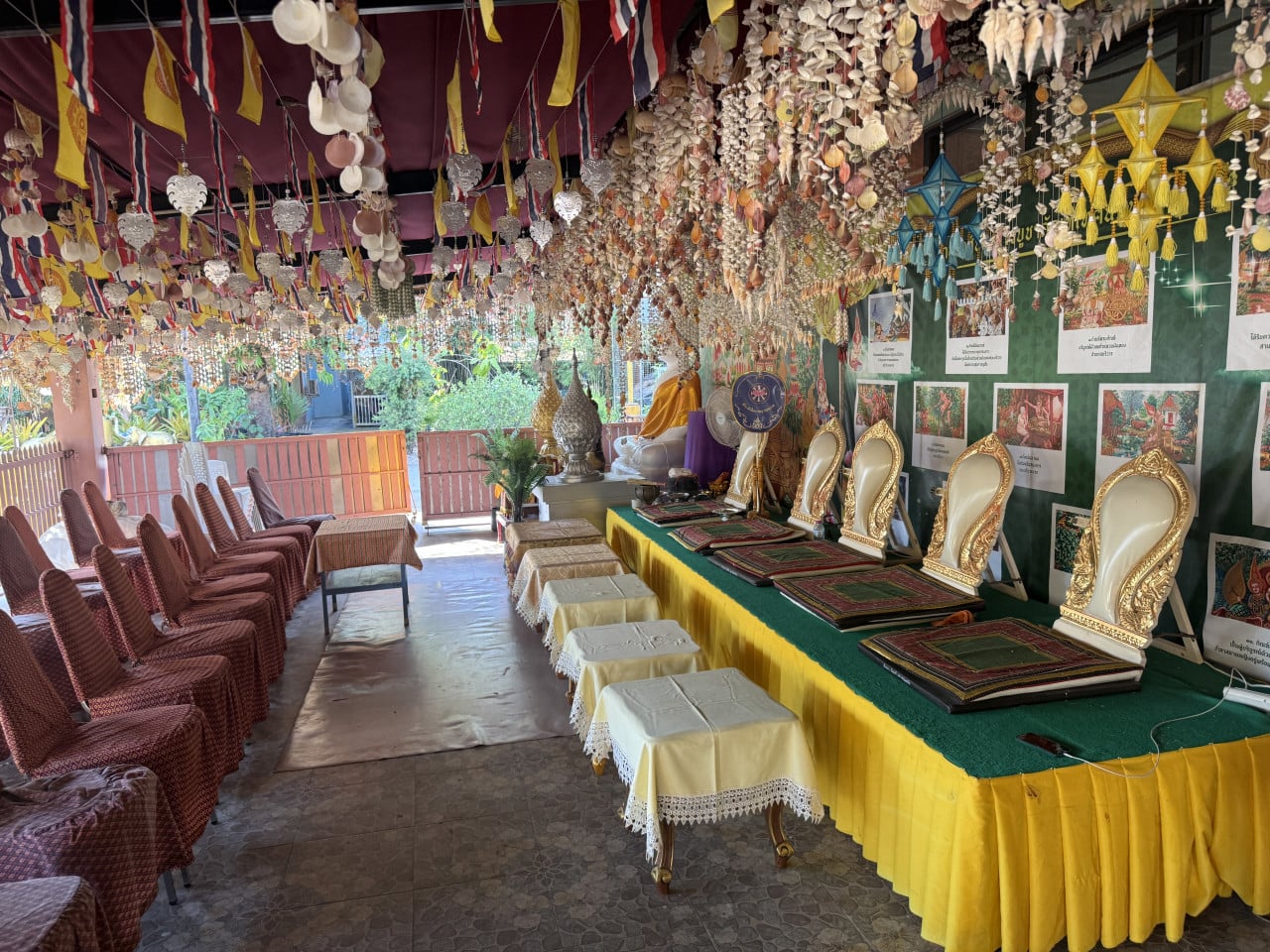
Next to the stalls was a kind of platform with armchairs, apparently intended for meditation or ceremonies—it looked somewhat like a place where monks receive visitors and give blessings. Shells and various decorations hung from the ceiling, while traditional Buddhist paintings adorned the walls.
A breathtaking golden temple
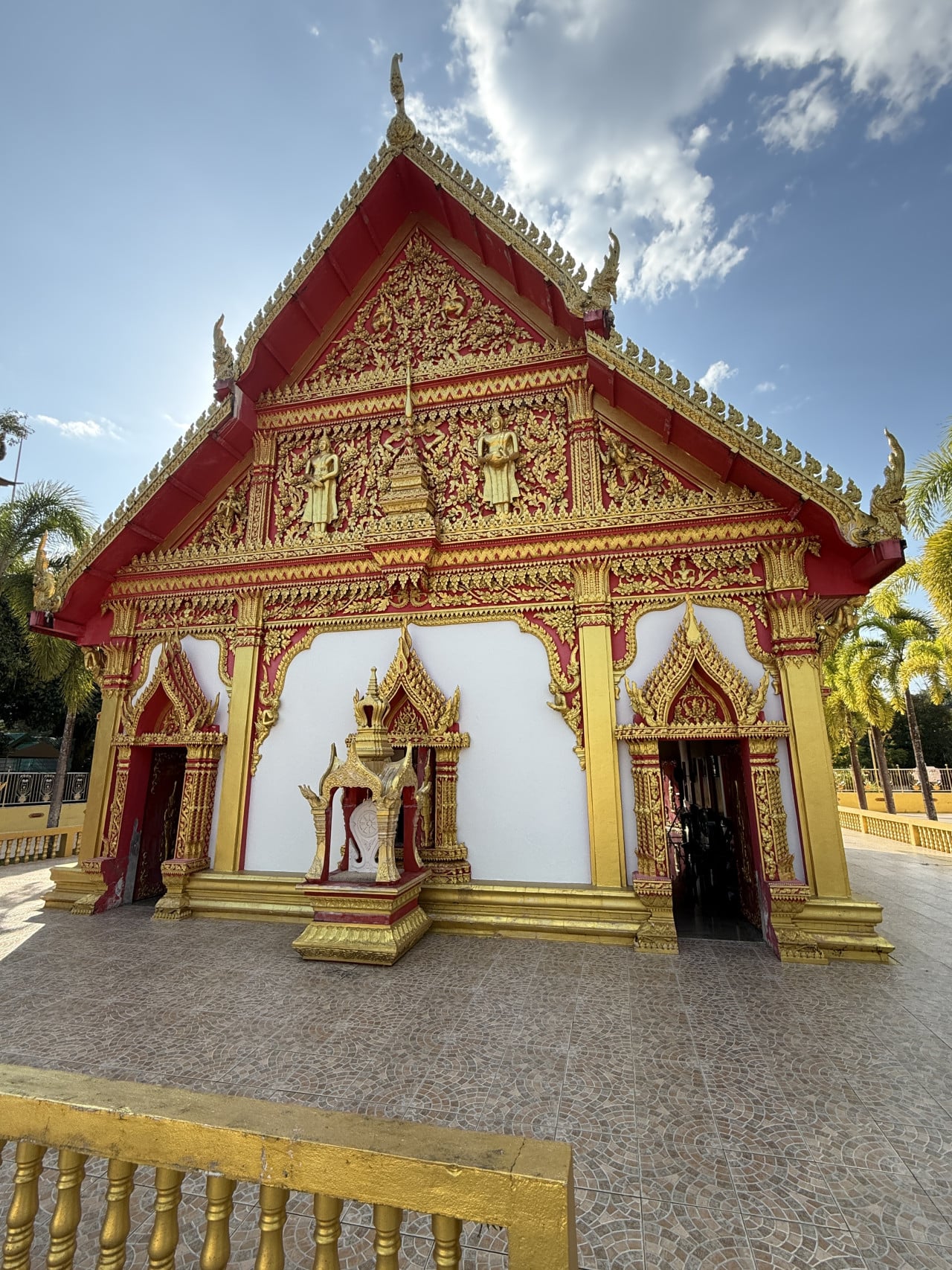
Then we entered the main temple complex. The temple was absolutely beautiful. It looked as though it were made entirely of gold—in reality, it is most likely covered with gold-colored paint or perhaps gold leaf applied to the surface, which is a common technique in Thai temples. Using solid gold on this scale would cost a fortune, but the resulting effect is just as stunning. Incidentally, some important Thai temples really do use genuine gold—such as the famous Wat Phra Kaew in Bangkok—so at the most sacred sites, including this one, it cannot be entirely ruled out that some elements may indeed be made of real gold.
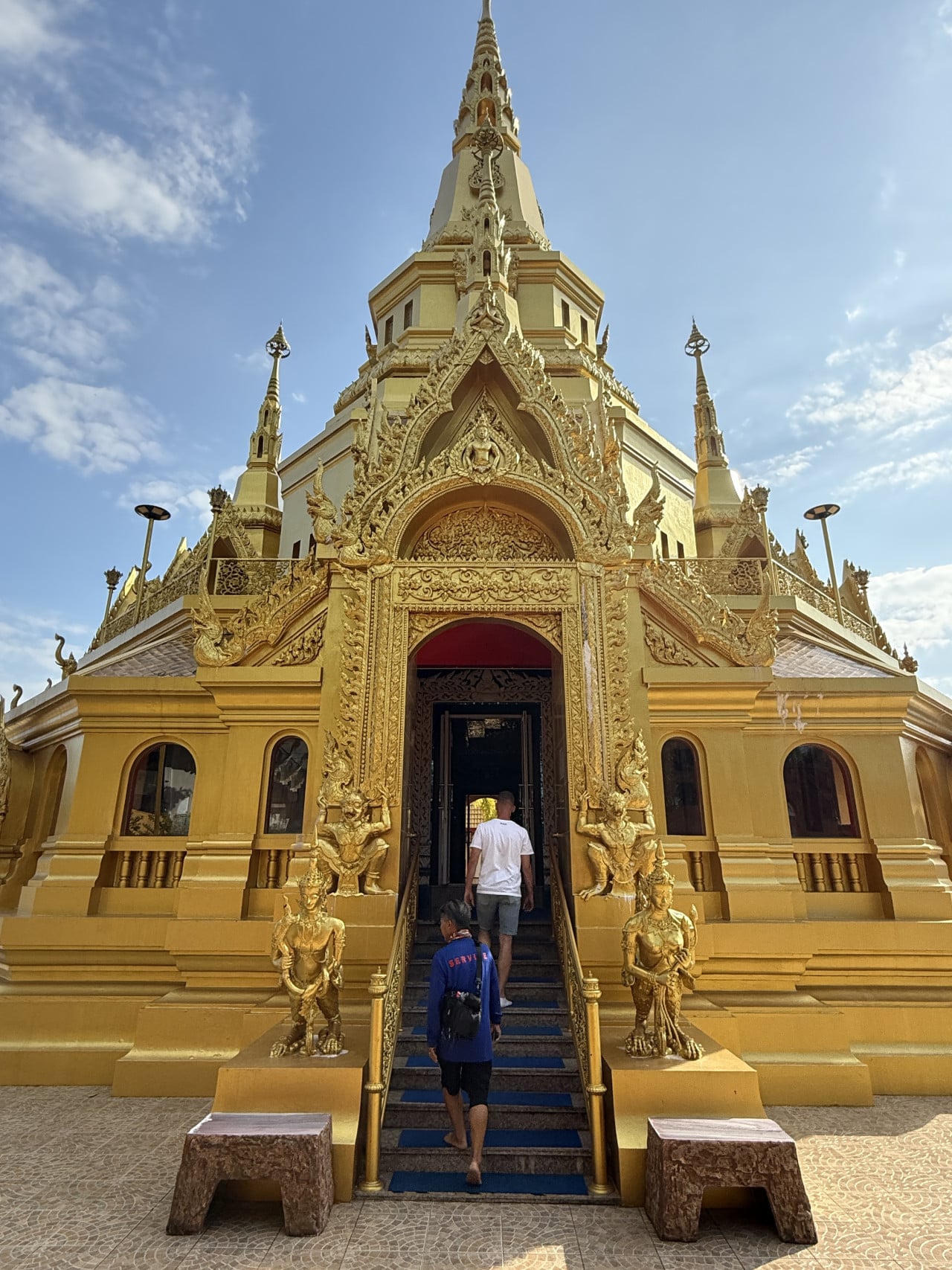
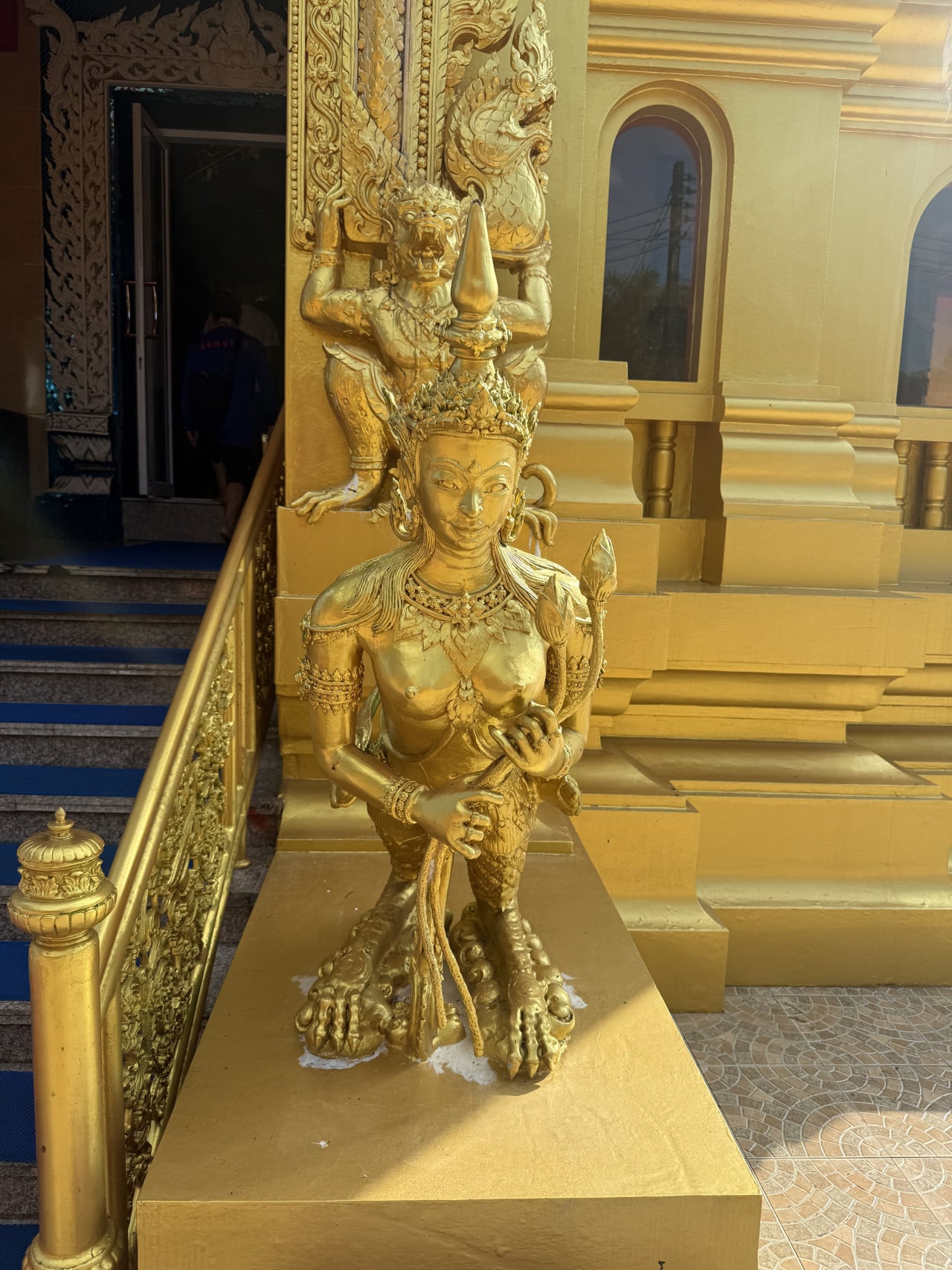
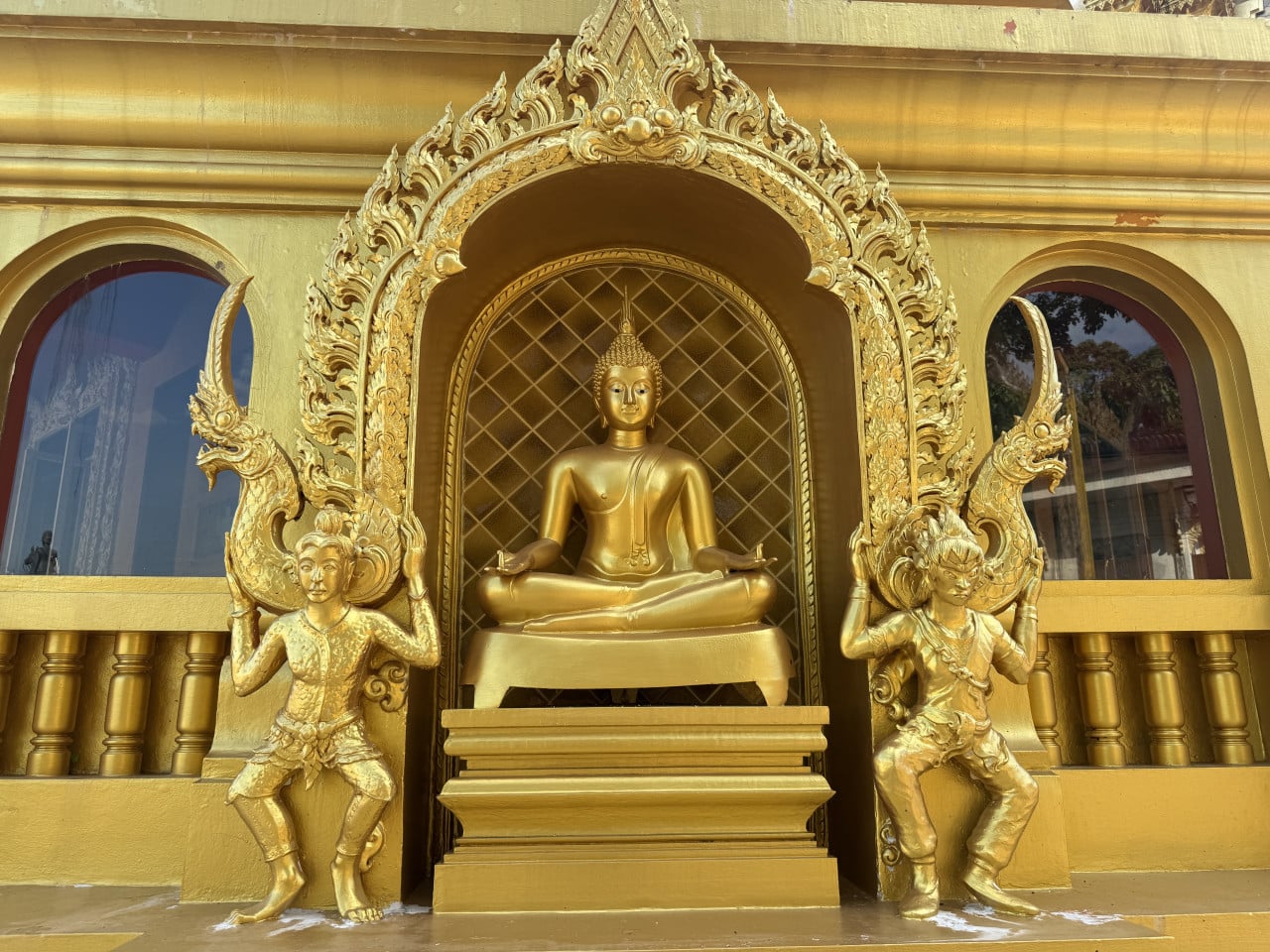
I climbed the stairs to the main temple. Guardians stood on either side of the entrance—gilded statues of mythical beings called yakshas, who protect sacred places from evil spirits in the Buddhist tradition. It was even more beautiful inside than outside.
What the Buddha statues mean
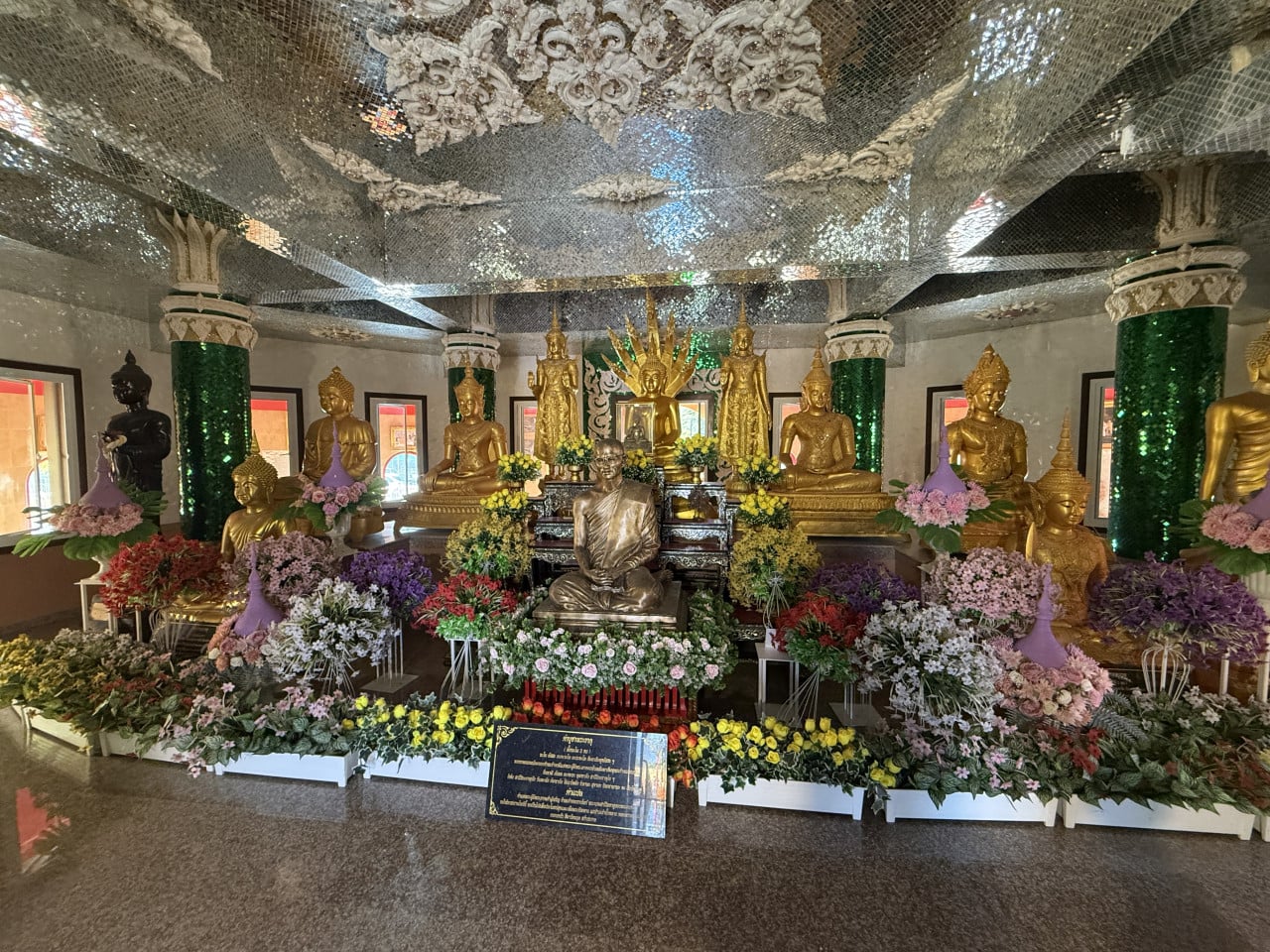
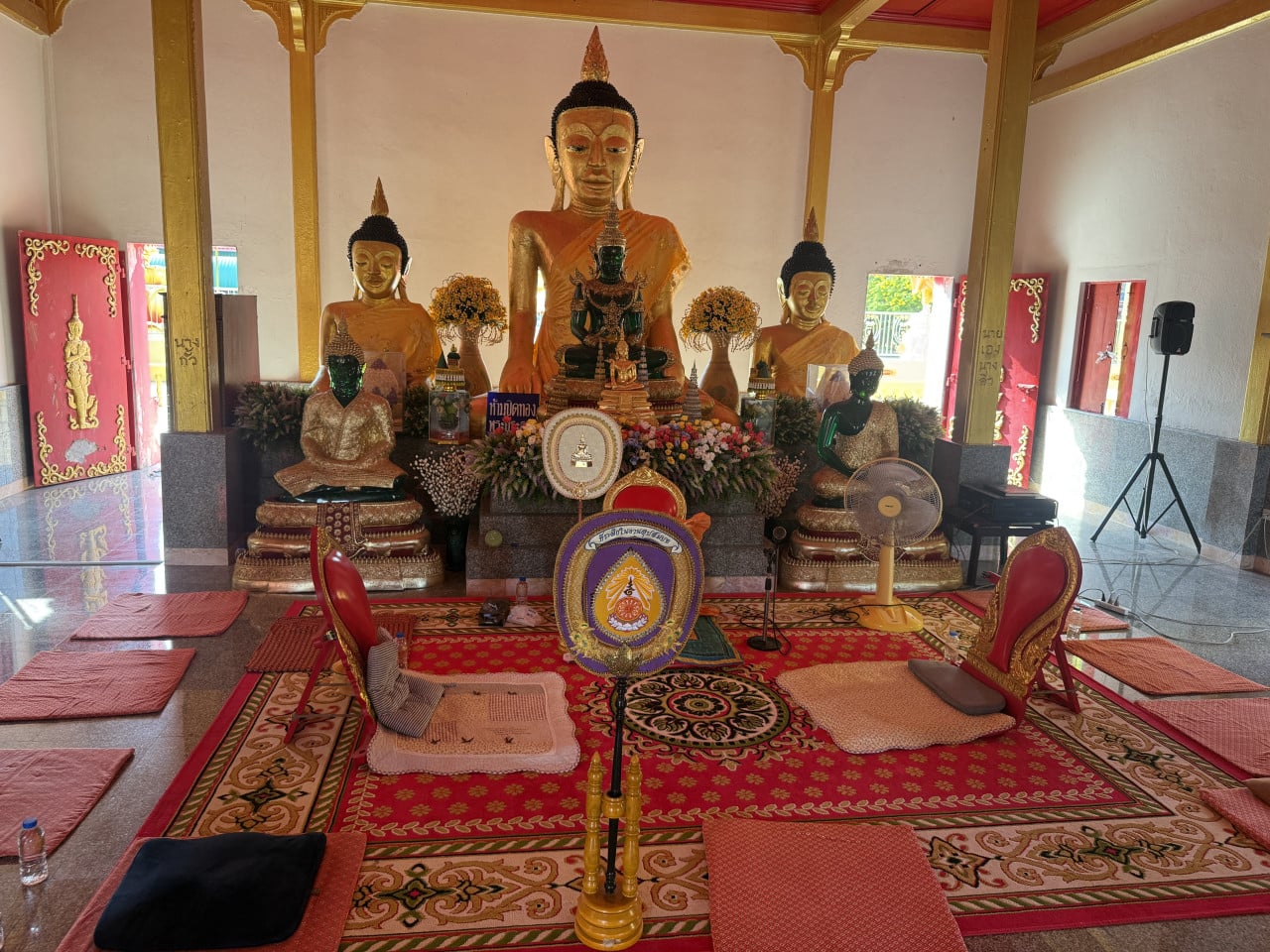
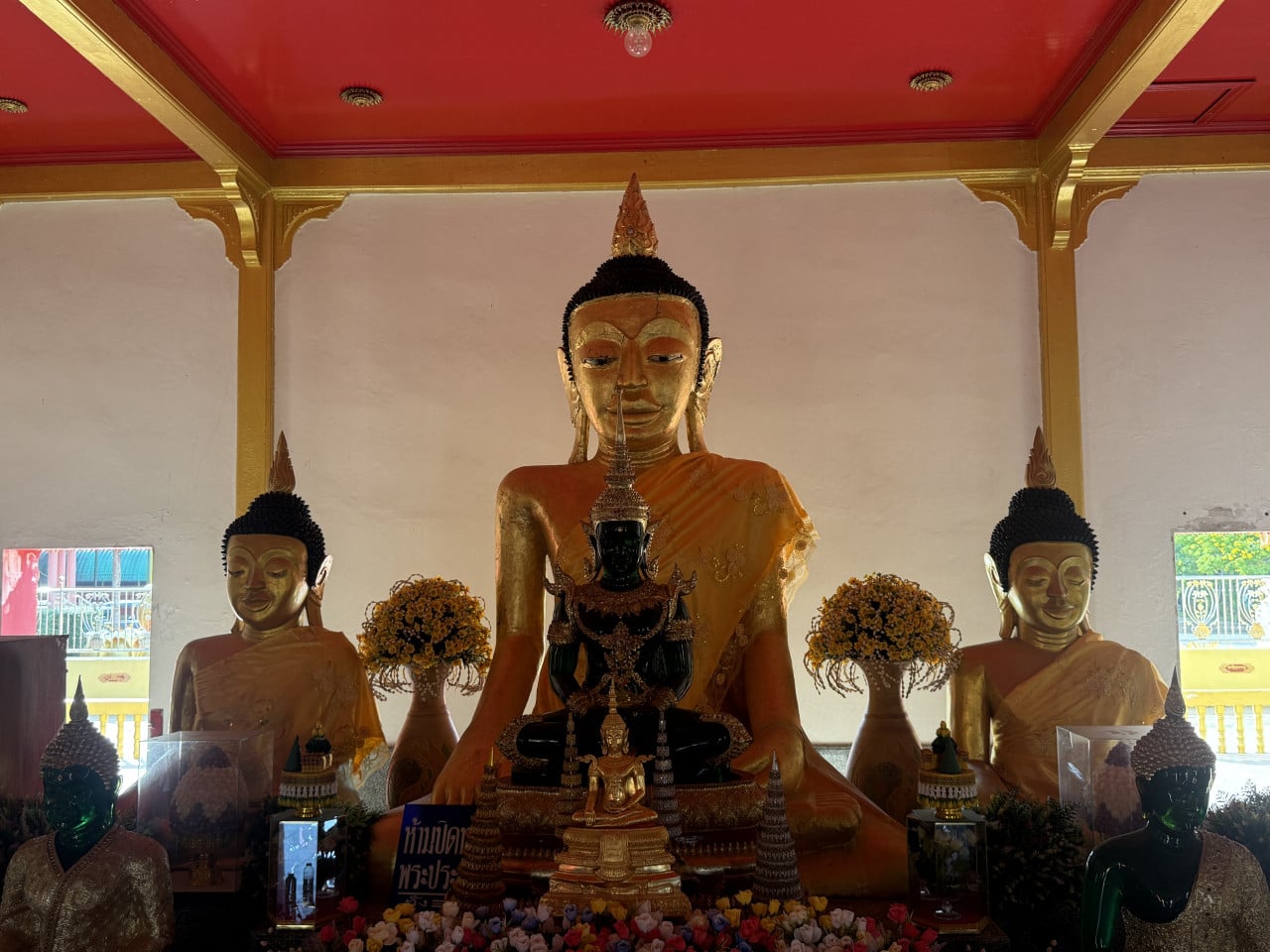
One room contained a beautiful arrangement of Buddha statues surrounded by flowers. A statue of the temple’s late abbot sat in the center, with golden Buddha statues in various poses around it. In the Buddhist tradition, each pose (known as a mudra) has a meaning:
Seated Buddha with hands resting in the lap—this is the so-called meditation pose (Dhyana mudra), symbolizing deep meditation and inner peace. The right hand resting palm-up in the left palm represents the unity of the mind.
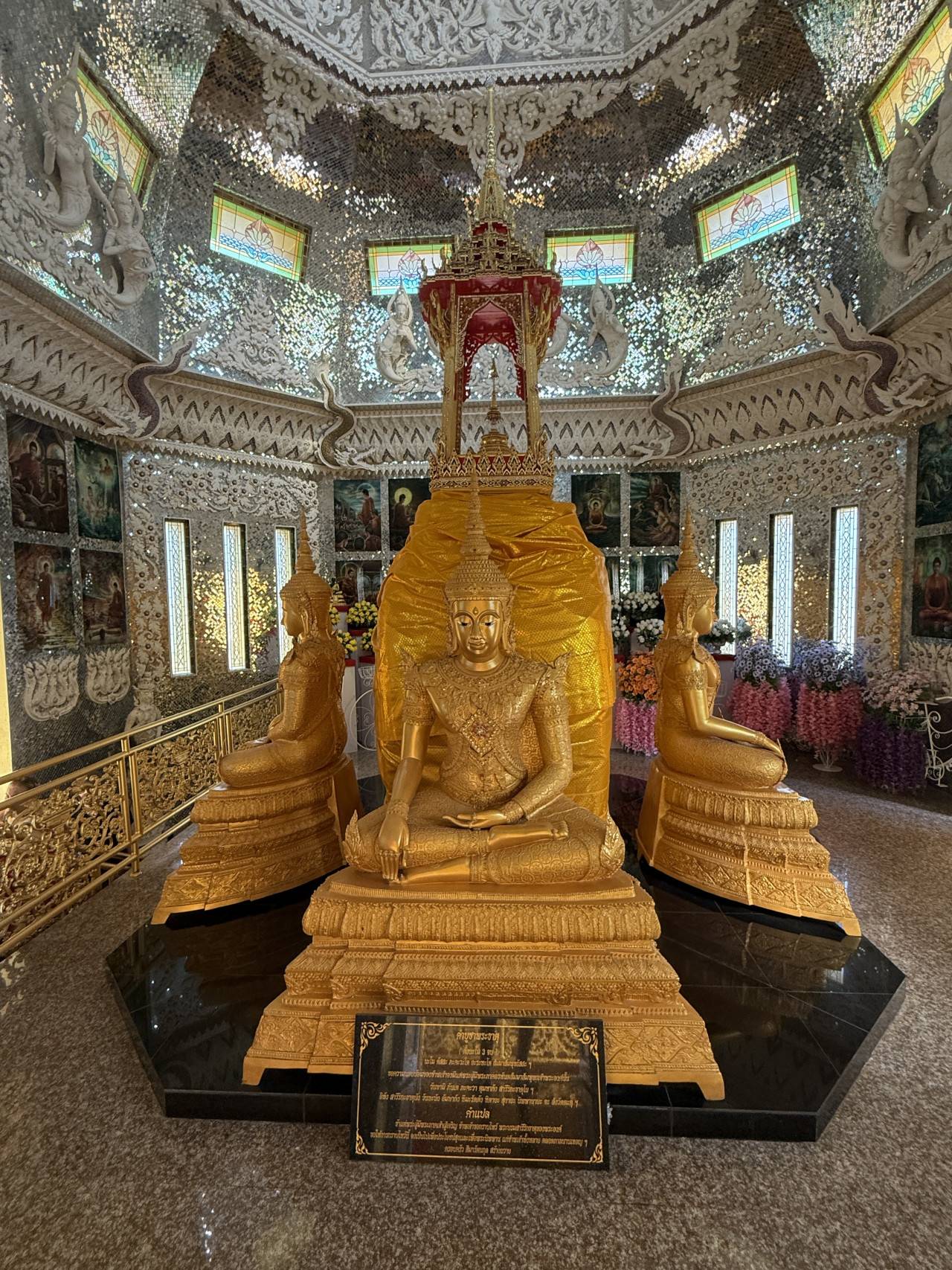
Buddha with one hand touching the ground—this is probably the best-known gesture, the Bhumisparsha mudra. It represents the moment when the Buddha attained enlightenment and “called upon the earth as witness” to his awakening.
Buddha with one hand raised, palm facing forward—a gesture of protection and fearlessness (Abhaya mudra), symbolizing courage and the dispelling of fear.
The ceiling of one of the rooms was covered with a glittering mirror mosaic—a typical feature of southern Thai temple architecture designed to create the impression of infinite space and a celestial realm. Buddhist paintings depicting scenes from the Buddha’s life were arranged between green columns decorated with more mirrors.
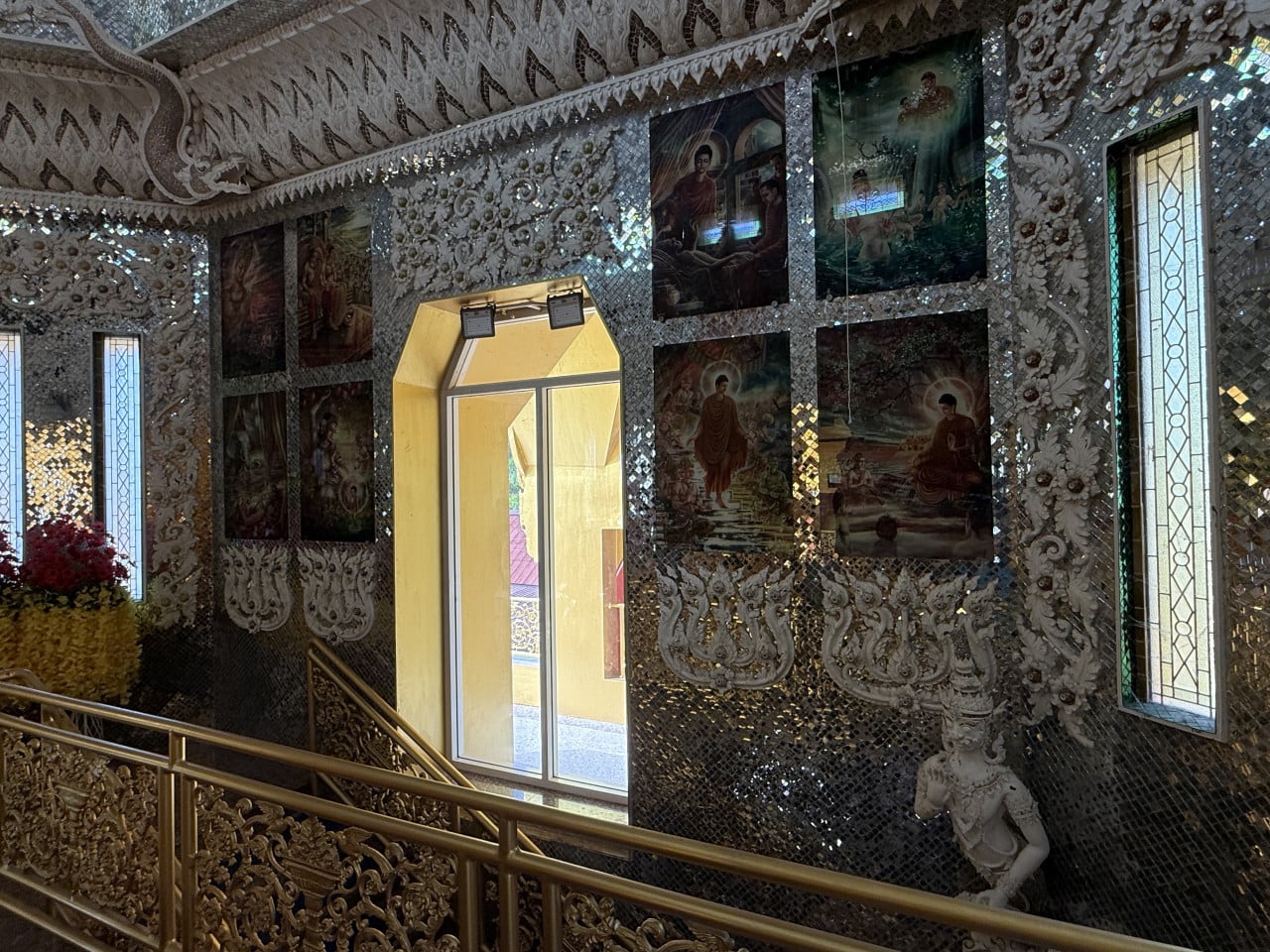
Views from the second floor and a courtyard full of statues
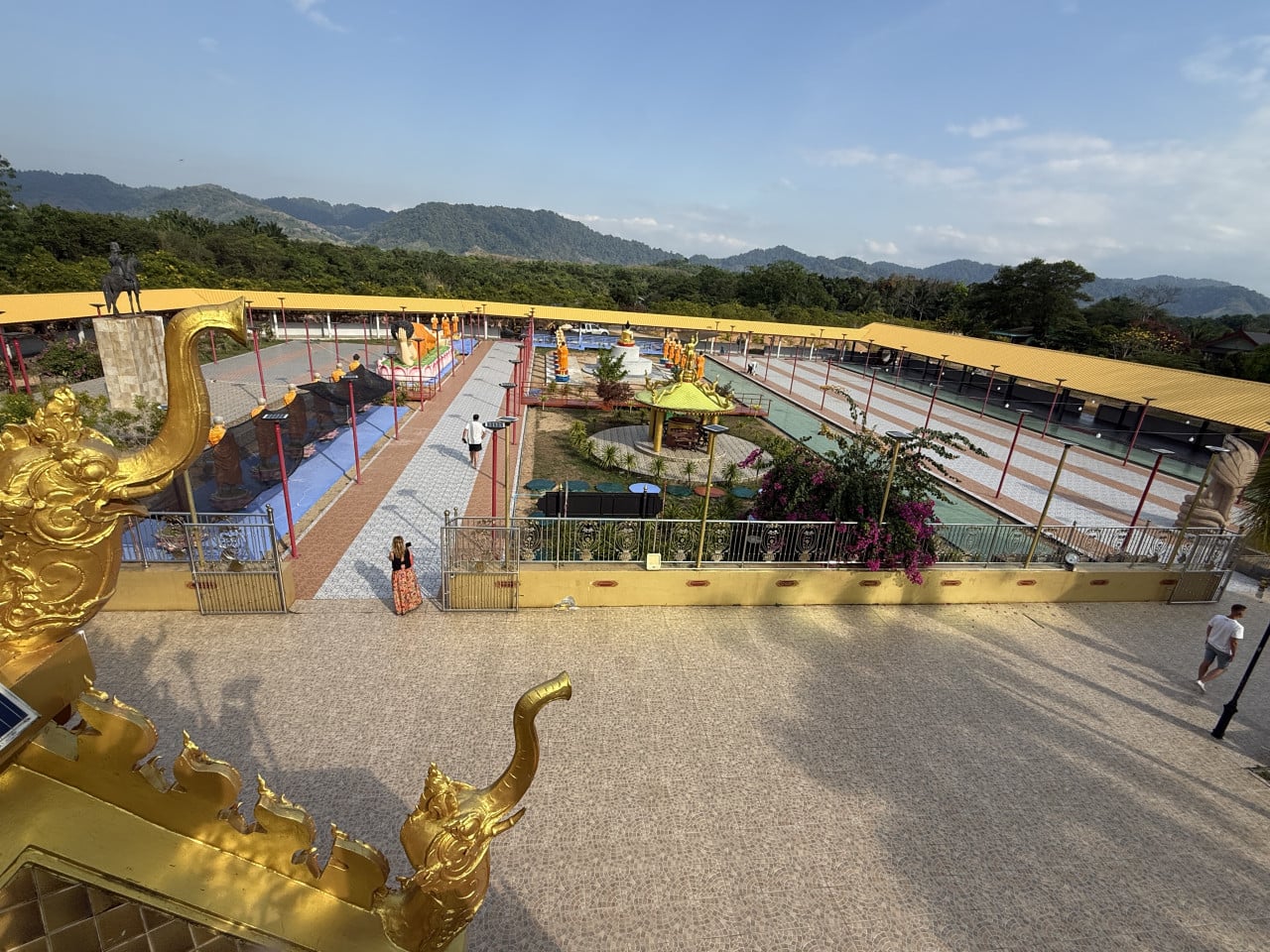
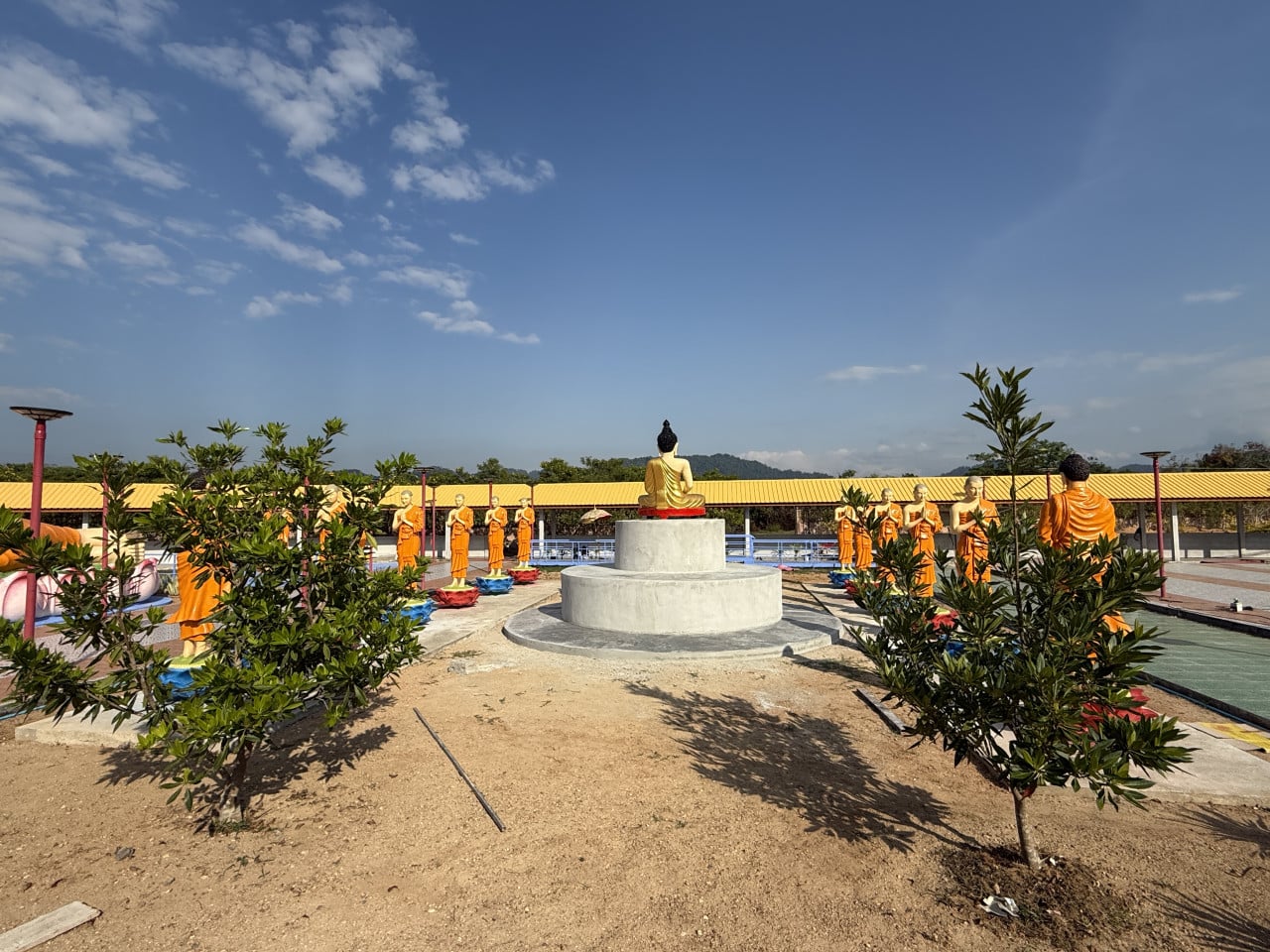
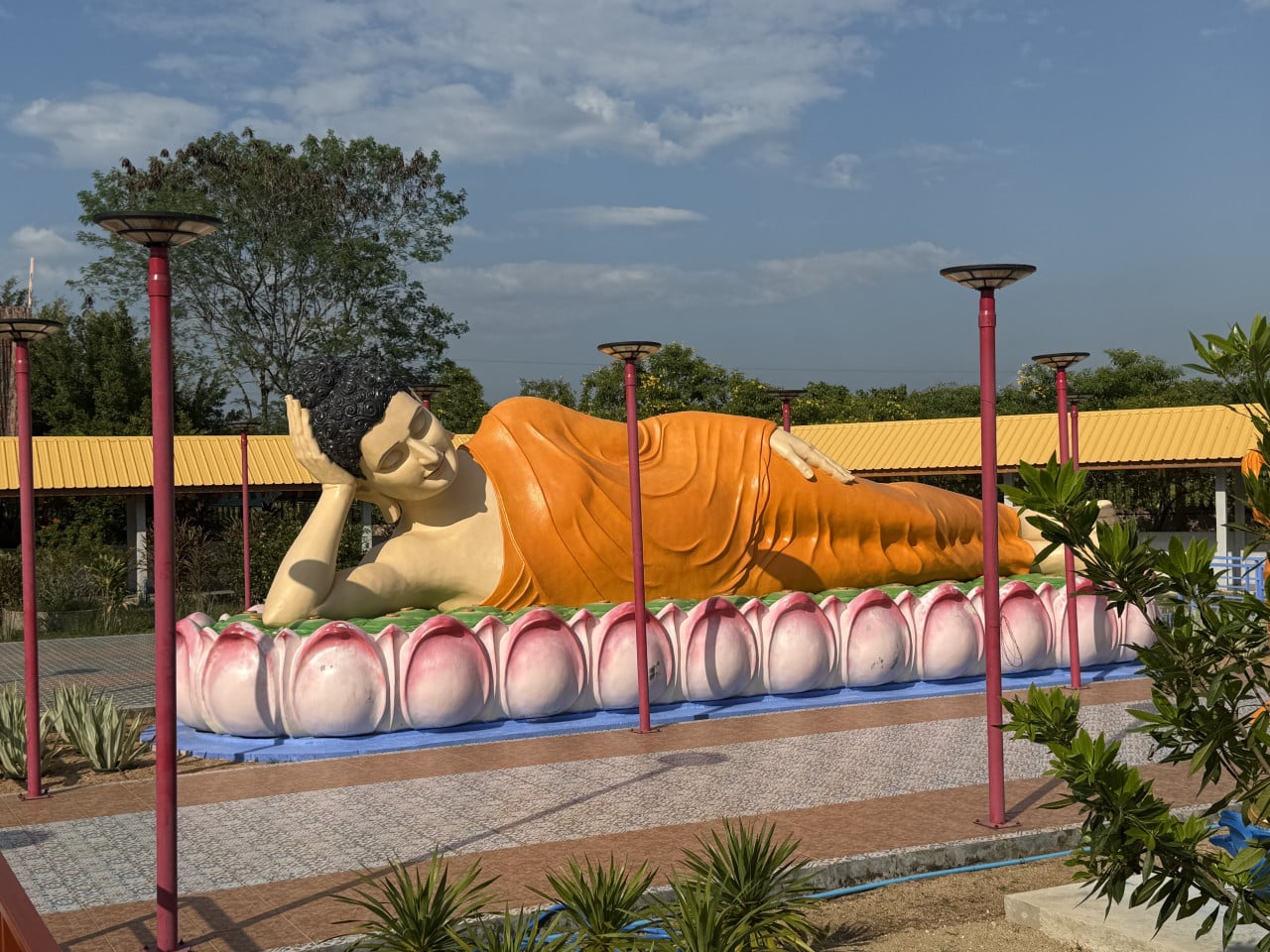
The upper floor of the temple offered an absolutely beautiful view of the entire courtyard. Below were broad walkways lined with more statues—including a large statue of the reclining Buddha.
The Reclining Buddha is one of the most iconic depictions in all of Buddhism. It represents the Buddha in his final moments on earth, just before entering parinirvana—the ultimate liberation from the cycle of birth and death. The Buddha lies on his right side, supporting his head with one hand, his facial expression completely calm and serene. He is not sleeping—this is spiritual rest, a symbol of complete detachment from the material world. The statue here at Kongka Phimuk rested on a pedestal of lotus flowers, another powerful Buddhist symbol of purity and enlightenment.
The courtyard also featured large golden statues of roosters, an elephant relief, and other animal motifs—all references to Thai folk tales and Buddhist cosmology, where animals often symbolize different virtues.
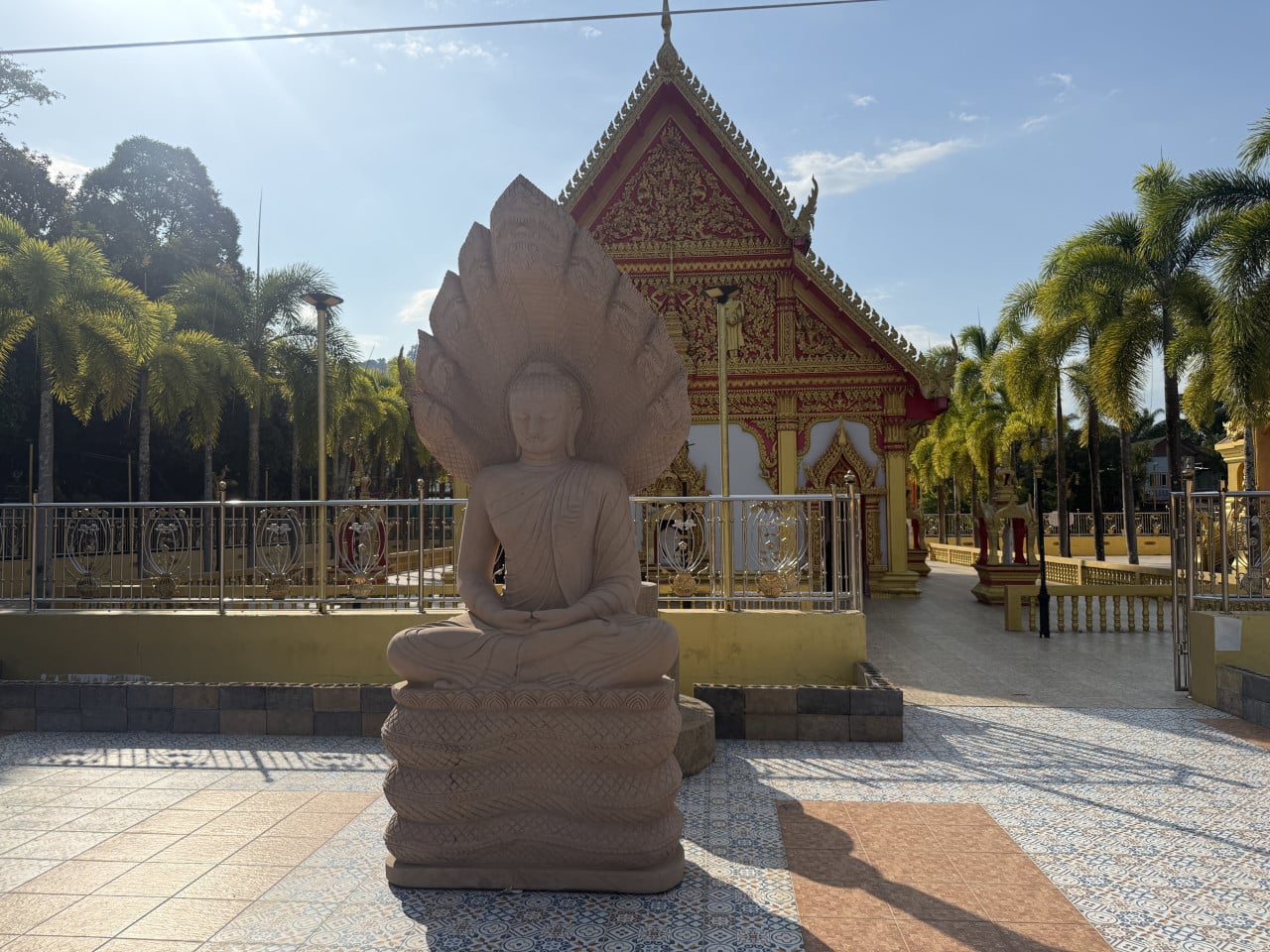
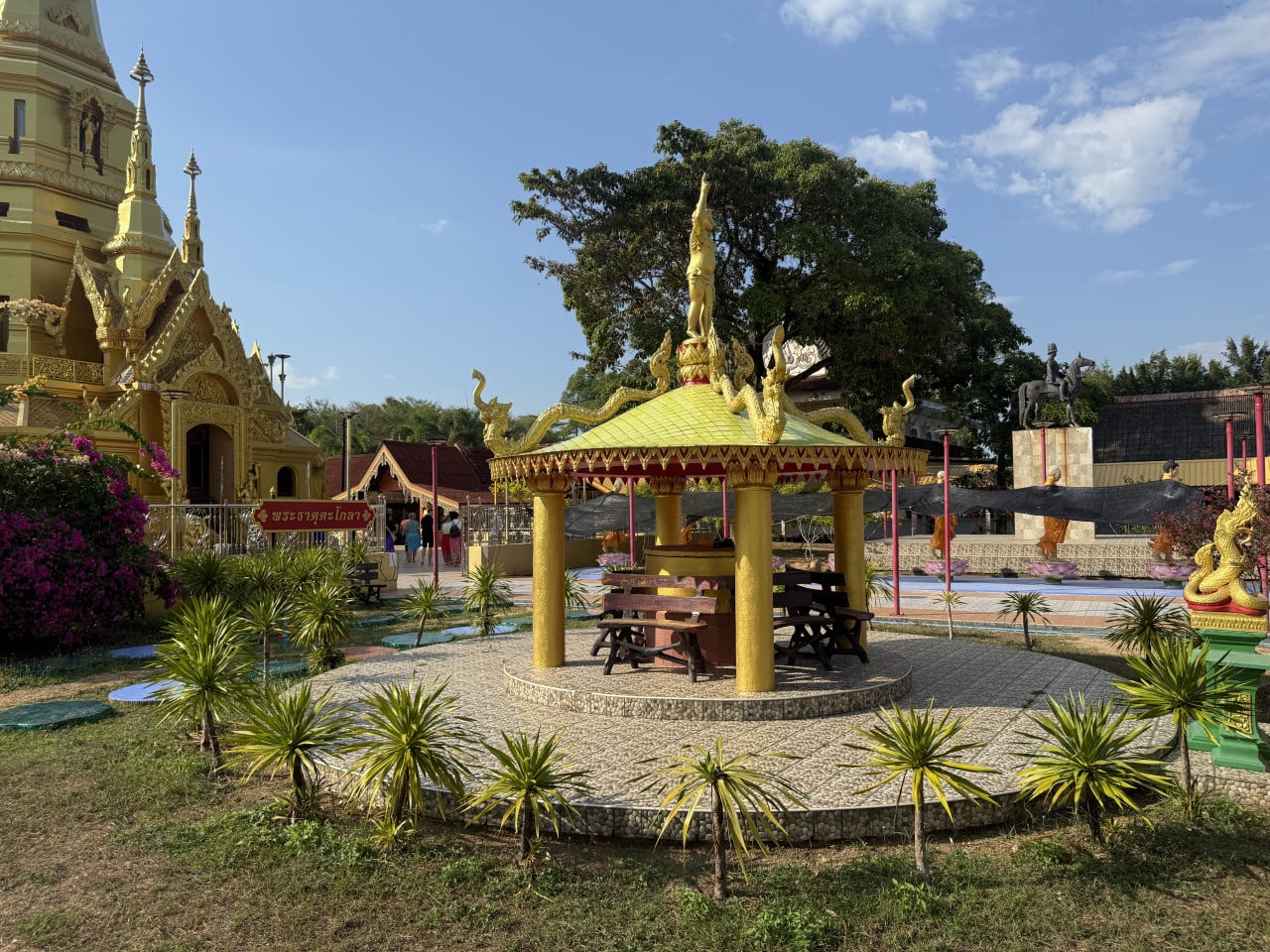
Monk ordination—a ceremony we witnessed in person
Some kind of ceremony was taking place inside the complex. As we discovered, it was most likely the ordination of new monks—one of the most important rituals in Thai Buddhism.
In Thailand, every man is expected to enter a monastery at least once in his life and spend some time as a monk. This is called Buat Phra, and most Thais consider it an essential rite of passage. It is not a lifelong commitment—on the contrary, temporary ordination is extremely common and can last anywhere from a few days to three months (typically during the Buddhist Lent in the rainy season, known as Phansa). Some men remain monks for longer, but the vast majority eventually return to ordinary life.
Thais say that a man who has not yet been ordained is “immature” and only becomes a fully-fledged adult after ordination. A man who has been a monk receives the title “thit.” It is a major event for the family because it is believed that a son’s ordination brings enormous merit (good karma) to the entire family, especially his parents—and his mother in particular.
The ceremony itself has several stages. Before ordination, the future monk becomes what is known as a “Nak” (from the word Naga—a mythical serpent that, according to legend, wanted to become a monk but could not because it was a serpent, so it asked the Buddha to have every candidate for monkhood called by its name). The Nak has his head and eyebrows shaved, symbolizing detachment from the vanities of worldly life. He is then ceremonially carried in a procession to the temple, where he puts on saffron robes and vows before an assembly of monks to observe the 227 rules of the monastic order (Patimokkha).
Right next to the ongoing ceremony, there was a terrible racket coming from some adjacent restaurant or “pub”—I’m not exactly sure—because ordination in Thailand is also a major celebration. The new monk’s family holds a feast for the entire community, loud music plays, and people eat and drink—simply the Thai way, where the sacred mingles with joyful revelry.
Barefoot the entire time
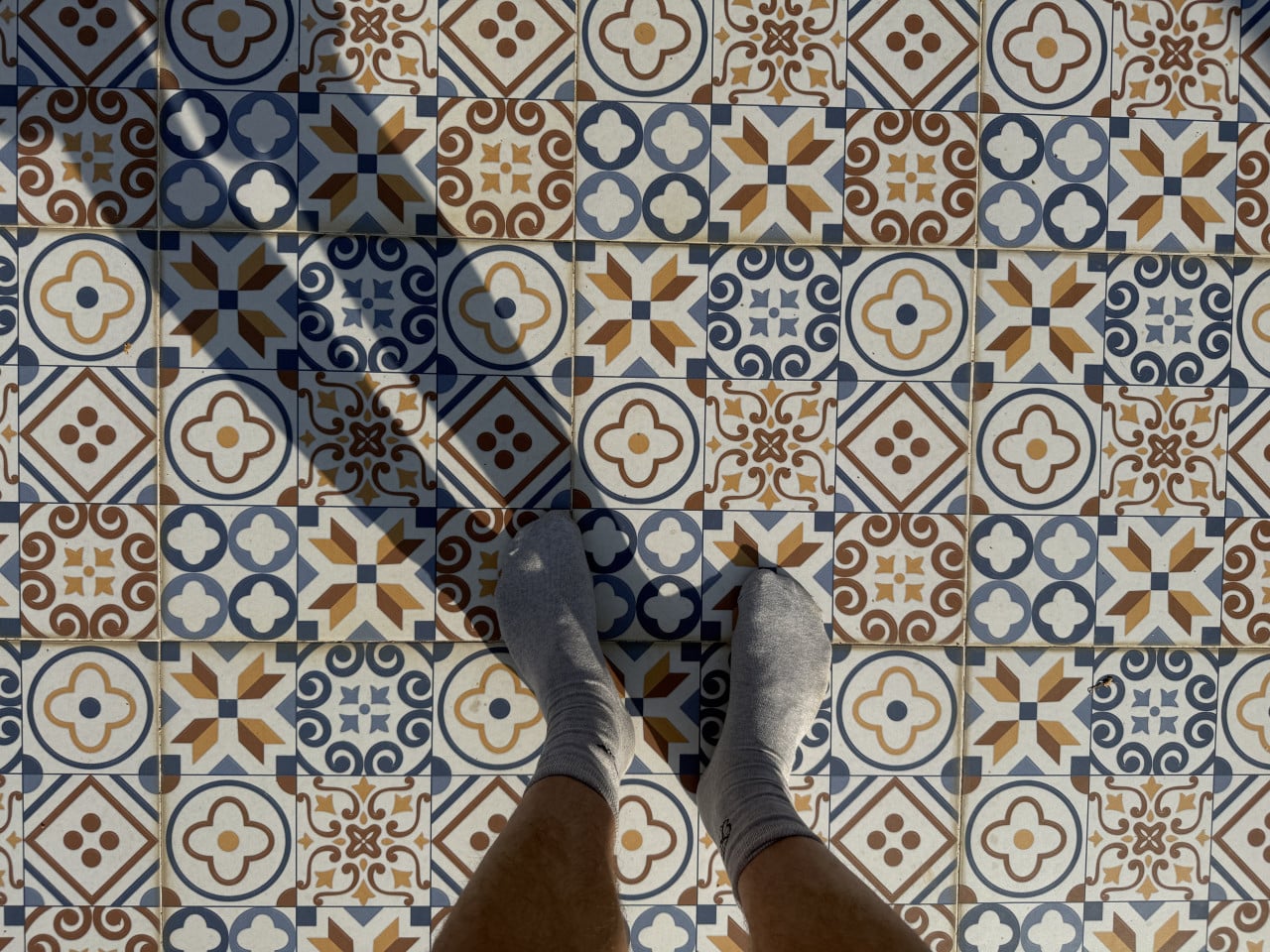
We walked around the complex barefoot the entire time—in Thai temples, you are required to remove your shoes before entering any sacred space. Shoes, hats, and sunglasses must all come off. It is a sign of respect and humility before the Buddha.
My personal view of Buddhism
Personally, Buddhism is one of the few religions that genuinely makes sense to me and resonates with me. I won’t go into too much detail, but when I look at the history of different religions, the Crusades, religious wars, and everything surrounding them, it often seems to me like nothing more than a pursuit of power and money.
Buddhism, however, seems different to me. It comes from the heart, from meditation, from the search for inner peace—that “peace of mind.” No conquest, no conversion at the point of a sword. And here in this temple, surrounded by Thai nature with views of the mountains, I felt that these people were sincere. That it was not a pretense or a performance for tourists. Just a quiet, beautiful place where you can pause for a moment and reflect.
Practical information
-
Name: Wat Kongka Phimuk (วัดคงคาภิมุข), also known as Wat Kongka or Kongka Temple
-
Location: Takua Pa, Phang Nga Province, approximately a 1-hour drive from Khao Lak
-
Admission: Free (voluntary donations welcome)
-
Dress code: Knees and shoulders must be covered, and shoes must be removed. Skirts are available to borrow on-site
-
Tip: The temple tends to receive fewer tourists, so you can enjoy it in peace. If you are lucky, you may come across a live ceremony—we witnessed one, and it was an unforgettable experience
-
Interesting fact: The temple is part of the popular “Temple + Tsunami Museum + Old Town” excursion, which can be booked from Khao Lak and typically runs on Sundays