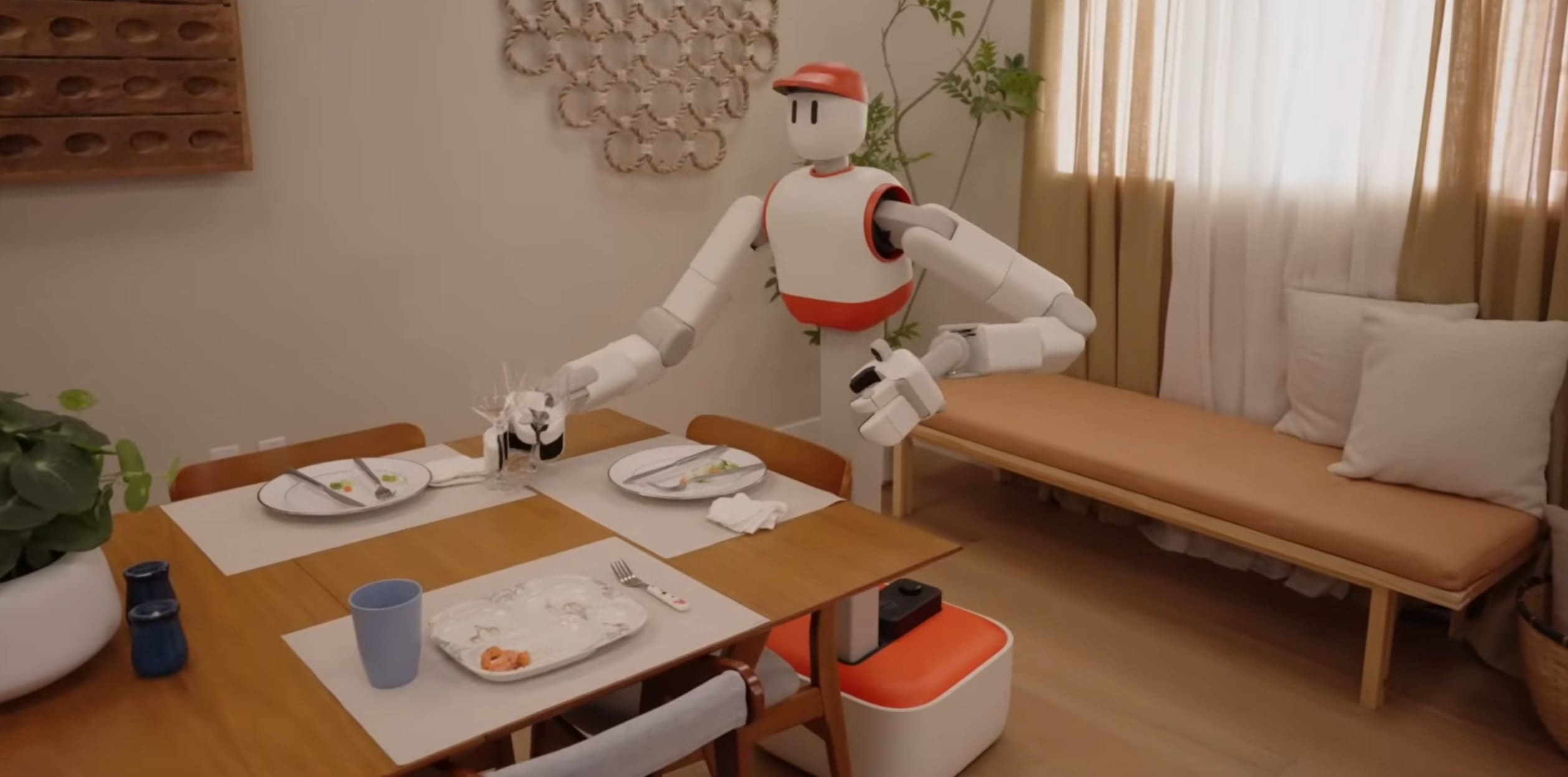
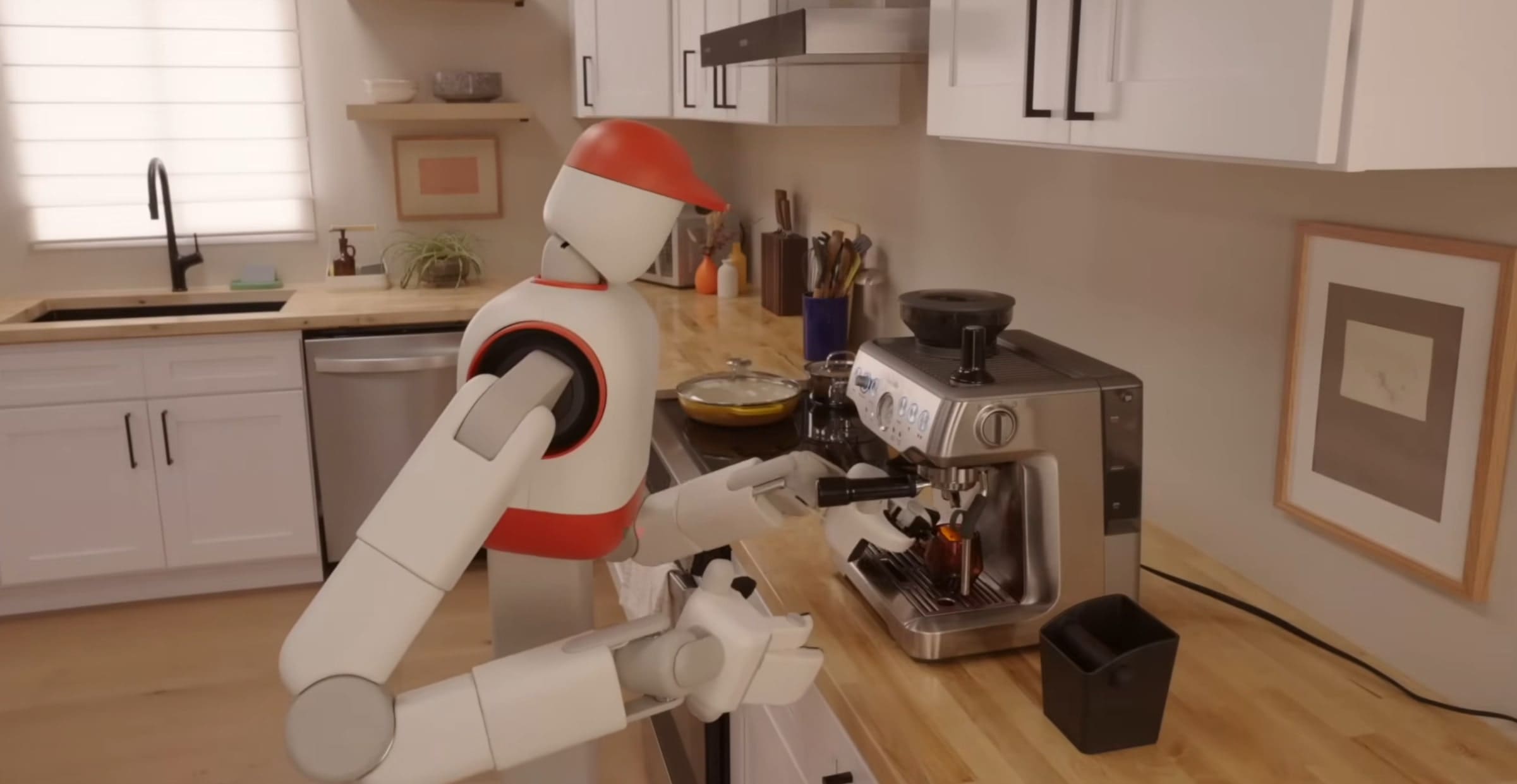
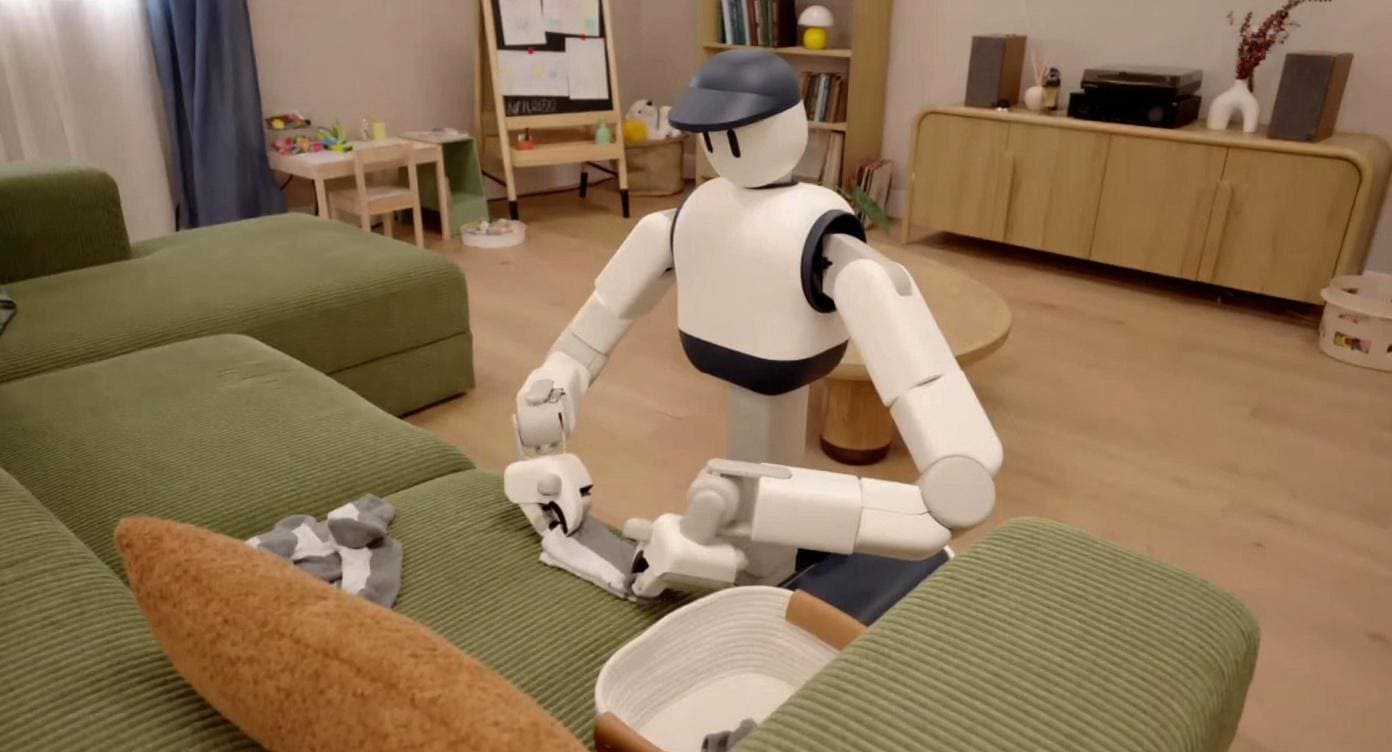
Imagine a robot that clears the table after dinner, loads the dishwasher, and even folds laundry—all learned from watching how real people do it in their homes. This is Memo, a new home robot from Sunday Robotics. The company emerged from stealth on November 19 with an investment of CZK 805 million from Benchmark and Conviction. Memo is not a humanoid figure, but a mobile machine on wheels with two arms that focuses on everyday household tasks: clearing the table, loading the dishwasher, folding laundry, organizing shoes, or making espresso.
What makes Memo special? Instead of expensive and slow training in which people remotely control robotic arms, Sunday Robotics created special gloves called Skill Capture Gloves. These gloves cost only CZK 4,600, compared with CZK 460,000 for remote-control equipment—a hundredfold difference in price. The gloves have the same shape and sensors as Memo's hands, so when a person wears them while doing household chores, the robot learns directly from those movements.
How Memo learns from real life
Sunday Robotics distributed more than 2,000 of these gloves to over 500 households. The people who use them are called "Memory Developers" and collect data from everyday situations. This has allowed the company to gather more than 10 million episodes of real family routines. Founder Tony Zhao explains that this approach makes it possible to quickly obtain diverse data because the gloves can be used anywhere, without having to transport robots.
The problem is that people have different heights, arm lengths, and body proportions. To make the glove data work for the robot, Sunday developed software called Skill Transform. It converts human movements into robot actions with a success rate of over 90%. The result? If a person can do it with the gloves, Memo can do it too. The team was often surprised by everything they discovered in the data—from cats in dishwashers to piles of plums on tables.
Memo is trained using the ACT-1 model, which is based exclusively on data from the gloves, without any traditional robotics data. This model combines object manipulation and spatial navigation in a single system. The robot receives a 3D map of a new home and figures out where to go and what to do on its own. This is a major advance because most robots can either pick up objects or move around, but not both at the same time.
What Memo is really good at
Memo excels at tasks that are a nightmare for roboticists, such as cleaning up after dinner. It picks up plates, throws leftovers in the trash, and puts dishes in the dishwasher—all involving 33 unique and 68 total interactions with 21 different objects. During a single cleanup, it travels more than 40 meters around the kitchen and handles fragile, transparent, or deformable objects. Take wine glasses, for example: too much pressure would break them, as would loading them incorrectly. Sunday broke many glasses during development. Nevertheless, no damage occurred during 20 live demonstrations.
What else can it do? It folds socks and clothes, organizes shoes, and makes espresso with foam. It also works in unfamiliar spaces—it was successfully tested in 6 previously unseen Airbnb apartments. Memo moves more slowly, at about 50% of a person's speed, has a soft silicone covering, and colorful visors with a camera providing a 360-degree view. One observer noticed how the robot held two glasses in one hand while opening the dishwasher door with the back of its wrist.
The team and what comes next for Memo
Sunday Robotics was founded by Tony Zhao, its CEO, and Cheng Chi, its CTO, both Stanford graduates who worked on projects such as ALOHA, Diffusion Policy, and UMI. They were joined by engineers from Tesla Autopilot, including Nishant Desai, Nadeesha Amarasinghe, and Perry Jia. Young researcher Alper Canberk, still a student, trained all of the company's models and contributed to everything from machine learning to circuit board design.
Development took more than a year for the infrastructure, followed by only three months for the autonomous features shown in the videos. In December 2024, Memo had just one arm and organized shoes. By October 2025, it was folding socks, handling glassware, and making coffee. The company plans to reduce manufacturing costs by at least 50% and send Memo to 50 families for beta testing in late 2026, with wider sales planned for 2027–2028.
Sunday is betting on real-world data rather than simulations such as CMU's VIRAL system, which trains robots entirely on computers. This robot is not science fiction—it is a practical helper trained on the chaos of everyday life.