Paris-based startup Genesis AI last week unveiled something roboticists have wanted for decades. A machine that moves its fingers like a real human.
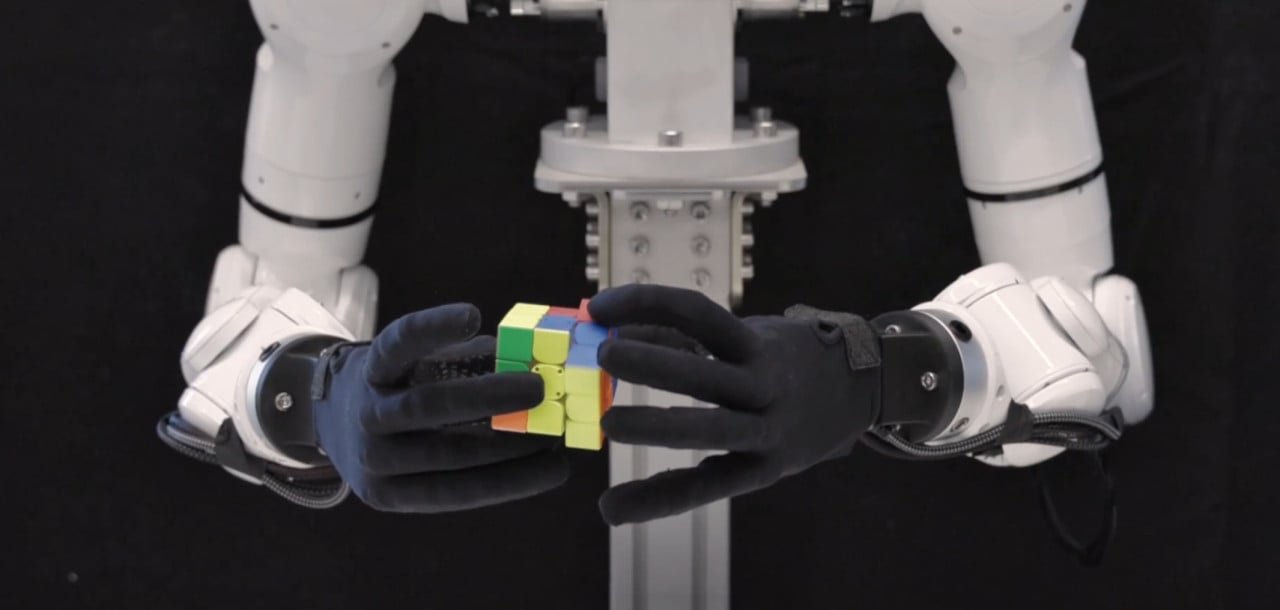
The company introduced the GENE-26.5 model along with a robotic hand designed to replicate human anatomy almost bone for bone. In a promotional video, the robot slices tomatoes, cracks an egg with one hand, solves a Rubik's Cube in midair, and plays the piano. Another shot shows it using both hands to make a smoothie, pipetting in a laboratory, and sorting four objects of different sizes into bins.
Genesis AI was founded in early 2025. It was co-founded by Zhou Xian, who holds a doctorate in robotics from Carnegie Mellon University, and Théophile Gervet, a former researcher at the French laboratory Mistral AI. The startup is headquartered in Paris, but part of its team works in Silicon Valley. Its investors include former Google CEO Eric Schmidt, French telecommunications billionaire Xavier Niel, MIT roboticist Daniela Rus, and computer vision expert Vladlen Koltun.
The company raised $105 million in its first funding round. Mistral AI once raised the same amount, which was then the largest initial funding round in France.
What GENE-26.5 Can Do
The model is not tied to a single piece of hardware. Genesis claims that GENE-26.5 can control a wide range of robots, including machines made by other manufacturers. Genesis is not seeking to sell a single robot, but to become the brain of the entire industry.
What has held robotics back for years? Researchers call it the "embodiment gap," meaning the divide between the human and robotic body. Transferring human movement to a machine has always involved some degree of loss. Genesis claims to have bridged this gap through the way it designed the hand and through a special data glove.
The glove is equipped with tactile electronic skin and maps movement at a 1:1:1 ratio between the operator's hand, the glove, and the robot. According to the company, it costs one hundred times less than conventional teleoperation systems and collected up to five times more usable, higher-quality training data during internal testing. The plan is to deploy these gloves directly in industrial facilities, where regular work shifts will also serve as training sessions for the model.
The data is supplemented by video footage from cameras mounted on workers' heads and a large volume of human footage from the open internet.
A Simulator That Trains Robots 430,000 Times Faster Than the Real World
Genesis has developed its own simulator, combining a physically accurate environment with photorealistic rendering. It can generate synthetic data up to 430,000 times faster than real time. Robots can therefore complete thousands of hours of training in a virtual world before touching a real object for the first time.
The result, according to the company, is a loop in which artificial intelligence trains itself. Engineers test and improve models at a speed that a physical laboratory could never offer. "Winning in robotics requires excellence at every level," Gervet said. "That is why we are obsessed with innovation across the entire stack, from artificial intelligence to hardware."
Why Europe and Which Industries Genesis Is Targeting First
In an interview with Reuters, Gervet explained why the company chose to establish itself in France. "There were two major reasons. The first was talent. The second was the industrial base here for us."
Genesis is in advanced talks with potential customers in France, Germany, and Italy. The company is targeting the automotive, electronics, pharmaceutical, and logistics industries. These are precisely the sectors where standard robotic grippers reach their limits. A typical example is tying wiring harnesses, a precision task at which conventional machines fail.
Vivian Sun, vice president of business and strategy, clarified that contracts will typically run for three to five years, depending on the needs of each customer. The company has already signed contracts with customers, but has not yet disclosed their names.
German bearing manufacturer Schaeffler announced this week that its robotics orders could reach hundreds of millions of euros by 2030. Europe is looking for ways to strengthen its own manufacturing base and reduce its dependence on Asian factories.
Competition vs. Genesis's Future Plans
Chinese company Linkerbot is developing similar hardware and is targeting a valuation of six billion dollars, Reuters reported. The two companies are racing to be the first to deliver machines capable of human-like manipulation directly to production lines.
"Genesis is bringing a paradigm shift to robotics. This is an important milestone for their team and for the entire industry." Eric Schmidt said, while Vinod Khosla of Khosla Ventures added that Genesis is getting closer to artificial intelligence capable of operating in the real world.
The company is planning another funding round, but is in no hurry to go public. It also plans to introduce its first universal robot, which is intended to be the culmination of everything it has presented so far: the brain, hand, glove, and simulator combined into a single unit.
Source: technology.org