

Gemma 3 270M: Ultra-Compact AI for Mobile Devices
Google's Gemma model family is expanding rapidly. Following the launch of Gemma 3 and Gemma 3 QAT for the cloud and desktops, Gemma 3n arrived for mobile devices with multimodal AI. Now comes Gemma 3 270M, a model with 270 million parameters (170 million for embeddings and 100 million for transformer blocks), designed for task-specific fine-tuning. With a vocabulary of 256,000 tokens, it is ideal for domains such as languages or specialized fields. Its context window is 32,000 tokens, which is sufficient for most tasks.
The model excels in energy efficiency: with INT4 quantization, it consumes just 0.75% of a Pixel 9 Pro's battery for 25 conversations. It runs on devices with at least 4 GB of RAM (CPU) or 2 GB of VRAM (GPU), with a file size of around 550 MB and quantized versions as small as 200 MB. On the Apple M4 Max, it achieves over 650 tokens per second with low latency.
Key Capabilities and Deployment
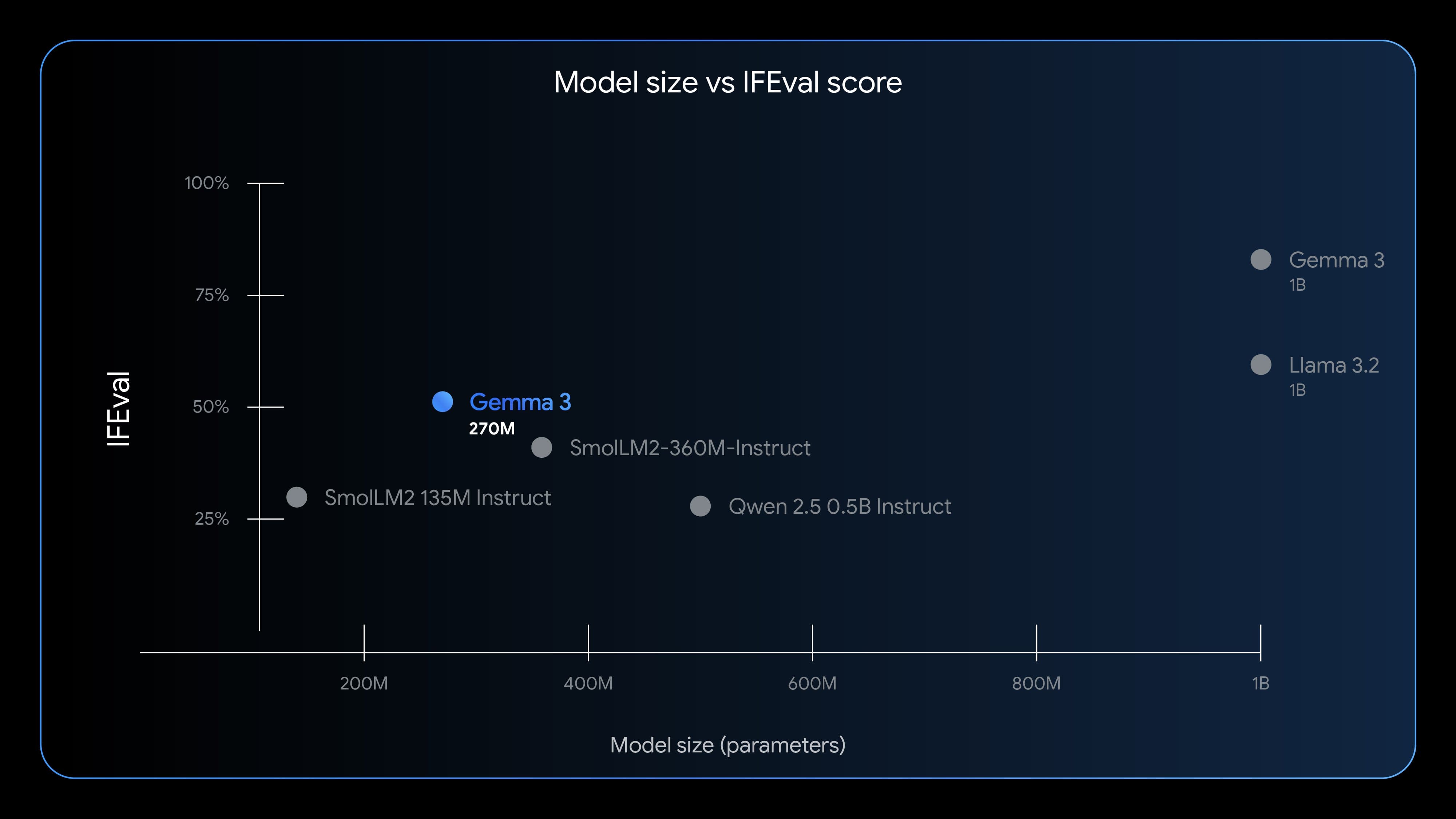
Gemma 3 270M is multimodal (processing text, images, and video) and multilingual (supporting over 140 languages), with built-in instruction-following capabilities according to the IFEval benchmark. Both pretrained and instruction-tuned checkpoints are available, including QAT for INT4 precision without a significant drop in performance.
Fine-tuning is fast—it can be performed with minimal data using LoRA on devices with 8 GB of RAM and 4 GB of VRAM. It supports platforms such as Windows, macOS, and Linux, as well as tools such as Hugging Face, UnSloth, and JAX. Deployment is possible locally or on Google Cloud Run, making it ideal for privacy-preserving offline applications.
Practical Applications
The model is designed for well-defined tasks such as sentiment analysis, entity extraction, query routing, and creative writing. One example is Adaptive ML's work with SK Telecom, where a fine-tuned version outperformed larger models in multilingual moderation. Other applications include the Bedtime Story Generator for offline story creation.
It is excellent for high-volume workloads, saving time and costs—it runs on inexpensive infrastructure or directly on the device. It enables the creation of a fleet of specialized models without a large budget.
Limitations and Availability
As a compact model, it may suffer from hallucinations and produce less robust outputs than larger LLMs. Neither the training data nor the source code has been published; only the pretrained weights are available. It can be downloaded from Hugging Face, Ollama, Kaggle, LM Studio, or Docker. Try it on Vertex AI, llama.cpp, Gemma.cpp, LiteRT, Keras, or MLX.
Gemma 3 270M, released in mid-August 2025, pushes the boundaries of efficiency for developers seeking fast, energy-efficient AI solutions on edge devices. We look forward to seeing your innovations in the Gemmaverse.


