

Brain Implants That Read Thoughts and Restore Movement to Paralyzed People
This article explores fascinating advances in brain-computer interfaces that are helping people with paralysis move, speak, and even think privately again.
James Johnson's Story: From Accident to Mind Control
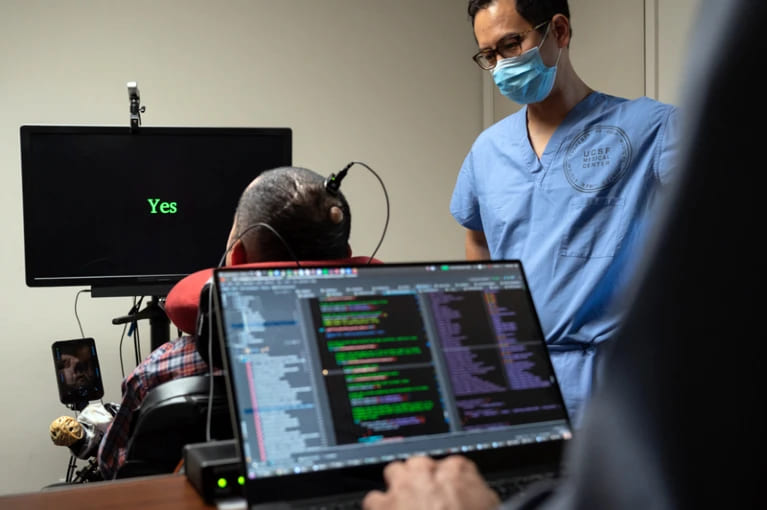
James Johnson, a man who broke his neck in a go-kart accident in March 2017, was left almost completely paralyzed below the shoulders. He had previously spent years caring for people with similar disabilities, so he knew what awaited him—deep depression and a sense of helplessness. However, his rehabilitation team connected him with researchers at the California Institute of Technology in Pasadena, who invited him to take part in a clinical trial of a brain-computer interface (BCI). This involved neurosurgery in which two electrode arrays were implanted into his cerebral cortex. These electrodes capture signals from neurons, which algorithms decode into thoughts and intentions.
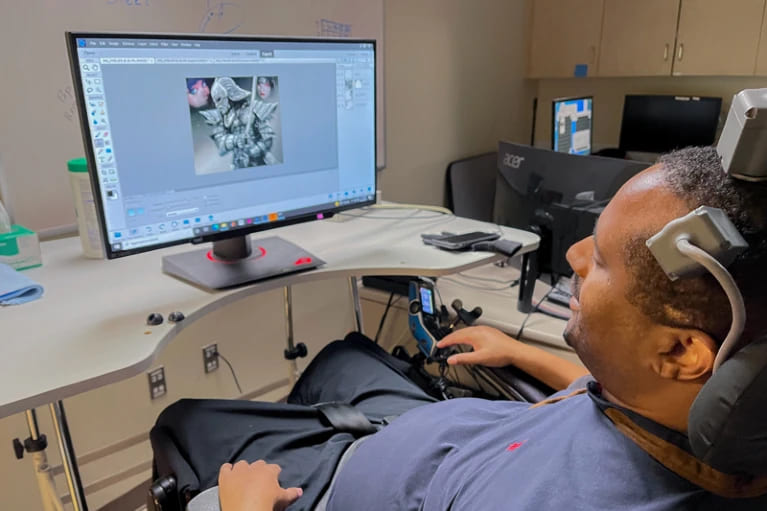
Johnson's implant was inserted in November 2018. The first time he used it, he moved a cursor on a computer screen using only his thoughts. He described it as a scene from the movie The Matrix—they connected him to a computer, and suddenly he could control the cursor simply by imagining movement. Since then, he has used it to control a robotic arm, edit images in Photoshop, play shooting games, and even drive a simulated car in a virtual environment, changing speed, steering, and responding to obstacles. "I'm always amazed by what we can do," Johnson said, "and it's really incredible."
This is one of approximately 35 people who have long-term BCI implants. Most of these implants come from Blackrock Neurotech in Salt Lake City, Utah, but interest in this field is growing. In 2016, entrepreneur Elon Musk founded Neuralink in San Francisco, which has raised $363 million (approximately CZK 8.4 billion) to connect people with computers.
From Early Experiments to Advanced Skills
The first long-term BCI implant was given in June 2004 to a man who had been paralyzed after being stabbed. Electrodes were inserted into his motor cortex, the area of the brain responsible for movement. A 2006 study led by Leigh Hochberg, a neurologist at Brown University in Providence and Massachusetts General Hospital in Boston, showed how this man controlled a cursor on a screen, a television, and robotic arms using only his thoughts. It was slow and imprecise, but it demonstrated that signals could be captured from the cortex and used to control devices.
Today, BCIs are far more sophisticated thanks to machine learning, which decodes neural activity without the need to understand every signal in detail. Algorithms map patterns of activity to the user's intentions. In 2021, a team led by Robert Gaunt and Jennifer Collinger at the University of Pittsburgh in Pennsylvania implanted electrodes into the somatosensory cortex, where touch is processed. This allowed a paralyzed person to feel pressure through a robotic arm equipped with pressure sensors—the time it took him to pick up an object was reduced from 20 to 10 seconds.
Richard Andersen of the California Institute of Technology studies the posterior parietal cortex, which plans movements at a higher level, such as "I want a drink." His colleague Tyson Aflalo described how this speeds up the decoding of intentions. Thanks to this, Johnson can drive a car simulator, while another participant plays a virtual piano.
From Writing with Thoughts to Protected Inner Speech
For people who have lost the ability to speak, BCIs are key to communication. Edward Chang, a neurosurgeon at the University of California, San Francisco, developed a system that decodes phonemes—the basic sounds of speech—from the dorsal laryngeal cortex. In 2021, it enabled a person who had suffered a stroke to communicate at 15 words per minute using a preselected vocabulary of 50 words.
Krishna Shenoy and Frank Willett of Stanford University achieved a speed of 90 characters per minute in 2021 by having participant Dennis Degray imagine handwriting. The system distinguished letters with 95% accuracy, which increased to 99% with autocorrect. Degray, paralyzed from the neck down, described it as learning to swim—chaotic at first, then natural.
In 2022, Ujwal Chaudhary of the University of Tübingen in Germany restored communication to a man with amyotrophic lateral sclerosis (ALS) who had even lost eye movement. He used sounds mimicking neural activity—a higher tone for "yes" and a lower one for "no"—which made it possible to select letters at a rate of approximately one per minute.
The latest advance comes from Erin Kunz of Stanford University. In 2025, her team developed a BCI that decodes inner speech—the silent dialogue inside the mind—with up to 74% accuracy for predetermined sentences. The device works only when the user thinks of a specific password, protecting privacy. The signals come from the motor cortex of four participants with speech difficulties caused by stroke or ALS. Sarah Wandelt of the Feinstein Institutes for Medical Research in New York praised this step as technically impressive and important for protecting privacy.
Neuralink and the Future: Wireless Implants and New Applications
Neuralink, founded by Elon Musk, is delivering revolutionary advances. Its Link device is compact, wireless, and implanted into the skull, with 64 thin threads containing 1,024 electrodes. The first publicly identified patient, Noland Arbaugh, who has a spinal cord injury, controlled a computer with his thoughts, played chess, and regained independence. Implantation is performed using robotic surgery to ensure precise placement in the cortex.
The Link charges wirelessly, records activity continuously even during sleep, and transmits data via Bluetooth. Neuralink is also developing Blindsight to restore vision. These innovations are opening the door to treating a broader range of conditions, such as ALS or psychiatric disorders. These technologies are not just science fiction—they offer real hope to thousands of people. With further studies, they will become more accessible and safer, but protecting users remains essential.
Source: www.nature.com


