

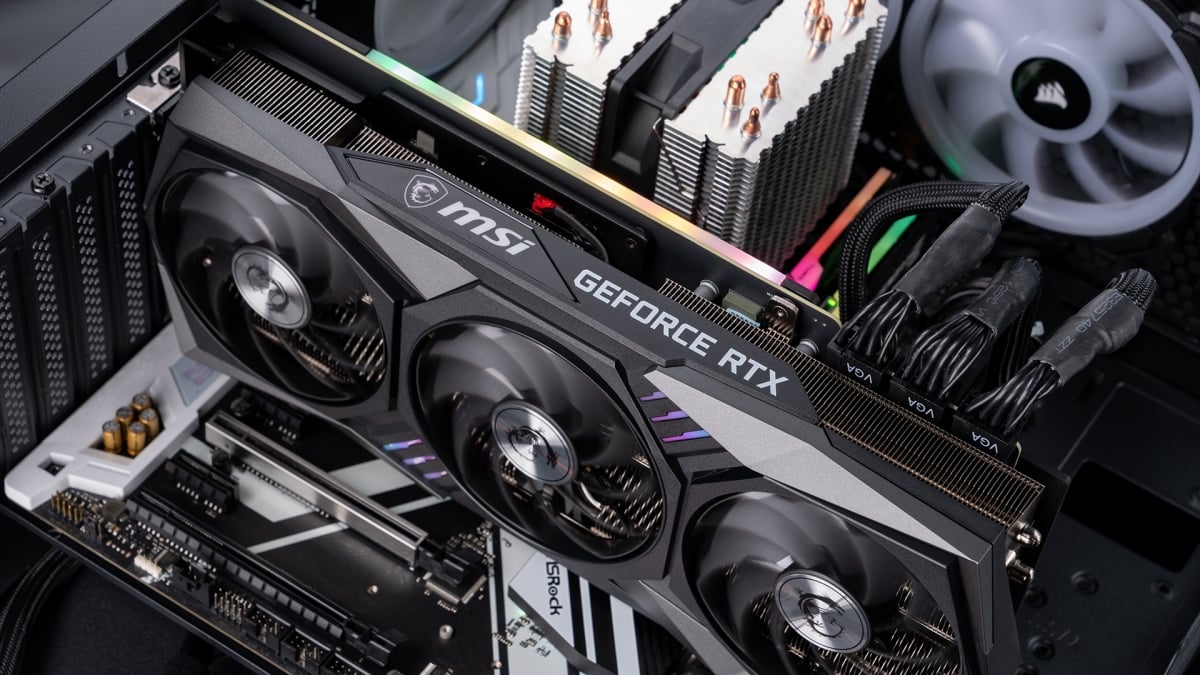
Your gaming PC sits idle for most of the day, waiting for you to launch your favorite game. But what if it could earn money and help train artificial intelligence in the meantime?
More than 400 million gaming PCs worldwide remain connected to the internet but unused most of the time. While technology companies such as Google, Amazon, and Microsoft invest billions in massive data centers, a parallel world is emerging—a decentralized network of ordinary computers that together provide enormous computing power. Bob Miles, CEO of Salad.com, sees it clearly: "If you look around the world, you’ll find hundreds of millions of gaming computers that spend most of the day just sitting there, connected to the internet. And in an era of exploding demand for AI, these are incredibly valuable devices."
From Crypto Mining to the AI Cloud
Miles founded Salad in 2018. Back then, the idea was simple—enable gamers to mine Ethereum without technical expertise. You download an app, let it use your graphics card when you’re not gaming, and receive rewards for games or gift cards. Then came the turning point. Ethereum switched to proof of stake, and mining came to an end. But Salad already had something far more valuable than cryptocurrency revenue—a network of tens of thousands of consumer GPUs and software capable of managing them.
Today, Salad operates more than 60,000 active graphics cards every day across 190 countries. Its customers include Stability AI and Discord. Revenue reached $10.4 million. And the price? Roughly one dollar per hour of computing power equivalent to an H100 chip—while AWS, Google Cloud, or Azure charge $3 to $7. Today, these graphics cards generate images using Stable Diffusion, process language models, and even assist with molecular simulations for developing new drugs. These are tasks that can be distributed across many computers at once.
Golem: A Decade-Long Bet on the Future
While Salad represents a Web2 approach to distributed computing power, the Golem Network project has been pursuing the Web3 path for much longer.
Golem launched in 2014 as one of the first projects on the Ethereum network. Its 2016 ICO raised 820,000 ETH in 29 minutes. The vision? A decentralized marketplace for computing power where anyone can rent out unused hardware and receive tokens in return. Ten years ago, it sounded like science fiction. The technology was not ready. Decentralized computing faced the same problems as all crypto applications—scalability and security.
But Golem never stopped building. The project still holds roughly $300 million in ETH in its treasury. It has never faced a scandal. It has never gone bankrupt. But it has also never experienced a major breakthrough. Its network has around 730 providers—a fraction of what centralized competitors have. Martin Best, who joined Golem five months ago, believes the time has finally come. "We are probably reaching a tipping point where things that were either abstract or seemed beyond the limits of technological possibility are suddenly becoming very real."
Joining Forces Makes Sense
Late last year, Salad and Golem announced a partnership. They are testing whether Web3 infrastructure can improve the economics of a Web2 business.
Today, Salad operates as a centralized marketplace. Payments go through traditional processors. Usage tracking runs through a centralized billing provider. Cross-border payments to GPU providers in 190 countries incur currency conversion fees, bank charges, and other costs that can exceed 5% of revenue.
The partnership routes some of Salad’s commercial workloads through Golem’s decentralized protocol. The first question is: Can Golem’s on-chain settlement and decentralized billing eliminate these fees? Over time, GPU providers on Salad could receive GLM tokens instead of gift cards and PayPal payouts.
Miles read Golem’s white paper nine years ago. "If you read what they described, it is very similar to what we have built today," he says. Salad took the Web2 route because ten years ago it was the only practical path to a real business. Now that Golem’s protocol has matured and there is a live revenue stream for testing, both teams are exploring whether a hybrid model works. "Boring is sexy," Best says of the gradual approach. "Instead of putting everything on the table immediately in phase one, we are doing it step by step."
Patient Builders
Do you see the pattern? While CoreWeave grew from an Ethereum miner into a $65 billion company in seven years, these quiet builders kept their heads down. The broader DePIN sector (decentralized physical infrastructure networks), which includes Golem, grew by 270% over the past year to a market capitalization of $30 billion to $50 billion. But gains have been uneven, and projects with long track records and working technology have not always received the recognition they deserved.
The question is: Will demand for AI grow enough to reach players at the edge of the market? The $65 billion worth of data center deals suggests that the top end of the market is well covered. But if Miles is right that 400 million unused gaming PCs represent an untapped computing layer for AI inference, the lower end of the market could be just as important.
As Canaan’s Leo Wang recently said: "It’s all about energy. We believe that energy will be a scarcer asset for everyone in the future." That scarcity is evident at every level of AI infrastructure—from $10 billion data centers backed by Google to a gamer in Berlin renting out their GPU overnight for a few dollars in crypto tokens.
It is worth considering: What if the future of AI lies not only in massive data centers, but also in our living rooms?
Source: forbes.com


