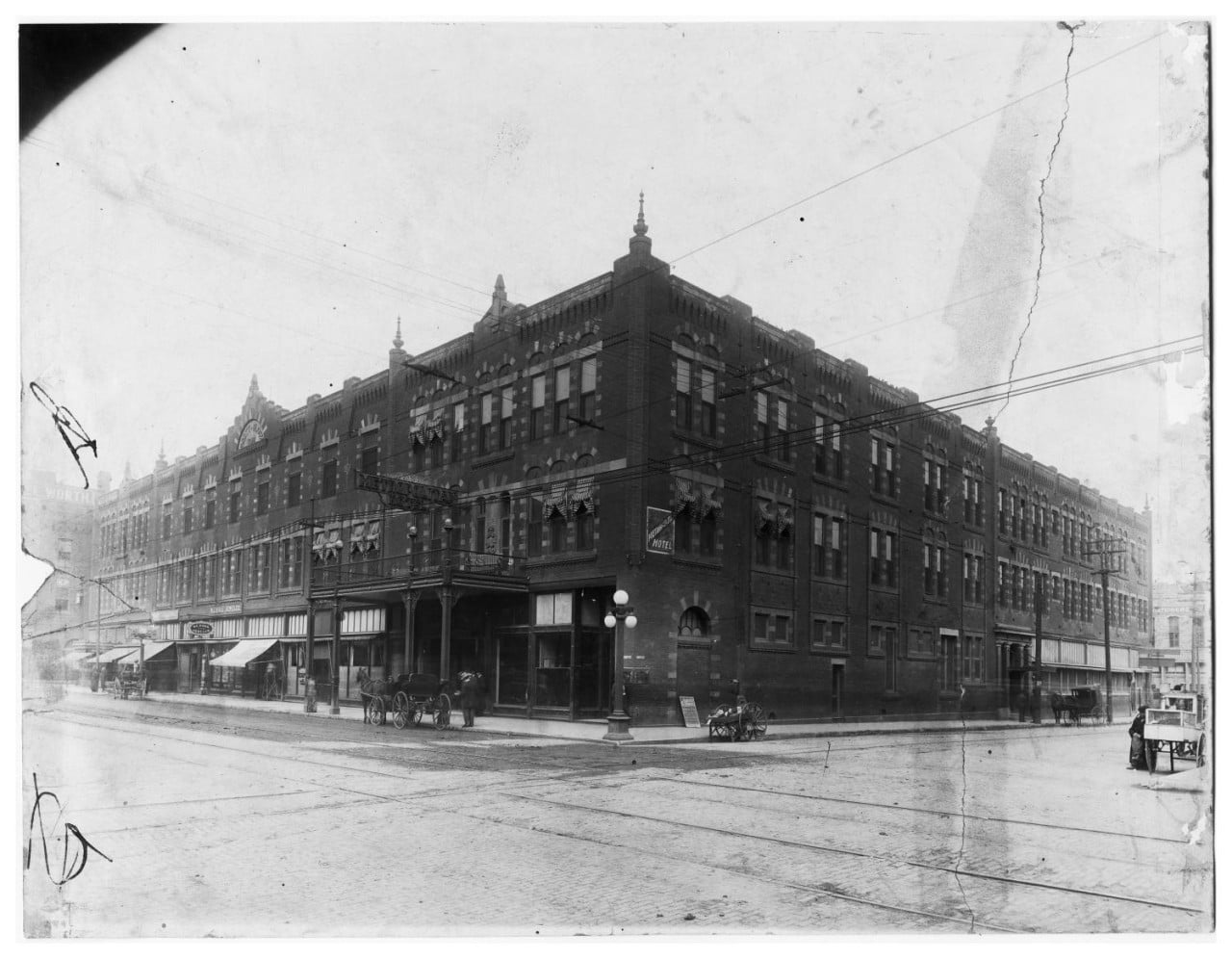
The Metropolitan Hotel was Fort Worth's first luxury hotel. It was built in 1898 by cattleman-turned-hotelier Winfield Scott. The building occupied the entire east side of the block on Main Street between Eighth and Ninth, placing it at a strategic location along the busy route between the T&P station and downtown. A streetcar passed by every ten minutes. The Metropolitan set a new standard for hotels in Fort Worth. It was three stories tall, built of red brick, and designed so that every room had an exterior window. Winfield Scott insisted that everything be first-class, so marble and mahogany were used extensively. Each room was equipped with central steam heating instead of the usual coal stoves, and every floor had a bathroom with hot and cold running water. The hotel boasted an excellent restaurant with a French chef and tailcoat-clad waiters, the largest banquet hall and ballroom in Texas, men's bars and a tobacco shop, and a separate ladies' parlor. It was also the first hotel in Fort Worth to operate on the so-called “European plan,” under which meals were charged separately from lodging. By contrast, under the “American plan,” guests dined together at a communal table at a designated hour. Another first-class feature was dinner accompanied by live music from a full orchestra every Friday and Saturday. The hotel even had its own wine cellar and artesian well, ensuring that no guest would ever suffer from a shortage of either clean water or quality liquor. All this comfort was available for the modest price of 50 cents to 1 dollar per day, the rate in effect when it opened.
Over time, the Metropolitan expanded and eventually occupied the entire block from Main Street to Rusk (Commerce). The first expansion took place in 1905, when the number of rooms increased to 200. Two more floors were added in 1908, bringing the total number of rooms to 425. Each renovation introduced new amenities and services, such as a telephone in every room and pneumatic tubes connecting the rooms with the front desk.
Local authors Mack Williams, Bill Fairley, and Simone Ramos wrote about this “Waldorf-Astoria” of Fort Worth. None of them, however, touched upon the dark side of its history—the murders, police raids, and other criminal activities that took place there. More murders and attempted murders occurred at the Metropolitan than at all the other Fort Worth hotels combined. Perhaps, in the tradition of Hollywood films, it was built on an ancient Native American burial ground, or there was something else about the site that brought out the worst in people.
The Metropolitan's troubles with the criminal element began in 1903. At about seven-thirty in the evening on January 10, Carrie Turner and Cora McNeill, two Black women, were walking past the hotel on Ninth Street on their way home when Walker Hargroves and his friend, both white men who had come to town from Bowie, Texas, approached from the opposite direction. Both men were highly intoxicated and in a “boisterous” mood. They said something to the women, but the women ignored them and quickened their pace. A moment later, they heard a pistol shot behind them, and a bullet ricocheted off the pavement just in front of them. When they cried out in surprise, a crowd began to gather. Hargroves retreated to the hotel bar, where Detective Sebe Maddox found him a short while later and arrested him for discharging a firearm within the city limits. Neither woman filed a complaint; both were simply glad to have made it home safely. Hargroves was released on bail once he sobered up and returned to Bowie.
As the city's most elegant tourist hotel, the Metropolitan also offered other services that were not discussed openly, namely high-stakes gambling and female companionship. In 1904, a farmer from Ellis County came to Fort Worth looking for his thirteen-year-old daughter, who had run away from home to the big city. With the help of Fort Worth detective Al Ray, he found her at the Metropolitan, where she was working as a chambermaid. Her first response when Detective Ray confronted her was to claim that she was not the missing girl, but after her family identified her, considerable persuasion was required to convince her to return home. How the hotel came to employ a thirteen-year-old girl was never explained, and some of the “chambermaids” did more than just clean rooms. She would not have been the first country girl to run away to the big city and end up in the world's oldest profession.
The most sensational case associated with the Metropolitan Hotel involved the murder of Captain Al Boyce Sr. He was the father of Al Boyce Jr. and a longtime friend of the Sneed family. John Beal Sneed married Lena Snyder of Georgetown in 1898, and in 1902 they moved to Amarillo, bringing the Sneed and Boyce families into the same community. Both families were wealthy, raised cattle, and moved in the same circles. Around 1911, Al Boyce Jr. began an affair with Lena Sneed. In October, she confessed to her husband that she was having an affair and declared that she intended to run away with her lover to South America. Beal Sneed did what any ambitious husband of the era would have done: he had his wife declared mentally ill and committed her to a private institution, the Arlington Heights Sanitarium in Fort Worth. Lena, however, wrote Al a letter asking him to come and rescue her. He did so on November 8, and together they fled to Canada. Sneed filed kidnapping charges against Al Jr. and hired private detectives to track down the couple, which they succeeded in doing when they found them in Winnipeg, Canada. He traveled there and brought his wife back. He returned her to the sanitarium and publicly announced his intention to begin extradition proceedings to bring Boyce to Fort Worth for trial.
Then Papa Boyce entered the scene. He came to Fort Worth and hired an attorney, a former federal prosecutor, who succeeded in having the charges against his son dismissed. This was in early January 1912. During his stay in Fort Worth, Captain Boyce took a room at the city's finest hotel, where Beal Sneed found him on the night of January 13. Boyce and his friends were sitting and talking in the hotel lobby when Beal Sneed entered and confronted him. Sneed regarded the elder Boyce as an accomplice in his son's theft of Sneed's wife. After they exchanged words, the cuckolded husband drew a pistol and fired five bullets into the old man's body. He turned himself in to the police, and a grand jury indicted him for murder. The defense relied on the so-called “unwritten law,” and that was enough for a mistrial to be declared on February 29 after the jury failed to agree on a verdict; at his retrial in December of that year, Sneed was acquitted. In the meantime, two more events occurred in the unfolding drama: Lena hired an attorney and secured her release from the institution, and Beal Sneed tracked down and killed Al Boyce Jr. in Amarillo.
Less than a year later, another violent incident occurred at the Metropolitan. In October 1913, C. W. Hudson, an employee of the Texas & Pacific, accosted Alex Friend, the operator of the hotel's tobacco shop, in the hotel lobby and struck him over the head with a “leaded cane.” Hudson was arrested and charged with attempted murder, explaining that he had mistaken Friend for the railroad's general manager. At the time, Hudson was in a dispute with the railroad over reimbursement for medical expenses following a serious accident he had suffered several months earlier. Friend was carried home in “serious condition,” but a doctor stated that his injury would not be fatal.
In March 1919, another love triangle erupted right in the Metropolitan's lobby. Warren Wagner, an oil magnate, accused his colleague in the industry, Floyd Holmes, of trying to steal his wife. For months, Wagner had threatened Holmes that Fort Worth “was too small for both of them.” He also stopped Mrs. Holmes on the street, telephoned her, and wrote letters urging her to leave her unfaithful husband. Wagner had a reputation as a violent man who was known to carry a weapon, so Floyd Holmes went to great lengths to avoid him. Unfortunately, both men found themselves in town at the same time, and both were staying at the Metropolitan. On the fateful day, Wagner declared in the lobby, “Holmes is the cause of all my troubles, and I'm going to kill him!” He then stormed out of the hotel and headed down the street, where he encountered Holmes. Holmes saw him coming, pulled a pistol from his car, and opened fire on the unsuspecting Wagner. He shot him twice in the back, killing him on the spot. Wagner was unarmed at the time. Nevertheless, it was not a clear-cut case of murder, because numerous witnesses had heard the victim repeatedly threaten to kill Holmes. In Texas, it was a case of justifiable self-defense.
On December 9, 1922, James M. Reynolds ambushed Claude Bell as Bell was crossing Main Street between Eighth and Ninth and shot him twice in the back. Mortally wounded, Bell staggered into the Metropolitan's lobby and collapsed there. He was rushed to the hospital, where he died fifteen minutes later. Reynolds claimed that he had acted “in defense of his family and in self-defense” because Bell was having an affair with his wife—the so-called “unwritten law.” As it turned out, the thirty-one-year-old victim was unarmed. Nevertheless, the jury accepted Reynolds's explanation and acquitted him of murder. It should be noted that Bell and Mrs. Reynolds had been meeting at another, far less expensive hotel, not at the Metropolitan.
The last recorded violent incident at the Metropolitan was a shooting in March 1932, when Whitmore Stonewall “Stoney” Phillips shot Elmer L. Churchill in the hotel lobby. Phillips was a thirty-two-year-old “one-armed criminal element” with a lengthy criminal record. Churchill was a forty-six-year-old oilfield drilling contractor. Both men were interested in the same woman, Sallie Moore, the hotel's stenographer. Phillips had been dating her before leaving town on business. When he heard that Sallie was seeing someone else, he hurried back and, on March 14, found her new suitor talking with the hotel clerk at the front desk. Phillips demanded to speak with him, and when Churchill ignored him, he drew a pistol and began firing. He emptied the magazine, went to a nearby men's restroom, reloaded, and returned firing again. He fired a total of five or six shots, two of which struck their target. At the first shots, the clerk threw himself behind the massive marble counter, probably saving his life. Others in the lobby who were not in the line of fire stood frozen. Among the witnesses was the hotel's eight-year-old newspaper boy.
Churchill died in the hospital the following day. Phillips was charged with murder, convicted, and sentenced to ninety-nine years. He died in prison in 1936. Sallie Moore left town and was never seen in Fort Worth again. It was another shameful chapter in the Metropolitan's history.
What might be called the “curse of the Metropolitan” extended beyond the hotel's doors. Simply working at the hotel could end badly. In 1905, thirty-two-year-old James M. “Grude” Britton, a former Texas Ranger, took over the hotel bar. It was supposed to be a quiet retirement, but Britton was a tough man with a combative disposition. He had a girlfriend who operated a brothel in the Amarillo Flats section of Jennings, a short distance from City Hall. On January 10, 1910, Captain Tom Blanton led a police raid on the establishment. Britton expected simple professional solidarity to protect him, as a former lawman, from official harassment. He was mistaken. He blamed Blanton personally for the raid and was ready to settle the matter if only he could find the police captain. He did not find him and went home, but returned to City Hall the next evening to lodge a formal complaint. Since he was unarmed, it appeared that he had abandoned any idea of confronting Blanton. Blanton was waiting for him on the City Hall staircase and shot him three times, firing the final shot while Britton was on his knees. The Metropolitan thus had to find a new bartender.
The reputation of the once first-class Metropolitan underwent a long and sorrowful decline. It did not help that vice took up residence in its rooms and suites during the 1920s. The hotel became a haven for bootleggers and shady gamblers who earned enough to secure protection. Everything operated without major problems until the fall of 1922, when the Fort Worth police, working with federal authorities, conducted a raid. Police Commissioner John Alderman had ordered his men to leave the Metropolitan alone, which infuriated Police Chief Harry Hamilton. The commissioner dismissed him for “insubordination,” and Hamilton took his complaint to the press. The City Council held a series of hearings and ultimately sided with the commissioner against the dismissed chief. Alderman served as commissioner for only one term, and the poor Metropolitan suffered another blow to its reputation.
By 1938, the Metropolitan was merely a pale shadow of its former glory. The Hotel Texas and the Blackstone Hotel had replaced it as the city's leading hotels. The Metropolitan was run-down and half-empty most of the time. Travelers arriving by train now passed it by in favor of better hotels. Extensive remodeling and repairs would have been needed to restore even a fraction of its former splendor. That did not deter the Milner hotel chain, which purchased it, made minor cosmetic improvements, and operated it for several more years as the Hotel Milner. Finally, in 1959, the hotel closed its doors and was demolished to make way for the Tarrant County Convention Center. The entire block served as a parking lot until it was transformed into General Worth Square, where a statue of JFK found a home after 2012. And it is President Kennedy's statue that maintains the site's strange connection with murder.