


Microsoft has published its latest report on the global spread of artificial intelligence for the first quarter of 2026. The report tracks the percentage of the world's working-age population actively using generative AI. The results are surprising, to say the least.
In the first quarter of 2026, the share of AI users worldwide increased by 1.5 percentage points, from 16.3% to 17.8% of the world's working-age population. At first glance, the figure may not seem particularly impressive, but it represents hundreds of millions of people who have integrated generative AI into their everyday working lives. Usage intensity is also increasing in countries with the highest adoption rates. 26 economies worldwide have already crossed the threshold of 30% of the working-age population actively using AI. Steady growth indicates that AI is becoming a standard workplace tool.
How is AI adoption measured? Microsoft tracks the share of people aged 15 to 64 who used a generative AI product during the period under review. The data is based on anonymized telemetry and adjusted for operating system market share, internet penetration, and the population size of individual countries.
UAE on top. US finally moving up
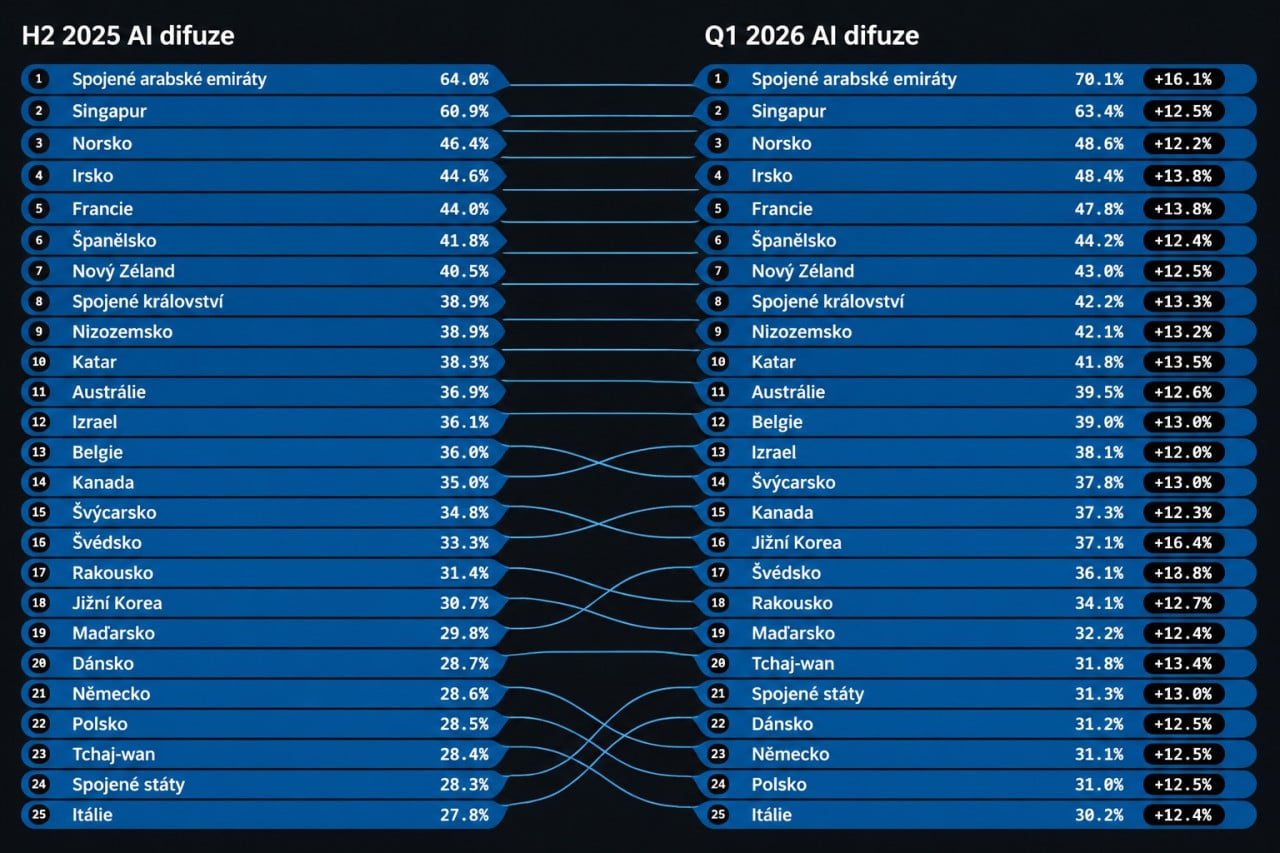
The United Arab Emirates sits comfortably at the top of the ranking, with 70.1% of its working-age population using AI. It posted a quarter-over-quarter increase of 6.1 percentage points, and no one is currently threatening its leading position. Singapore remains in second place (63.4%), followed by Norway (48.6%) and Ireland (48.4%).
And what about the United States? It has finally begun moving up the rankings. It climbed from 24th place to 21st, with an adoption rate of 31.3%. The progress is noticeable, although the US still lags significantly behind the leaders.
The Czech Republic stands at 30.1% globally, placing it among the countries that have just crossed the thirty-percent threshold.
The biggest surprise comes from Asia. Twelve of the fifteen fastest-growing economies since June 2025 are in Asia. Each of them attracted over a quarter more AI users than a year earlier. Leading the way are South Korea, with growth of 43%, and Thailand, with 36%. Japan added 34%. Mongolia, Iran, Laos, and Turkey also recorded strong gains, all above 30%. What do these countries have in common? Languages that AI had largely ignored until recently.
The driving force behind this growth is the significant improvement in the language capabilities of AI models. Better performance in Asian languages has opened the door to AI for users who previously faced a language barrier. Available benchmarks such as MMMLU, which test AI knowledge in 14 languages, show that models handle Asian languages substantially better than they did two years ago.
Japan is a model example
Japan deserves a chapter of its own. In the first half of 2025, it still ranked 56th globally. In Q1 2026, it climbed to 48th place. Adoption increased by 3.4 percentage points in a single quarter, more than three times the global average.
What is behind this? AI performance on Japanese professional exams has improved dramatically. While older models achieved scores of around 50% on Japanese professional tests, the latest systems exceed the 90% accuracy threshold. On the MMLU benchmark, Japanese-language accuracy rose from about 50% for GPT-3.5 Turbo to approximately 80% for GPT-4o. GPT-5 then achieved 87% in Japanese on the more demanding MMLU-Pro test, even surpassing its English-language result (85%).
The impact was directly visible on GitHub. Japanese developers uploaded 129% more code changes to repositories than a year earlier. The global average was 78%.
The gap between the Global North and South is widening
Behind the growth lies an uncomfortable truth. The Global North and Global South are rapidly drifting apart. The Global North recorded an adoption rate of 27.5% in Q1 2026, up from 24.7% in the second half of 2025. That is an increase of 2.8 percentage points in a single quarter.
The Global South reached 15.4%, up from 14.1%. That is an increase of just 1.3 percentage points. The North is growing twice as fast as the South. This gap is driven by problems that cannot be solved with a better model or a faster processor. Limited access to electricity, weak internet infrastructure, and a lack of digital skills in these regions are holding back AI adoption in ways that technology companies alone can do little to change.
Developers are not going away. Quite the opposite
One of the most widely discussed questions surrounding AI is its impact on jobs. Will AI agents take programmers' jobs? The available data says the opposite.
Anthropic released the Claude Opus 4.5 model in November 2025, while OpenAI launched a rapid succession of Codex models: GPT-5.1-Codex-Max (November 2025), GPT-5.2-Codex (December 2025), and GPT-5.3-Codex (February 2026). Meanwhile, GitHub Copilot evolved from a code suggestion tool into a full-fledged platform capable of independently completing development tasks and generating pull requests.
The result? The global number of "git pushes," meaning uploads of code changes to shared repositories, increased year over year by 78%. The number of newly created repositories rose by 45% compared with Q1 2025. The number of pull requests associated with AI agents has increased by more than 28x since June 2025.
And developers themselves? In 2025, total employment of software developers in the US reached approximately 2.2 million, representing a year-over-year increase of 8.5% and an all-time high. Data for March 2026 shows that developer employment is 4% higher than during the same period last year.
Source: microsoft.com


