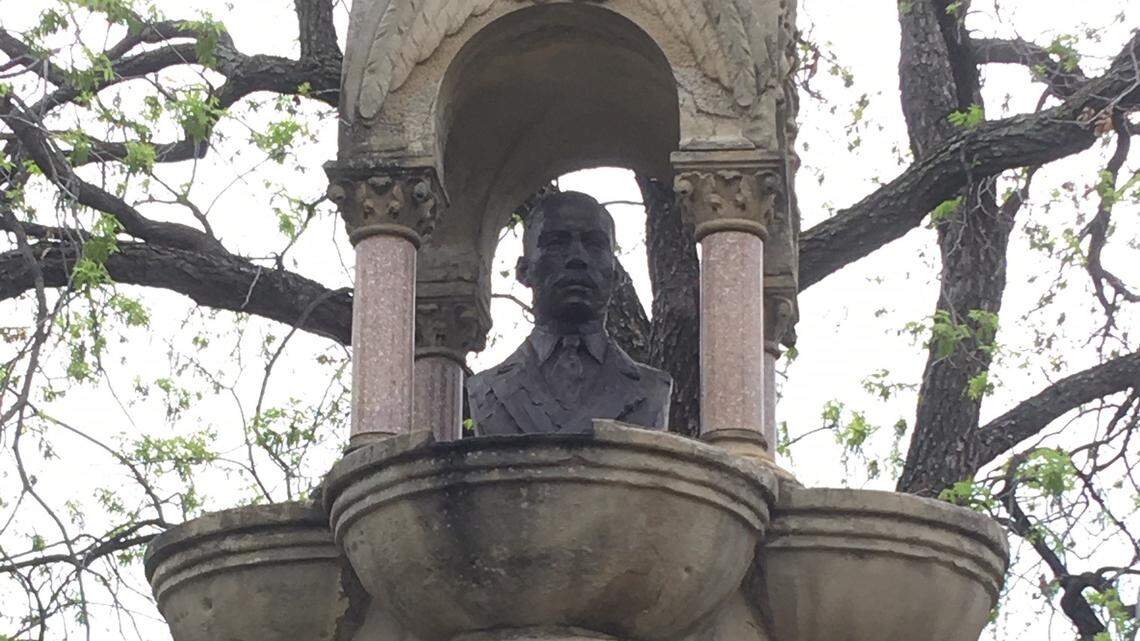
If you are at all interested in Fort Worth or have ever visited this beautiful city, you have surely heard of Al Hayne, the hero of the 1890 Texas Spring Palace fire. If not, just drive along Lancaster Avenue, and at the intersection of Lancaster and Commerce streets you will see his monument. Poor Al is a little weatherworn after more than a hundred years, but he is still recognizable.
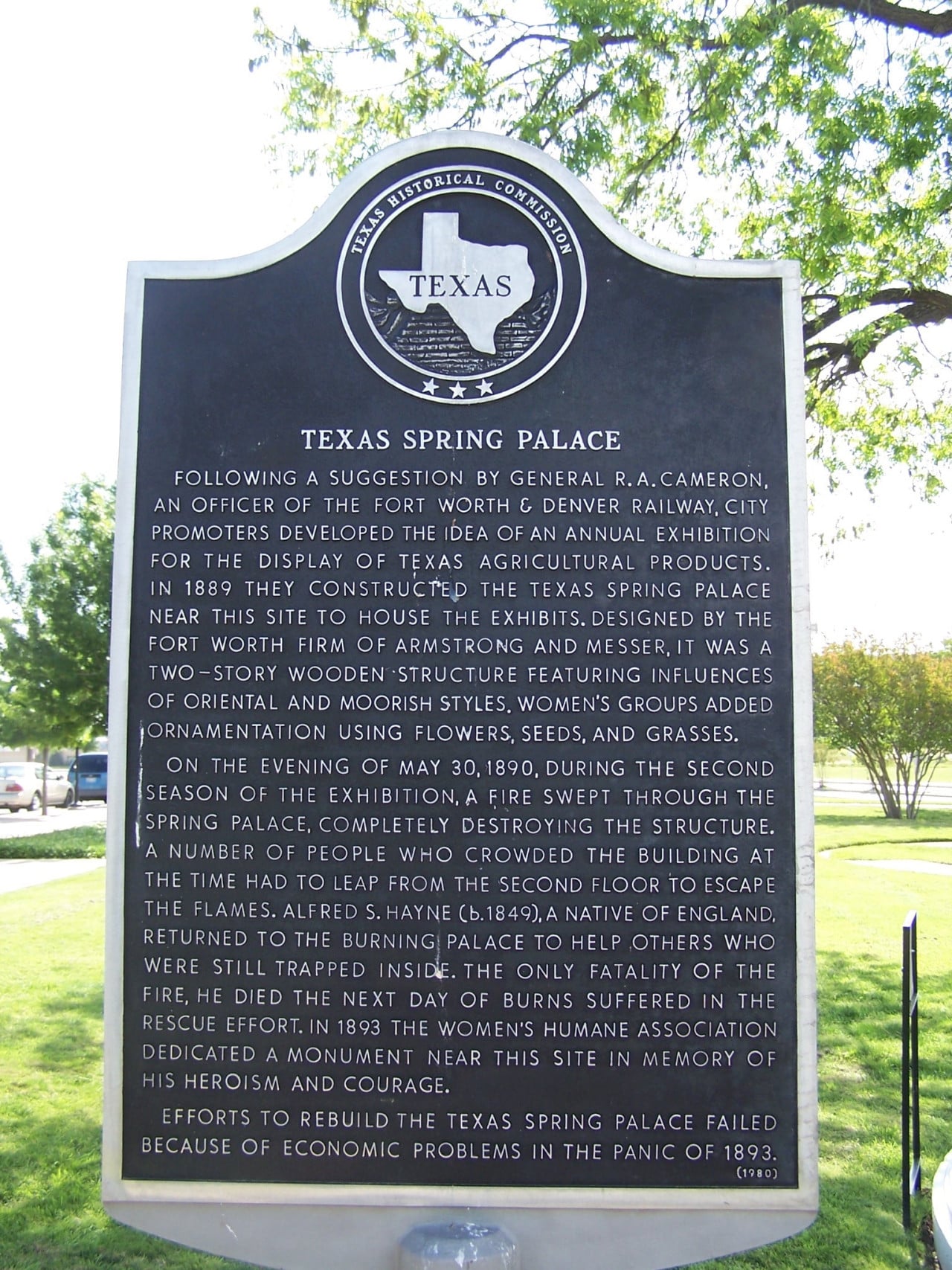
He should forever be remembered for his selfless actions on the night of May 30, 1890. It was the final night of the second season of the Texas Spring Palace when the building caught fire. At the time, the venue was packed with visitors, perhaps as many as seven thousand, enjoying the closing evening of the grand exhibition. It was approximately 10:00 p.m., and the Elgin Watch Band had just finished its concert. A cotillion ball was about to begin on the second floor, so many people were making their way there. Elsewhere in the building, people were strolling around and taking one last look at the exhibits under the electric lights.
And then, suddenly, the building was on fire. Although there was some dispute over exactly how the fire started, everyone agreed that it began at the eastern end of the second floor. The ringing of the fire alarm in the building’s northeast corner caught everyone’s attention. A wild rush for the exits ensued, but the structure had not been designed for rapid evacuation. Although there were ten "large" exits on the ground floor, only two narrow staircases led down from the second floor, both on the south side of the building. The designers had apparently decided that additional staircases would detract from the impressive appearance of the exterior. The entire crowd on the second floor was therefore dependent on those two staircases.
Al Hayne, an English-born civil engineer who had called Fort Worth home for ten years, was there that night. He immediately sprang into action, found a rope somewhere, and used it to lower women and children to safety from the west tower. He also helped desperate mothers find their crying children and showed them the way to the stairs. As the building began to collapse, he plunged into the inferno one last time to see whether anyone had been left behind. But the rescuer himself became a victim. Too weak to save himself, he leaned against an exterior wall and could barely stand. Burning embers rained down on him, and he was only moments from death when another hero sprang into action.
Jesse Williams was standing on an adjacent lot watching the festivities when the fire broke out. He could not take part in the festivities because he was Black, and racial segregation was then simply a part of life. Yet he had the heart of a hero. In 1890, he was twenty-six years old and had been born into slavery in Virginia. Sometime after 1870, he left Virginia and made his way to Fort Worth. In 1880, he worked as a porter at a boardinghouse in an upscale neighborhood on Houston Street. One of the residents of this house was Fort Worth mayor John J. Brown. Jessie’s circumstances did not improve significantly over the next ten years. In the summer of 1890, he was an unemployed stable hand looking for any kind of work. He had, as he put it, "good references," which may have included former mayor Brown, and considered himself qualified for a position as a "general helper," which was essentially just a more dignified term for a porter. He had no known family in the city.
Jesse could have remained at a safe distance and, like thousands of others that night, simply watched the Spring Palace burn. But something drove him forward to help save people he did not know and who ordinarily would not even have given him a glance. He caught one woman who was being lowered by rope from the second floor, and when Al Hayne appeared in the doorway, he quickly rushed forward to save him. It is difficult to say whether the two men even knew each other.
When Jesse reached the Englishman, Hayne was lying on the ground, writhing in pain. Williams physically lifted him and carried him to safety. He carefully laid the severely injured Hayne on the ground, where others began tending to him. Only then did he notice that his coat was on fire. With the help of strangers, he extinguished it and then disappeared into the crowd. Almost no one noticed him. Everyone was focused on getting Hayne to the city’s only hospital, St. Joseph's Infirmary, where he died within an hour.
From the first cries of "Fire!" it took only four minutes for the entire building to be engulfed in flames, and another eleven minutes for it to become a heap of smoldering ashes. Amazingly, only one person died. Thirty people were injured in the rush for the exits, and some suffered minor burns. Much of the credit for the safe evacuation belongs to several heroes whom the newspapers wrote about in the following days, including E. F. Fudge, T. P. Keater, Russell Harrison, E. F. Segerson, and B. B. Paddock. Al Hayne, however, received the overwhelming majority of the attention in subsequent reports, undoubtedly because he was the only one who lost his life. The Fort Worth Gazette called him the "hero of the Spring Palace fire" and wrote: "A truer hero never died on American soil or for the American people."
Only after the same newspaper had vividly described Hayne’s heroic deeds did it mention the "brave colored man" who "did everything he could to save poor Al Hayne." In the newspaper’s account, Hayne was a "hero," while Williams "performed a heroic deed." It was a significant distinction. The only other African American associated with the Spring Palace fire was an unnamed "Negro boy" whom some sources later blamed for the fire, claiming that his energetic dancing started it when his shoe struck a match containing phosphorus. This story resembled the legend of Mrs. O’Leary’s cow, which was said to have caused the Great Chicago Fire.
Six days after the fire, an anonymous reader wrote a letter to the Gazette pointing out that there had been two heroes that night: "The white hero Al Hayne sacrificed his life to save others, and it was the Black hero Jesse Williams who risked his own life to pull the white man from the burning palace." After that, Jesse seemed to vanish from the face of the earth. The only notice Fort Worth took of him was a series of advertisements he placed in the "Work Wanted" section as a "young colored man" seeking employment. At the time, he lived above Bill Love’s saloon on Twelfth Street. Love was a respected figure in the Black community and may have been one of the "excellent references" Jesse mentioned in his advertisement. It is impossible to determine whether he eventually found work, although it is difficult to imagine why anyone would not want to employ a man who had risked his life to save Al Hayne.
Fort Worth never forgot Al Hayne. Three years after the fire, a women’s humanitarian association erected a monument to him in front of the T&P station. Hayne’s monument was the first thing people saw when they stepped off the train. And in the history of the Fort Worth Fire Department, he was elevated to the status of a full-fledged firefighter. (The professional fire department was established the same year the monument was erected.)
Jessie Williams, by contrast, was nearly erased from the pages of history. After only fifteen years, the Fort Worth Telegram could write about the "monument to a forgotten hero" and lament that people knew almost nothing about Al Hayne apart from his birthplace and his actions on that fateful night. But if people knew little about Hayne, they knew even less about Jessie Williams. Star-Telegram newspaper columnist Amos Melton tried to keep his legacy alive in 1930, when he wrote a recap of the fire and credited Jessie with "running into the building and pulling Hayne from the wreckage." Several longtime Fort Worth residents who had lived through 1890 still remembered Jessie in interviews conducted sixty and sixty-seven years after the event. D. E. Claypool told a reporter in 1950 that he had helped an unidentified "Black man" pull Hayne from the fire that night. And in 1957, Clay Sandidge still vividly remembered "the Black man who bravely entered the wreckage and pulled Hayne out." But memories are not the same as monuments.
Besides Jesse Williams being nearly erased from the story of the Spring Palace’s fiery end, little about the course of his life can be found in the historical record. From the 1880 census, we know that he was born in Virginia around 1864, most likely into slavery. As a Black man who grew up under slavery and Reconstruction, he was condemned to remain virtually invisible for the rest of his life. We do not know where or when he died. By 1900, he cannot even be traced in census records. He may still have been living in Fort Worth and was simply overlooked, or he may have moved elsewhere. After his fifteen minutes of fame on the night of May 30, 1890, this mysterious Black man, who stepped out of the crowd, performed a heroic deed, and disappeared back into anonymity, virtually vanished from the face of the earth.