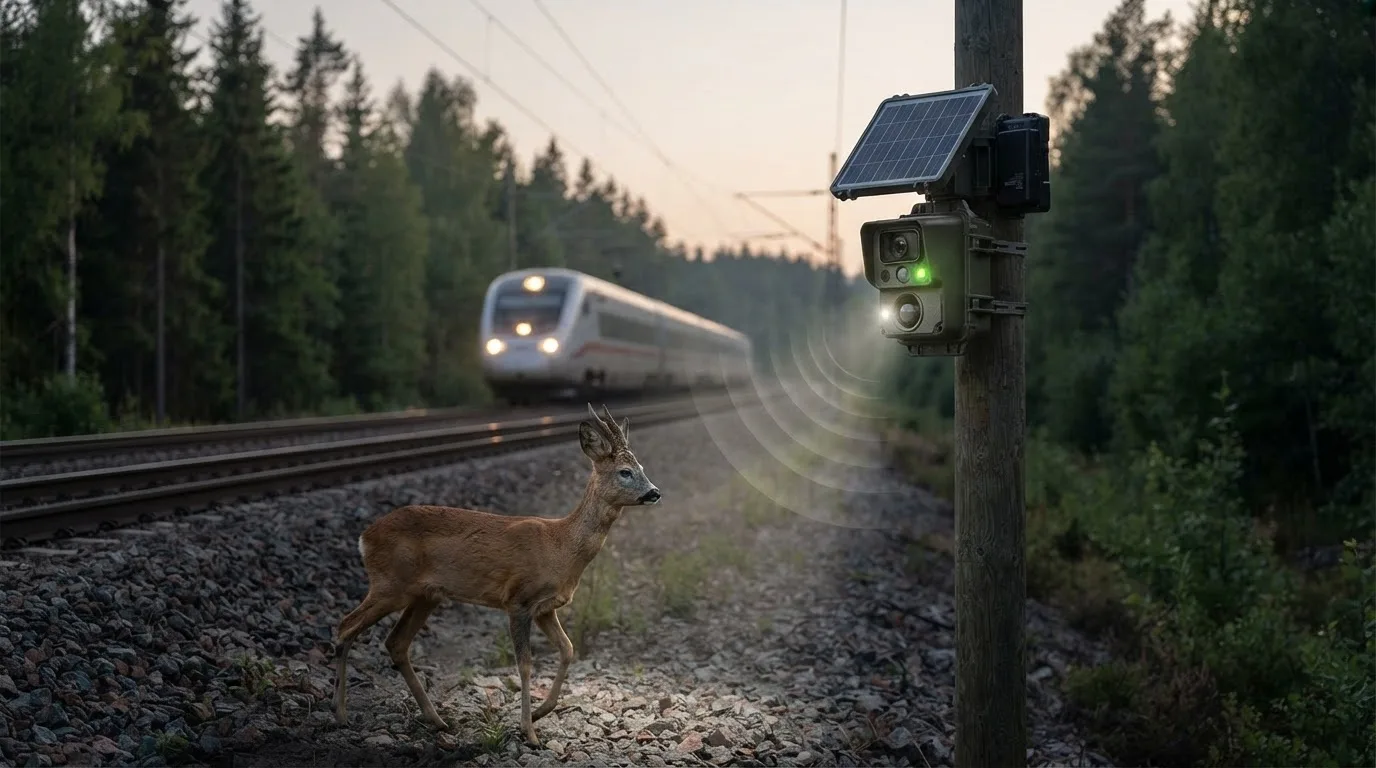
Wild animals and transport infrastructure do not mix. A deer on the tracks, a flock of birds near a runway, or a bear near a substation can mean delayed trains, damaged machinery, and often needless death. Swedish company Flox Intelligence wants to tackle this problem more intelligently than with sirens and fences. Its device first identifies the animal and then drives it away using a sound to which that particular species actually responds. The company currently operates around 150 of these devices across three continents. This week, it is presenting at the TechCrunch Disrupt technology conference in San Francisco, where it is among the finalists in the Startup Battlefield 200 competition for startups.
Wildlife collisions cost hundreds of millions
The problem is not limited to remote areas. The U.S. Federal Aviation Administration (FAA) estimates that between 1990 and 2025, aircraft collisions with animals cost the country's civil aviation industry an average of more than $270 million per year.
The situation on the railways is not much better. French transport operator SNCF says that stray wildlife delays or otherwise disrupts more than eight thousand trains every year, making it one of the five most common causes of delays. In Brittany in northwestern France alone, trains struck animals a total of 120 times in 2023. The consequences affected 660 services, which accumulated more than 15,000 minutes of delays.
Existing protection relies mainly on sirens, lights, fences, trained falcons, or culling. However, animals quickly become accustomed to repetitive stimuli, and fencing tends to have weak points.
From self-driving cars to moose and bears
It was reports of damage to both equipment and nature that gave Sara Nozkova the idea of building a device that would work differently. I was convinced that a louder deterrent was not the solution, she told TechCrunch.
Nozkova had previously spent thirteen years working in transportation and developing self-driving vehicles. She saw how well machines performed in cities, factories, or warehouses, where everything is predetermined and the software recognizes the objects around it. But once they venture into the wild, they quickly become lost because it is too complex and constantly changing.
She therefore joined the artificial intelligence laboratory at the KTH Royal Institute of Technology in Stockholm. There, she began developing a system that responds according to which species is approaching and what it is doing at that moment. This research led to the creation of an independent company in 2020
The camera identifies what is approaching
Flox's technology processes all data directly on site, so it does not need to send anything to remote servers and wait for a response. Much like self-driving cars, it monitors what is happening around it, but it has been trained to recognize the behavior of wild animals.
It all starts with a motion sensor. As soon as it detects activity, it wakes the system and turns on the camera. Based on the footage, the artificial intelligence identifies the specific species and plays an acoustic signal that is effective against it. What works on a moose is therefore different from what works on a flock of birds.
According to the founder, the system learns from experience and varies the sounds. This means the animals do not keep hearing the same thing and do not stop responding to the stimuli, which is the greatest weakness of ordinary deterrents.
The company sells battery-powered modules that can be attached to a pole, tree, or other structure. It also provides software that allows customers to see the location of the equipment and surrounding activity on a map. The application can also prepare reports for authorities or overviews of the movements of individual species. In the future, Flox plans to adapt the software so that it runs directly in vehicles, including trains, cars, or drones.
The deterrents are already in use
According to Nozkova, around 150 units are currently operating in North America, Europe, and Australia. They are installed at airports, along perimeter fences, and near roads and railway lines. They are most commonly found at the ends of protective fences or in places where wildlife regularly migrates. They also monitor national parks, fields, urban neighborhoods, mines, and critical infrastructure such as electrical substations.
The company generates revenue in two ways. It first sells clients the hardware itself, then charges a subscription for the software and artificial intelligence from the second year onward. It also works with vehicle manufacturers, which pay an annual licensing fee to integrate the system into their vehicles, such as trainsets. One of its partners is the engineering group Alstom. Flox aims to end this year with revenue of around $1.5 million.