

Cursor, an American startup valued at $29 billion, has launched its new in-house coding model. It is called Composer 2, and on paper it looks great. Better benchmark results, a dramatically lower price, faster response times. But then a tweet appeared that complicated everything.
Capabilities of the New Composer 2
Let’s start with the good news. Cursor published results from three different tests, and the numbers are compelling. On CursorBench, Composer 2 achieved a score of 61.3, compared with 44.2 for the previous version. On SWE-bench Multilingual, it scored 73.7 versus 65.9. The price is even more interesting. Composer 1.5 cost $3.50 per million input tokens. Composer 2 costs $0.50. An 86% price cut is a figure developers will notice immediately. The faster Composer 2 Fast variant costs $1.50 per million input tokens, and Cursor has made it the default option.
The model has a context window of 200,000 tokens and is trained on so-called long-horizon tasks. This means it can do more than simply write a function on request: it can navigate an entire repository, decide what to change, modify multiple files at once, and respond to errors. Cursor calls this "long-horizon coding," and it is exactly what developers expect from AI assistants.
Kimi K2.5: The Chinese Foundation Cursor Kept Quiet About
And here comes the twist. Shortly after the announcement, a tweet appeared on X claiming that Composer 2 is actually the Chinese open-source model Kimi K2.5 from Moonshot AI, fine-tuned using reinforcement learning specifically for Cursor’s needs. Cursor itself did not explicitly mention this anywhere.
Since people really want me to say this: "KIMI K2.5" ‼️
— Lee Robinson (@leerob) March 20, 2026
Yes, that is the base we started from. And we are following the license through inference partner terms (e.g. Fireworks)
I'm thankful for OSS models personally, good for the ecosystem.
A debate immediately erupted on Hacker News. One commenter put it bluntly: "Composer 1 was Qwen, this one is Kimi. The entire company is built on packaging open source and reselling it." Others argued that there is nothing unusual about this, since many technology products work in a similar way. Someone even noted that a Kimi developer had confirmed a tokenizer match, suggesting that this may involve more than mere fine-tuning.
Cursor hosts the model itself on its own infrastructure, so user data is not being sent to China. But the question of transparency remains. Why didn’t the company say so from the start?
Benchmarks: Better Than Claude, Worse Than GPT-5.4
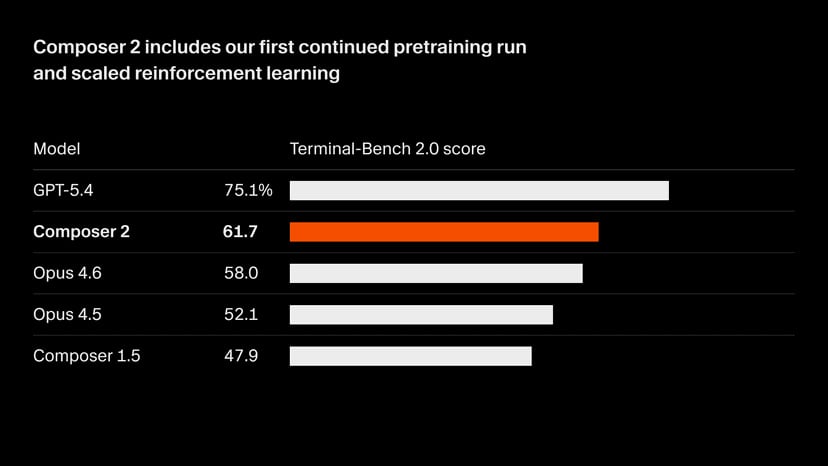
The results are good, but not flawless. On Terminal-Bench 2.0, which tests an AI’s ability to work in the command line, Composer 2 achieved a score of 61.7. That is better than Claude Opus 4.6, which scored 58.0. But GPT-5.4 leads with 75.1, and that is a huge gap.
However, Cursor is not presenting this as a battle for first place. Its argument is different: we offer a model that is good enough, significantly cheaper than the competition, and perfectly integrated into our environment. For developers who use Cursor every day, this combination may be more compelling than raw performance.
Cursor Under Pressure: Will Developers Still Have a Reason to Pay?
This brings us to what is really behind the entire release. Cursor is not just an editor with AI. It is a platform that sits between developers and models from OpenAI, Anthropic, and Google. And these companies are now promoting their own coding tools, such as Claude Code and Codex.
A growing number of developers on social media are switching from Cursor to Claude Code. They are drawn to terminal-based workflows, more straightforward controls, and the feeling that they are working directly with the source rather than through an intermediary. Cursor must be aware of this.
Composer 2 is therefore a strategic move. The company is saying: we have our own model, it is cheap, it is fast, and it is fine-tuned specifically for our environment. Simply reselling other companies’ models is not enough for us. But if it is based on a Chinese open-source model that anyone can download and fine-tune themselves, how strong is its product advantage really?


