Chinese company Unitree Robotics demonstrated the exceptional technological capabilities of its G1 humanoid robot, which managed to walk autonomously in extreme conditions. The robot completed a trek in the high-altitude Altai region of Xinjiang in northwestern China, where temperatures dropped as low as -47.4 °C. During the test, it took more than 130,000 steps and traced the symbol of the Winter Olympic Games in the snow.
This is the first confirmed case of a humanoid robot managing prolonged autonomous walking in such harsh climatic conditions. For comparison, the competing Chinese DR02 robot from Deep Robotics has a certified minimum operating temperature of only -20 °C and an IP66 protection rating.
Preparing for the Freezing Challenge
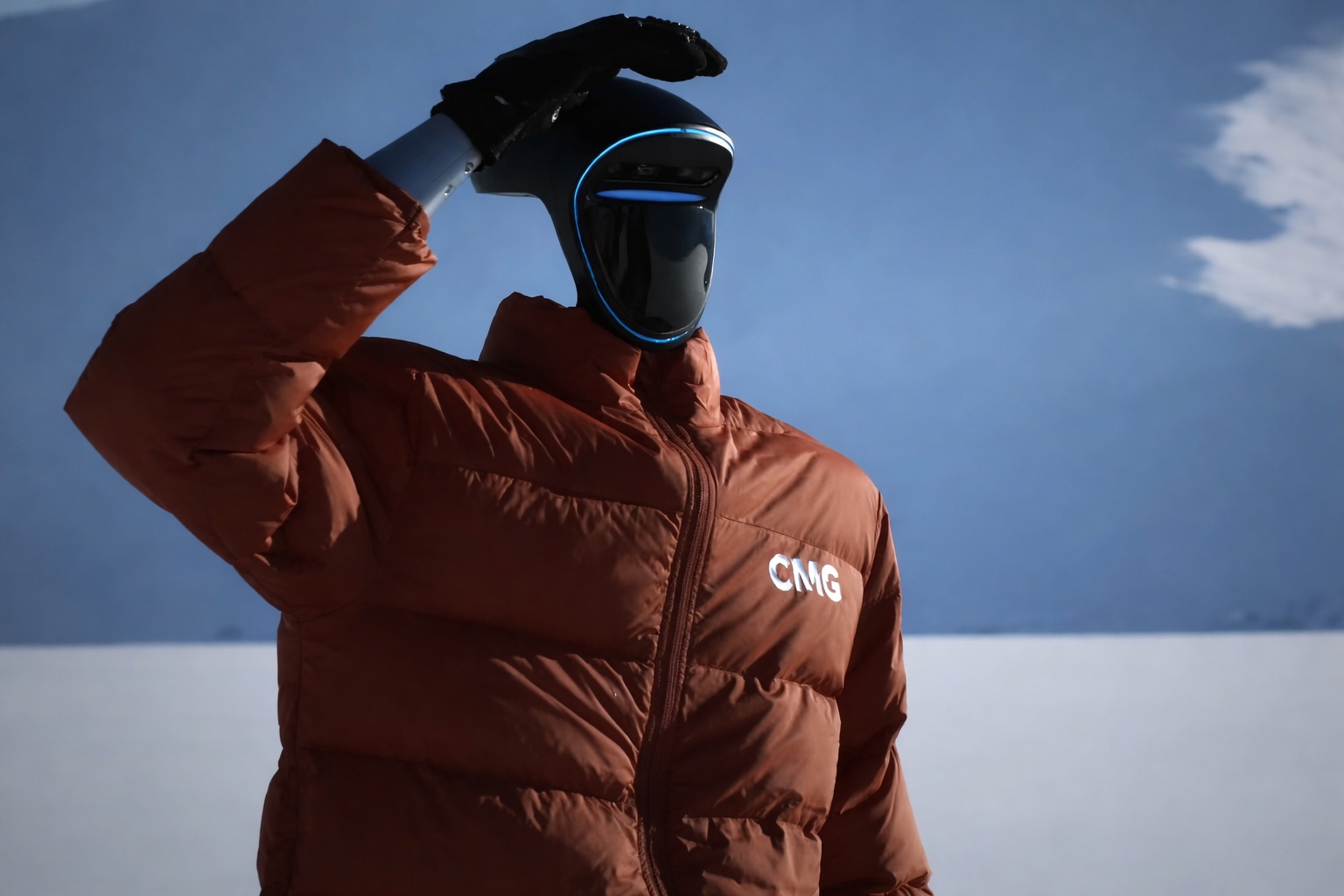
To prevent the robot from failing in extreme conditions, engineers had to make special modifications to the G1. The robot was fitted with an orange insulated jacket and plastic protective covers on its lower limbs, protecting the joints, actuators, and battery system from freezing. These modifications were a pragmatic solution for protecting sensitive components from thermal stress.
During the experiment, the robot created the symbol of the Winter Olympic Games on the snowfield—five interlocking rings, including text and the year. The entire design measured approximately 186 × 100 meters, making it visible from a great height. For real-time navigation, it used the Chinese BeiDou satellite system, which provided centimeter-level accuracy. Advanced adaptive path-planning algorithms enabled stable and smooth movement across uneven, icy terrain.
Technical Specifications of the G1 Robot
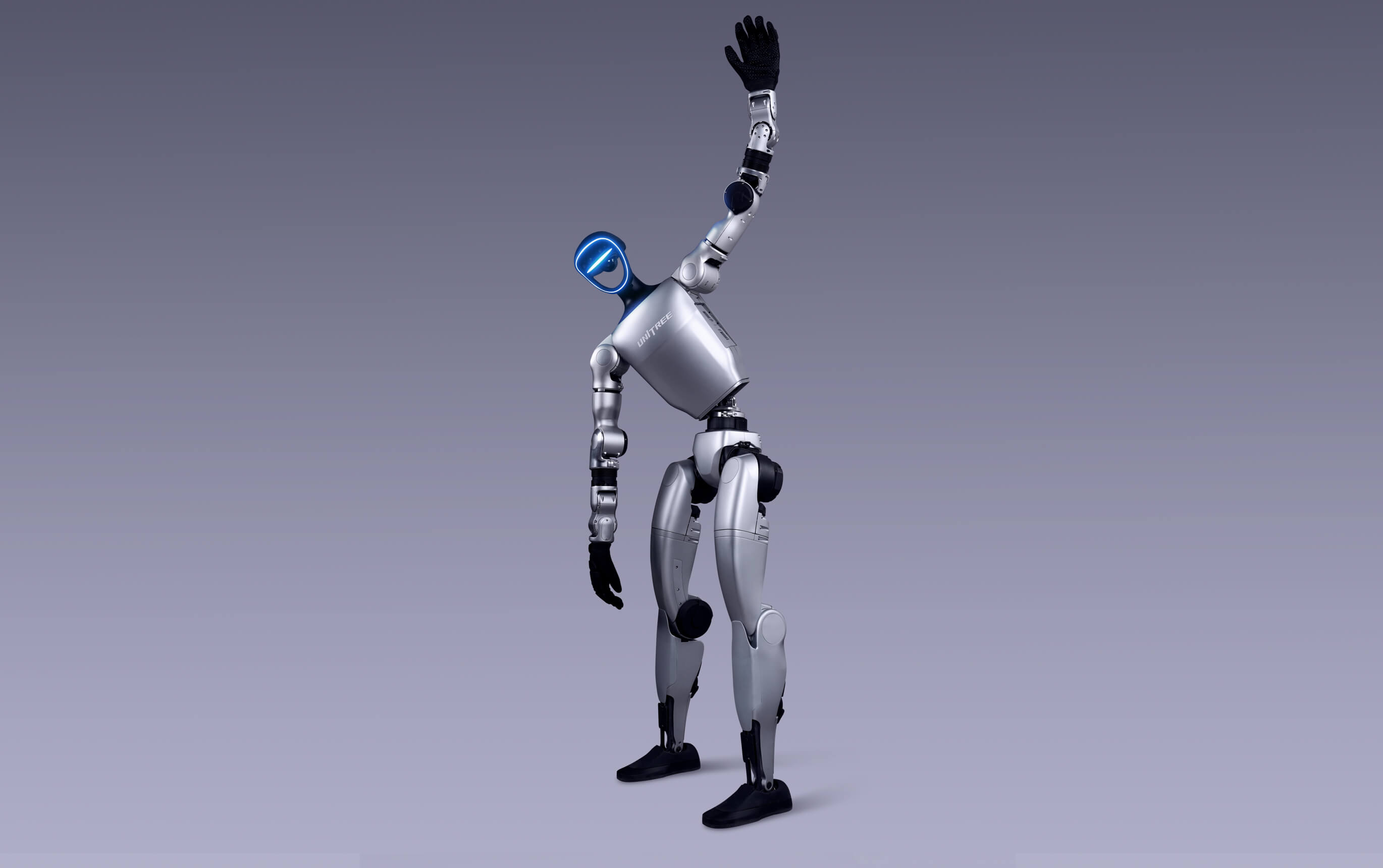
The Unitree G1 humanoid robot was officially introduced in May 2024 as an entry-level humanoid robot. It stands approximately 127 centimeters tall and weighs 35 kilograms. Depending on the configuration, its design includes 23 to 43 joint motors with a maximum torque of 120 newton-meters.
The robot is equipped with advanced sensors, including 3D LiDAR (a remote-sensing technology using laser beams), an Intel RealSense depth camera, and a noise-canceling microphone for voice control. Power is supplied by a 9,000 mAh battery, which provides up to two hours of operation and supports quick replacement. The joint system is controlled by an eight-core processor, enabling agile movement and a maximum walking speed of approximately 2 meters per second, equivalent to roughly 7.2 km/h.
The robot runs on UnifoLM, Unitree's proprietary unified large model for robotics, and supports reinforcement learning for motion control and task execution.
Commercial Success and Marketing Strategy
The starting price of the G1 robot on the Chinese market is 99,000 yuan, equivalent to approximately CZK 355,000. Unitree is one of China's leading manufacturers of humanoid robots, and according to figures released last month, the company delivered a total of more than 5,500 units in 2025.
In addition to its technological significance, the entire experiment also had a marketing objective. From an aerial perspective, the logo of China Media Group (CMG) is clearly visible on the snowfield. The company will send a nearly 500-member team to the Winter Olympic Games in Milan and Cortina, Italy (February 6–22, 2026). As the exclusive rights holder for mainland China, it will provide ultra-high-definition coverage.
The Altai test highlights the importance of environmental resilience in the humanoid robotics industry. While most companies focus on controlled indoor environments, resistance to weather and temperature extremes is becoming a competitive advantage. With this experiment, Unitree pushed the survivability of a general-purpose bipedal system to the absolute limit.
Sources: perplexity.ai and interestingengineering.com