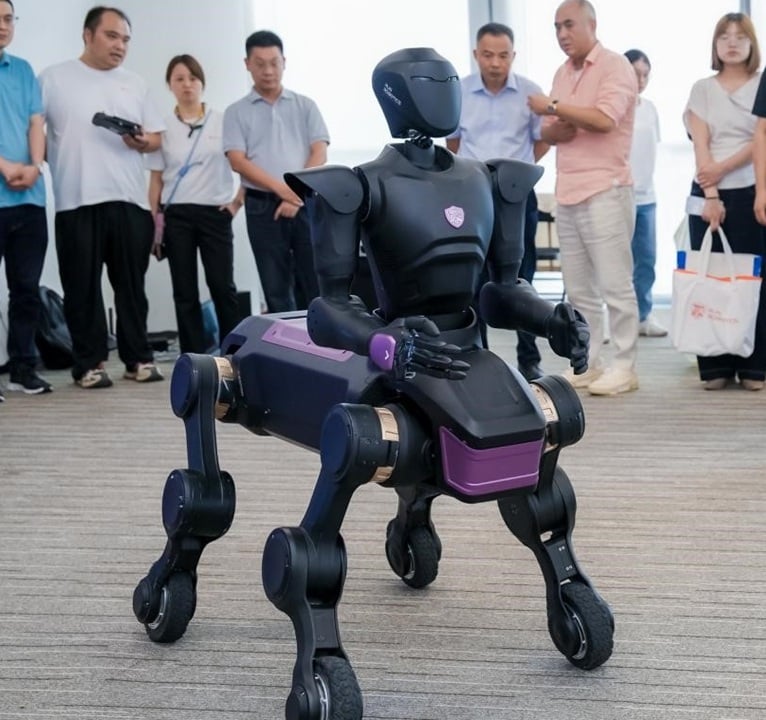
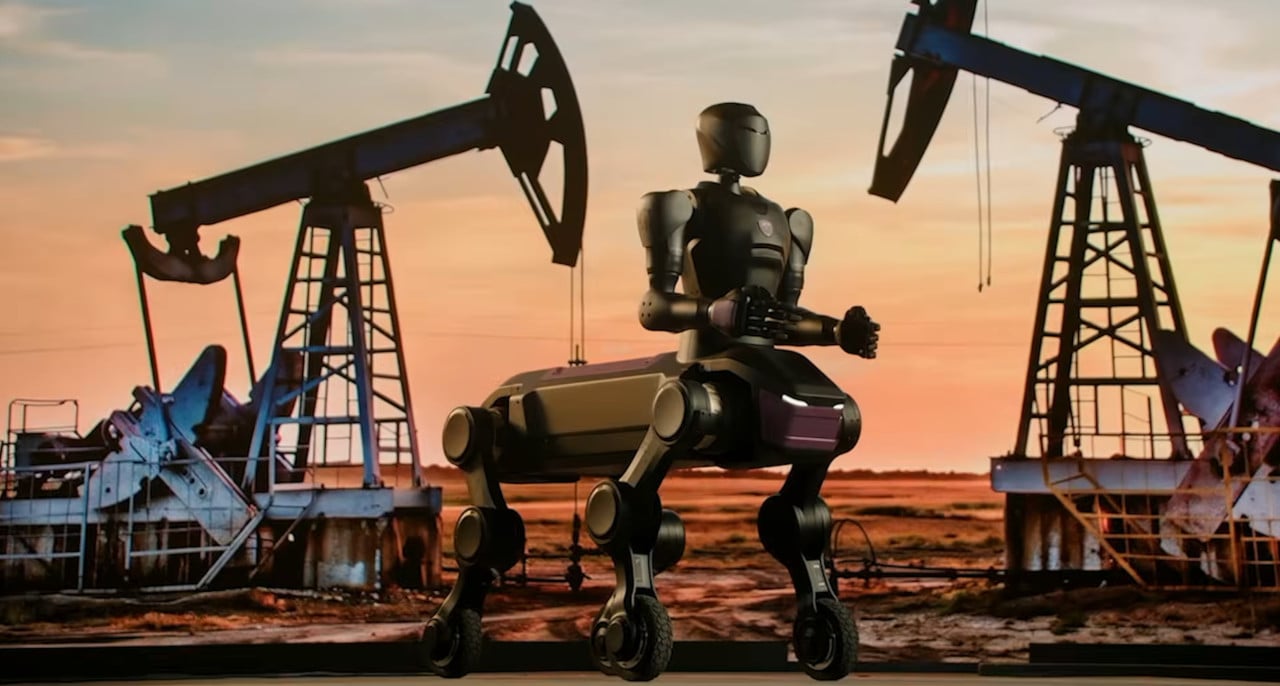
This July, a machine appeared at the Shanghai exhibition center that, at first glance, does not fit into any conventional category. At the WAIC 2026 conference, Shanghai-based Run Robotics unveiled a robot it calls a centaur. Below is a four-wheeled chassis designed for difficult terrain; above is a torso with two human-like arms. According to the company, it is the first machine of its kind in the world, and more than 95 percent of its components were supplied by domestic manufacturers. It is intended for places people would rather avoid: steelworks, oil fields, mines, and areas with elevated radiation levels.
Most so-called humanoids today try to walk on two legs. Run Robotics chose a different approach, dividing the machine's body into two parts with distinct functions. The lower half moves, while the upper half works.
The four-wheeled chassis can move quickly across level ground, and when it encounters stairs, ice, or a pile of debris, it switches into a configuration in which the wheels behave more like legs. The suspension continuously adapts to the terrain. The entire concept is based on this combination: the wheels provide speed, while the articulated suspension enables it to cross uneven surfaces. The upper section of the Centaur robot can clear obstacles, operate equipment, or assist in rescuing people. Its arms have more than thirty freely moving joints, and its hands can sense touch, allowing it to handle both a valve and a button on a control panel.
Company head Zhou Pin described the machine's development as the result of gradually refining the product rather than a one-off technological leap. According to him, the new design is intended to address problems that manufacturers have faced for years: robots adapt poorly to different operating environments, can perform too little actual work, and are difficult to deploy on a larger scale.
While moving, it can lift an average of one hundred to one hundred and twenty kilograms, and in a stationary position up to two hundred and ten kilograms. The chassis meets the requirements for operation in potentially explosive environments, while the company also emphasizes its low weight and reliability.
The platform is modular. Depending on requirements, it can be fitted with various upper-body configurations, ranging from a pair of arms and dexterous hands to multi-axis force sensors. A steelworks needs something different from the remote inspection of pipelines in an oil field, and the modular design is intended to provide precisely this kind of versatility.
The machine navigates autonomously. Its proprietary environmental perception system combines lidar, binocular camera vision, and depth cameras, which the robot uses to build a real-time image of its surroundings. It recognizes hot pipes, valves, gauges, obstacles, and people, determines their position and status, plans its own route, avoids obstacles, and identifies the location where it needs to work. All decision-making remains within the machine, from scanning the environment to completing the task.
Importantly, it works with controls designed for human hands. The facility does not need to be modified; the robot adapts to the equipment already installed in the building.
Run Robotics has its research and manufacturing base at the Zhangjiang Science City in Pudong, Shanghai, where it benefits from a closely interconnected supplier network, the availability of engineers, and support from the local government.
The company plans to complete an automated assembly line in the final quarter of this year, with small-scale production to follow. According to the company, it has already secured orders—even before the line has been built. If the machine proves in real-world operation what it demonstrated in Shanghai, this design may turn out to be better suited to hazardous industrial work than the much-discussed bipedal humanoid.
Sources: interestingengineering.com, tech.yahoo.com and superhuman.ai