

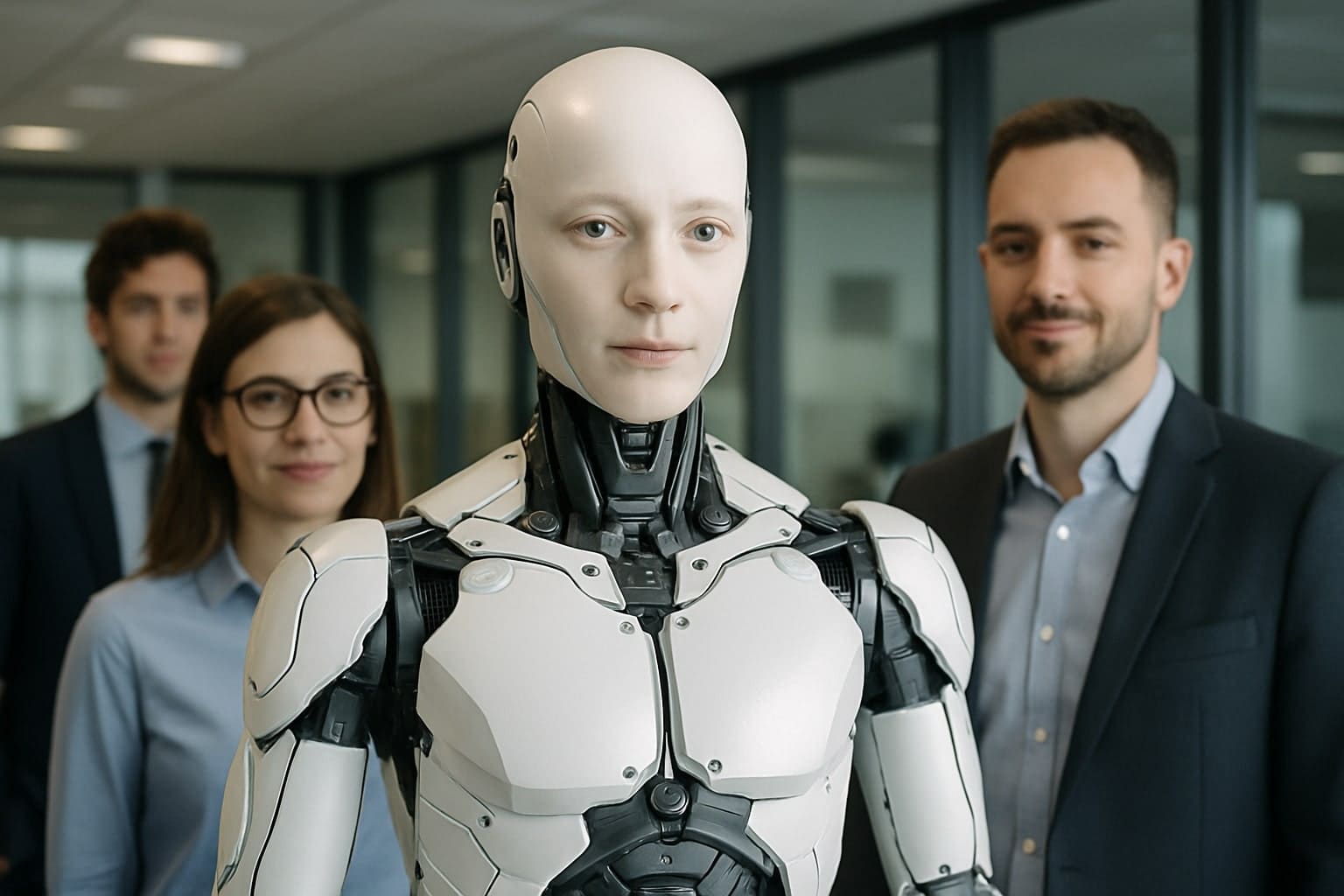
Artificial Employees Are Coming: Anthropic’s Warning About a New Era of Autonomous AI in Corporate Networks
Anthropic has issued a warning that should not go unnoticed. According to this leading AI company, we could witness the arrival of fully autonomous "virtual employees" powered by artificial intelligence as early as next year, operating within corporate networks. These are not merely chatbots or simple automation tools – these virtual workers will have their own digital identities, memory, corporate roles, and even unique access credentials to enterprise systems.
A New Era of Digital Workers Brings Security Risks
Imagine a situation in which your company employs a digital colleague who has their own email address, access to internal systems, and the ability to independently decide how to solve complex problems. Does it sound like science fiction? According to experts at Anthropic, this future is already just around the corner – and it brings with it a number of security questions to which we do not yet have clear answers. Jason Clinton, Chief Information Security Officer (CISO) at Anthropic, points to several key issues. "Unlike traditional bots or agents focused on narrowly defined tasks, these virtual employees will have much greater autonomy," Clinton explains. "This raises fundamental questions about what happens if an AI employee starts acting maliciously or makes a mistake – for example, gaining unauthorized access to sensitive systems during routine operations." The main security concerns include:
- Identity Management
Companies will have to rethink how they manage digital identities. Virtual employees will require secure user accounts with appropriate network access controls. It is not yet clear who will be responsible for managing these accounts and for the actions taken by autonomous AI. - Risks of Autonomy
Unlike current automated systems, these AI workers will be able to independently assess situations and act without direct human oversight. This significantly increases the potential damage in the event of an erroneous decision or system compromise. - Accountability
In cases where a virtual employee causes damage (for example, by compromising code repositories), it remains unclear who should be held responsible – the agent’s developer, the company that deployed it, or an entirely different party?
Microsoft and a New Era of Collaboration Between Humans and AI Agents
Alongside Anthropic’s warning, Microsoft is presenting its own vision of the future, in which humans and AI agents collaborate in the field of cybersecurity. Microsoft is already developing advanced AI systems that help security teams identify and respond to cyber threats much more effectively. "Traditional security teams are overwhelmed by the volume of alerts and potential threats. AI agents can process routine tasks and analyze data on an unprecedented scale, allowing human experts to focus on strategic decision-making and complex problems," says one of Microsoft’s researchers. While Anthropic warns of the risks, Microsoft emphasizes the potential benefits. However, both approaches share one common element – the need for robust security frameworks for working with AI systems integrated into corporate structures.
Industry Response and the Search for Solutions
The rise of new types of non-human identities in enterprise IT environments has already prompted cybersecurity companies to develop specialized tools. These tools are designed specifically for monitoring and managing virtual worker accounts. "We need entirely new classification systems and monitoring tools tailored to virtual workers, not just humans," explains a cybersecurity expert. "We need to maintain constant visibility into what AI employee accounts are doing at any given moment and be able to respond effectively if anomalous behavior is detected." Some companies have already experimented with integrating AI bots into organizational structures, but encountered resistance due to concerns about the impact on the human workforce. The rapid evolution of this technology means that security strategies must adapt just as quickly.
Potential Implications for the Future of the Workplace?
The integration of advanced artificial intelligence into workplaces is already challenging existing management structures and processes. With the arrival of autonomous virtual employees, it will be necessary to redefine fundamental concepts such as work responsibility, oversight, and performance evaluation. For managers and security teams, this means developing entirely new approaches:
- Robust Identity Management Systems – new frameworks for creating, monitoring, and terminating virtual employee accounts.
- Clear Definition of Responsibility – who is accountable for the actions of highly autonomous AI systems.
- Continuous Monitoring and Auditing – specialized tools for tracking virtual employee activities in real time.
- Ethical Guidelines and Regulatory Frameworks – clear rules governing what AI employees may and may not do.
Anthropic emphasizes that the security of virtual employees represents one of the most urgent areas for investment. The company itself has committed to rigorously testing its Claude models to ensure their resilience against cyberattacks, as well as to continuously monitoring security issues.
Prepare for the Future That Is Already Here
AI-powered virtual employees are not a distant future – according to experts at Anthropic, we will encounter them as early as next year. This reality brings both enormous opportunities for increased productivity and innovation and significant security risks that we must address now. For organizations, this means actively starting to consider how to integrate these new digital workers into their structures and processes. Security teams must develop new strategies and tools for monitoring and managing virtual identities in order to minimize the risks associated with the high autonomy of these systems. As Jason Clinton of Anthropic concludes: "The time to prepare is now. Organizations that begin addressing the security aspects of virtual employees today will be better prepared for the challenges of tomorrow." In an era when the boundaries between human and artificial workers are increasingly disappearing, a proactive approach to security will be key to successful digital transformation.


