In one of the halls in Austin, Texas, robotic humanoids undergo daily training. They stack boxes on conveyor belts, sort toys into bins, and place accessories into crates. People stand right beside them almost the entire time. Rather than doing real work, the robots are being trained.
Apptronik calls this facility a "robo park," and it has recently become one of the most interesting places in the robotics industry. Across nearly 90,000 square meters, machines are learning to work like humans. The facility operates seven days a week. Every movement, every attempt, and every failure is recorded. This generates tons of data used to train the artificial intelligence inside these robots.
The creation of a “data factory”
Jeff Cardenas and his team founded Apptronik in 2016. The company actually emerged from a university laboratory in Texas, specifically the Human-Centered Robotics Laboratory. Its origins were military: the project received funding through the U.S. military's DARPA Robotics Challenge, which sought machines capable of operating in disaster-stricken areas and during emergencies. Over time, however, Apptronik shifted its focus from selling individual components to offering a complete solution: a humanoid robot.
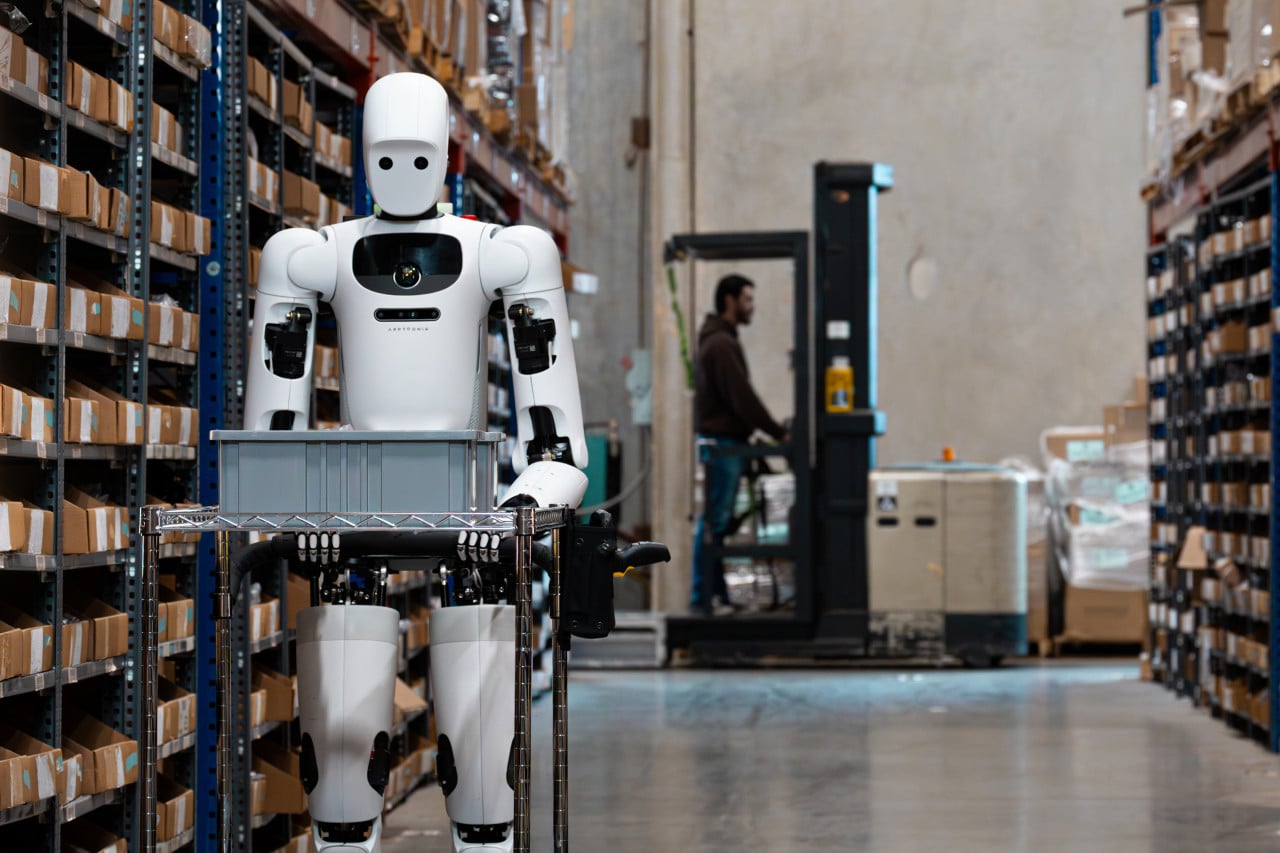
The Apollo robot was first unveiled to the public in 2023. It stands approximately 180 centimeters tall, weighs just enough to move safely, and can lift heavier objects. The current version, Apollo 2, is stronger and has a better battery and sensors. It can work for four hours and lift up to 25 kilograms with both hands. But Cardenas knows that building a good robotic body is not enough. A body without a brain is just a pile of metal. A brain is made from vast amounts of data.
When you enter the hall, you see a system resembling a cross between a factory and a playing field. Apollo robots stand at their stations, each accompanied by an operator. The operator controls the robot as it performs tasks, gives it instructions, and watches how it learns. Everything is recorded – every movement, every mistake, every success. “It's like a factory, but instead of manufacturing things, it manufactures insights,” Cardenas said in an interview. He compares the experience to a playground. The robots build practical experience here, which Cardenas calls a “data factory.”
Others have already come up with this idea as well. Elon Musk has discussed a similar concept for his Optimus robots, which he wants to place in something he calls the “Optimus Academy.” The idea is similar: to create an endless cycle of learning and improvement. Data from every hour is sent directly to the artificial intelligence in Apollo. The system gradually learns to handle objects better, maintain its balance more effectively, and avoid mistakes it has made in the past. The improvements take place within the algorithms.
Apollo robots are already in use
Apptronik is no longer purely a laboratory project. This year, the startup reached a valuation of $5.5 billion and has raised approximately $1 billion for its development. Its investors include Google and Mercedes. Mercedes is already using Apollo, deploying it in its factories for simple tasks such as collecting components and preparing them for assembly lines. So far, these are not complex tasks.
Google DeepMind, the company's research division, uses Apollo robots differently, employing them to improve its own robotics models. By observing how Apollo behaves in the real world, DeepMind can refine its own algorithms. Apptronik has ambitious plans and is now working on the third version of the robot, Apollo 3, which it intends to sell as a commercial solution. However, Cardenas declined to estimate exactly when it will enter the market.
Interestingly, Apptronik is doing something that few of its competitors are. It produces not only humanoid versions with legs but also versions on wheels. Cardenas believes that walking humanoids will be the most important in the future because, in theory, they could do anything a human can. In the near future, however, wheeled versions may have the best chance of succeeding. They are safer and consume less energy. Moving on two legs with a heavy battery inside the body is complicated, and a robot falling could cause significant damage.
Robotics is gaining momentum
Apptronik is not alone in this race, and the market is changing rapidly. San Jose-based startup Figure AI is currently valued at $39 billion and is already beginning to deploy its robots in logistics centers. Palo Alto-based company 1X plans to send more than 10,000 humanoids into homes this year, which effectively amounts to mass production. Agility Robotics is preparing for an initial public offering (IPO), and its Digit robot is already working at nine sites for companies such as Amazon and Toyota.
Cardenas sees the development unfolding in three phases. First, it had to be proven that the technology works. We are now in the second phase, in which it must be demonstrated that robots can generate revenue. The third phase will come when the entire operation becomes profitable. “Humanoids are like the personal computer for us. If you believe that's the case, then we're in 1980. We're in the era of spreadsheets and word processors,” Cardenas said. It is an analogy suggesting that everything is only just beginning.
Source: businessinsider.com