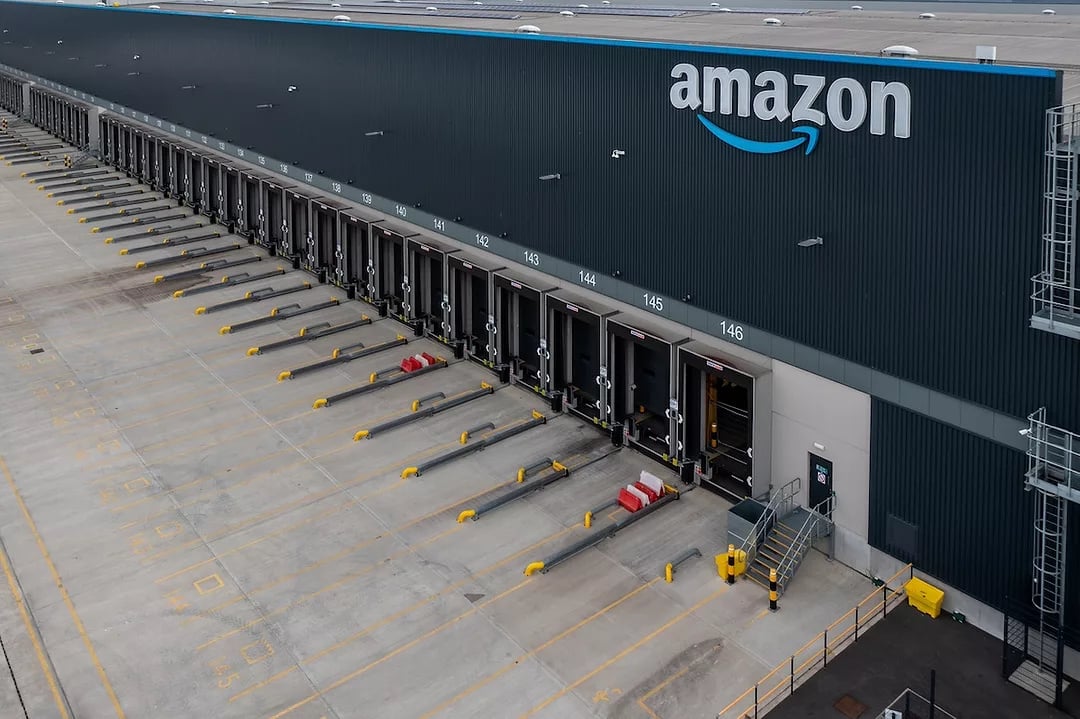
Laura works night shifts at an Amazon warehouse in northeastern Ohio. She operates a lift that raises her 40 meters above the ground. “I’m a treasure hunter,” she says jokingly. “I use the lift to look for things.”
The warehouse has not yet adopted the advanced robotic systems transforming other Amazon facilities. But automation is slowly creeping in. In the eighteen months Laura has worked at the facility, she has seen a dramatic change. The human resources (HR) team, which used to be physically based in the building, is now only available during regular business hours. On night shifts, she manages to see an HR employee once a week if she is very lucky. Never on weekends.
Last year, Laura’s cousin died. She tried to take a day off through the app, but a message appeared saying that she needed proof of their relationship. "The app blocked me because I didn’t have a death certificate," she recalls. She had to find someone from HR to help her. When she was later hospitalized, the app would not even let her request medical leave. She ultimately missed three days of work. All of this required a longer-term leave arrangement that took a month to resolve because the app kept requesting more medical documentation. "When I manage to find someone from HR, the first thing they ask me is whether I’ve tried using the app," Laura says. "But of course I’ve tried it if I’m already looking for a person."
Amazon Has Begun Replacing HR Staff with AI
Amazon has been explicit about its vision: it wants to be a leaner organization, with automation filling the gaps. “We want to operate like the world’s largest startup,” CEO Andy Jassy wrote in a 2024 letter to shareholders. Immediately afterward, he issued an order to eliminate an excess of managers. This approach manifested itself most clearly in HR, which became a primary target of layoffs.
As early as 2023, Amazon laid off more than 27,000 people in two waves, focusing primarily on HR staff. Less than a year earlier, the company had renamed HR “PXT,” short for People Experience and Technology. The name hinted at where things were headed. Another 30,000 layoffs followed over the past two years. Amazon says it was eliminating middle management to increase “ownership and efficiency.” HR chief Beth Galetti explained this in an announcement to employees. Yet Amazon emphasized the “transformative” impact of artificial intelligence in a press release. The CEO later claimed the opposite: “It’s not really AI-driven at all. Not right now, at least,” he said at a press conference. “It’s culture.”
The reality is different. Interviews with warehouse workers and former HR employees, along with legal documents, show that Amazon is indeed removing people from HR processes. This affects both warehouse workers and corporate employees.
Susan worked in HR for more than 15 years as an investigator. According to her, Amazon had been laying the groundwork for this transformation for more than a decade. As early as 2014, it was trying to reduce HR roles at individual warehouses. “When we started the projects, they told us clearly: The goal is to eliminate local HR as much as possible. We want everything to be self-service. Because hiring people for every warehouse simply isn’t scalable,” says Susan, who asked to remain anonymous.
Over time, Amazon worked to gradually shrink HR workspaces. At first they had two desks, then one. Then their working hours were reduced. Susan describes how Amazon eventually eliminated their permanent presence during shifts. Workers were only supposed to visit during their breaks. “You’ll wait in line for 25 minutes, then talk to someone for two minutes and miss lunch,” Susan explains. “People would then say to themselves: Hey, I’d rather talk to AI anyway. We took away enough of the benefits of going to HR staff in the first place. It simply pushed them into it.”
The Aza AI App
Amazon launched a chatbot called Aza, which warehouse workers have been using for years. While workers once had access to HR staff in person, they now handle everything through the app. The company says Aza is intended for the "simplest questions." According to its account, these questions make up the vast majority of what HR staff used to handle.
The reality, however, is very different. The number of HR workers in warehouses across the country has shrunk over the past two years. Workers used to have a group of HR employees based directly in the building. Now they may not encounter even one during an entire shift. In some places, HR coverage is even “shared” among warehouses. Images from Reddit and social media show empty desks with signs reading “Ask Aza.” These are the places where HR staff used to sit.
Italo Medelius works in North Carolina: “You never see anyone at the desk. I’ve seen a line of people waiting for someone from HR, but the guy never showed up. The last time I tried to speak with HR, there were about five people in line. Then a manager came out and said: the HR employee isn’t here. He only works from nine to ten in the morning.”
An anonymous worker from Georgia said that the reduction was never officially announced. Her warehouse used to have three to five employees. Now only one remains, and even then only on good days. No one is there at night or on weekends. The warehouse’s email contact stopped working. Unless someone goes there in person, the app is their only remaining option. "When I started, HR was more helpful," she recalls. "Problems were resolved within five to ten minutes." Now, even when staff are present, "there’s very little they can do. They mostly just show you how to use the app."
Some workers turn to the anonymous Voice of Associates (VOA) forum, where they can share their complaints with management. Ron Sewell from Georgia recommends it: "I tell everyone that VOA is the most useful thing. Just be polite and professional." Yet the Aza app is unable to handle complex cases. The chatbot often provides only generic answers instead of specific information. Workers become trapped in a loop in which the app refers them to a person who does not exist or is unavailable. If they do find someone, that person refers them back to the app.
David works in New York. He wanted to reduce his working hours, which had been cut to ten hours a week. Submitting a request to HR accomplished nothing. Managers were unable to explain why. "The problem either resolves itself or it doesn’t. And you just have to live with it somehow," he says. "At Amazon, it isn’t worker versus manager. It’s the system versus everyone." Amazon uses a points system for workers on flexible schedules. Eight points means termination. David somehow accumulated four points without explanation. Sometimes it was a mistake. Sometimes the app simply crashed.
Hope Lost in a Loop. When a Computer Replaces a Human
Warehouse workers have almost limitless reasons for needing help from HR. Problems getting time off approved, sick leave, pregnancy, workplace injuries. If you take more unpaid days than you have available, you can be fired. Thousands of people go through this process.
April Watson had worked in Georgia since 2021. At first, there were at least six HR employees there. At the beginning of this year, two remained. Then they disappeared entirely. Watson suffered a concussion. A neurologist said she needed to work more slowly and limit physical exertion. She had all the medical paperwork. Even so, she waited more than a month for her request to be approved. This was partly because the chatbot produced the wrong form. In the meantime, she was disciplined for mistakes and slow performance.
Her case is not unique. In recent years, several groups of workers have filed lawsuits. They claim Amazon denied them reasonable accommodations. Among them was Cayla Lyster, a New York warehouse worker diagnosed with Ehlers-Danlos syndrome. She claims Amazon failed to accommodate her properly when it changed her duties in 2023. According to the lawsuit, she was forced to take unpaid leave while waiting for approval. Amazon then reduced her available balance of unpaid days, putting her at risk of being fired. The federal Equal Employment Opportunity Commission later determined that Amazon had violated disability law by denying warehouse workers necessary accommodations or failing to implement them properly.
Othea Jones, a former warehouse worker from Texas, had a stroke at work. A doctor said she needed accommodations. Yet the app rejected her requests. She had to take time off. Two months later, she was fired for excessive absenteeism. The lawsuit claims that Amazon "does not engage in a good-faith dialogue about reasonable accommodations, partly because the app is simply not designed to allow it". It adds that the app is a complete disaster.
It is not just warehouse workers. Amazon’s corporate division is currently implementing a mandatory return to the office. Engineer Eleazar Zwillinger was unable to upload medical documentation to the MyHR portal. The chatbot told him to open a new case using a button that did not exist. A consultant later admitted that there was "pressure to deny accommodations".
Christi Springer, another corporate employee, received a call from HR after her role was eliminated. "It sounded like an AI voice," she said.
Ashley Cook worked as a cloud engineer. She was experiencing health problems and needed to work from home and take occasional breaks. Her manager told her to apply through the app. Amazon approved her medical leave, but then extended it without her consent. Each time, she was told that her medical documents were insufficient. She uploaded them multiple times. When she tried to discuss a new position, her manager again referred her to the app. Like the warehouse workers, she was trapped.
AI Makes Decisions for People and Leaves HR Powerless
Courtney Badger worked in the HR department. She was laid off in May. She says thousands of HR workers lost their jobs in the past year. Her role involved investigating complaints from warehouse workers. As Amazon laid off HR workers, Badger received more complaints. Workers had no one else to turn to. "I noticed the lack of an HR presence," she says. "The fewer people there are on-site, the more people file claims with HR. That shouldn’t happen, but unfortunately the opposite is true." Her job required coordinating with local HR staff, who then made the final decisions.
Over nearly a year, she watched Amazon automate more and more of her responsibilities. Then it intensified the pressure. A tool to transcribe her calls with workers. Amazon Quick Suite to write reports. "As things became automated, expectations for how quickly we had to work kept increasing," she says. "When I started, I had to complete four cases a week. When I left, they said that automation had sped things up and I had to close nine cases a week." Her team struggled to keep up with the volume. It was difficult to be thorough and give cases and people the attention they deserved. "Amazon is so metrics-driven," she says. "There’s just a lot of pressure around it."
The company’s vision was for AI to do almost everything Badger did. Everything except phone calls with workers. When she was laid off, she was told: we don’t need as many of you anymore because we have AI. "It’s called Human Resources," she says. "There should be a human element. I saw the human presence disappear from that work during my time there."
Susan, a former conflict resolution specialist with fifteen years at Amazon, sees the same thing. The team gradually became more centralized over the years. But in 2025, Amazon issued an order: everyone had to relocate to one of a handful of offices. Anyone who refused had to leave. "That was a direct strategy for reducing headcount," Susan says. Before this pressure began, the team had more than 100 people. Now around 20 remain. Susan acknowledges, however, that AI tools really did make her more productive. "I was the top performer almost every week," she says. "And I’ll tell you this: What would normally take me 40 hours, I could easily do in eight."
She watched Amazon invest in automation for years. But now she is seriously wondering: will there even be any HR jobs left in five years? "When companies start automating, we always provided value by being able to sit down and defuse a situation. But beyond that, there’s nothing we do that a computer couldn’t. It’s scary. Really scary," Susan concludes.
Meanwhile, Amazon itself has already laid off thousands of HR workers and made clear which path it wants to follow. Its human resources department had more than ten thousand employees globally in 2025, while its total workforce exceeded 1.57 million.
The daughter of Laura, the Ohio warehouse worker, worked in HR. She saw where things were heading and managed to move into another position before the wave of layoffs arrived. "HR became a computer job. You enter something into a computer and the computer gives you an answer. That’s why she left," Laura says. Two weeks after her departure, her friends in HR lost their jobs.
Badger is not alone in her concerns. According to a survey shared by the organization United for Respect, more than half of workers at Amazon and Walmart had the same fear. The main concern was how HR decisions were being handed over to automated systems.
Source: fastcompany.com