

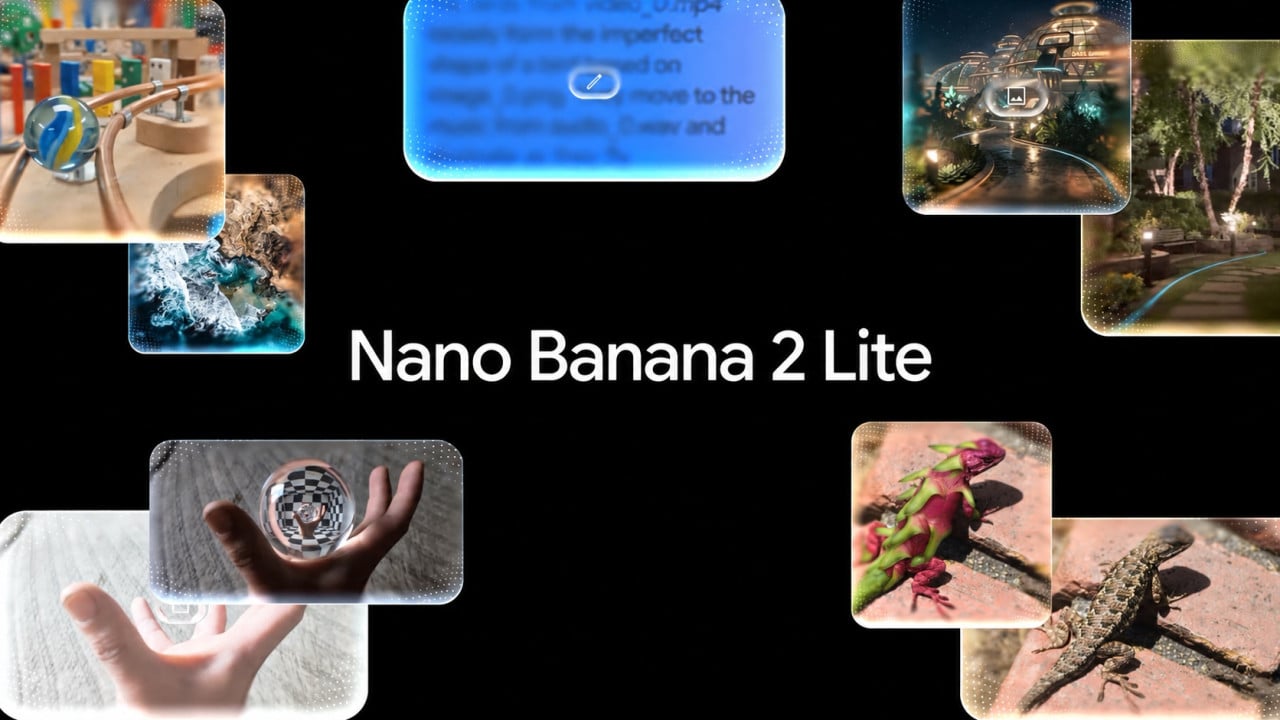
Google unveiled two tools at once on Tuesday. Nano Banana 2 Lite can create an image in four seconds and costs a fraction of what it did before. Alongside it, the company expanded access to the Gemini Omni Flash model, which creates video and can edit it through ordinary conversation. Both are aimed primarily at developers and creators who need to produce content quickly and at scale.
Images, advantages and disadvantages
Nano Banana 2 Lite is the fastest and most cost-effective image model in the Nano Banana series so far. Google has reduced its so-called latency, meaning the time it takes for the model to respond. This is useful when you need to quickly sketch out an idea, run through dozens of them in succession, and choose the right one. A thousand images cost $0.034. For someone who creates designs at scale and keeps a close eye on costs, it is an attractive offer.
The model is optimized for speed, not maximum quality. Even so, according to Google, it maintains solid prompt fidelity, character consistency across images, and legible text rendered directly in the image. The company recommends it as a direct replacement for the original Nano Banana, which it now labels as an older model, and advises developers to switch to the new version.
Google has divided its offering into several tiers. Nano Banana 2 remains the general-purpose model for everyday work because it offers a good balance of quality, speed, and price. Above it is the more powerful Nano Banana Pro for demanding professional tasks where accuracy is more important than speed. The new Lite version occupies the lowest tier, where the main priorities are volume and low cost.
Video you can edit with a command
The second new development is the broader rollout of the Gemini Omni Flash model. Google first showed it at its I/O developer conference at the beginning of the year, and it is now becoming available to developers through the Gemini API and Google AI Studio. The model creates and edits video using a combination of text, images, and video. It costs $0.10 per second of output, the same as the Veo 3.1 Fast model.
Omni Flash can edit video using natural language, combines different inputs to keep scenes consistent, and draws on the Gemini model's knowledge in areas such as history and biology. It can also synchronize text and graphics directly with the action in the video.
The model still has its limitations. It creates ten-second videos, with longer ones expected later. Uploading audio references through the API does not work yet, and character consistency has some gaps when scenes change or the camera moves. Google promises improvements.
Both models together
The most interesting results emerge when the tools work together. Nano Banana 2 Lite quickly generates an image, which then serves as a reference for Gemini Omni Flash to animate into a video. Thanks to the so-called Interactions API, up to three edits can be chained together in a single session while the model retains the context.
Google has also released several sample applications. One of them, Anywhere, transports you from an uploaded photo to dozens of famous locations and turns the result into a short animated clip with a click. The Space Lift app transforms a photo of a room into interior design concepts in various styles and turns them into a video with a single tap. The third, Omni Product Studio, converts static product images into e-commerce videos.
Drawbacks of rapid content creation
Some users complain about so-called AI slop, meaning the internet being flooded with mediocre machine-generated content. Despite this, technology companies continue to pour money into these tools. Google primarily markets its models as assistants for creating advertising content.
Tensions are also growing between Hollywood and technology companies. Google recently signed a $75 million deal with the popular independent studio A24. The partnership drew heavy criticism from fans.
Nano Banana 2 Lite is rolling out not only on developer platforms but also in Google's mainstream products. You can find it in AI Mode in Search, the Gemini app, NotebookLM, Google Photos, Stitch, Google Flow, and Google Ads. Both models mark generated content with a SynthID watermark, which is intended to help identify it as a creation of artificial intelligence.
Source: techcrunch.com


