Anthropic Introduces Sonnet 4.5: The Best Model for Coding and Agents
Anthropic has just released Claude Sonnet 4.5, a model that is becoming the world leader in coding. This model excels at building complex agents and operating computers. It also brings significant improvements in reasoning and mathematics. Code is part of every application, spreadsheet, or tool that people use every day. The ability to operate these tools and solve challenging problems defines modern work.
Along with the model comes a range of product improvements. Claude Code now includes checkpoints that save progress and allow an immediate return to a previous state. The terminal interface has been refreshed, and a native extension for VS Code has been added. A new context editing feature and memory tool in the Claude API allow agents to run longer and handle greater complexity. Claude apps now support code execution and file creation directly within conversations, including spreadsheets, presentations, and documents. The Claude for Chrome extension is available to Max users who joined the waitlist last month.
Anthropic is sharing the building blocks it uses for Claude Code. This package is called the Claude Agent SDK. The infrastructure that powers its cutting-edge products and enables them to reach their full potential is now available to developers.
This model is the most aligned frontier model Anthropic has ever released. It delivers major improvements in several areas of alignment compared with previous Claude models. Claude Sonnet 4.5 is available everywhere right now. Developers can use it through the Claude API under the name claude-sonnet-4-5. Pricing remains the same as for Claude Sonnet 4: CZK 69 per million input tokens and CZK 345 per million output tokens.
Frontier Intelligence in Practice
Claude Sonnet 4.5 achieves state-of-the-art results on SWE-bench Verified, which measures real-world software coding capabilities. In practice, it can remain focused on complex, multi-stage tasks for more than 30 hours. On OSWorld, a benchmark that tests AI models on real-world computer tasks, Sonnet 4.5 leads with 61.4%. Just four months ago, Sonnet 4 led with 42.2%. The Claude for Chrome extension brings these capabilities to the browser, where the model navigates websites, fills in spreadsheets, and completes tasks.
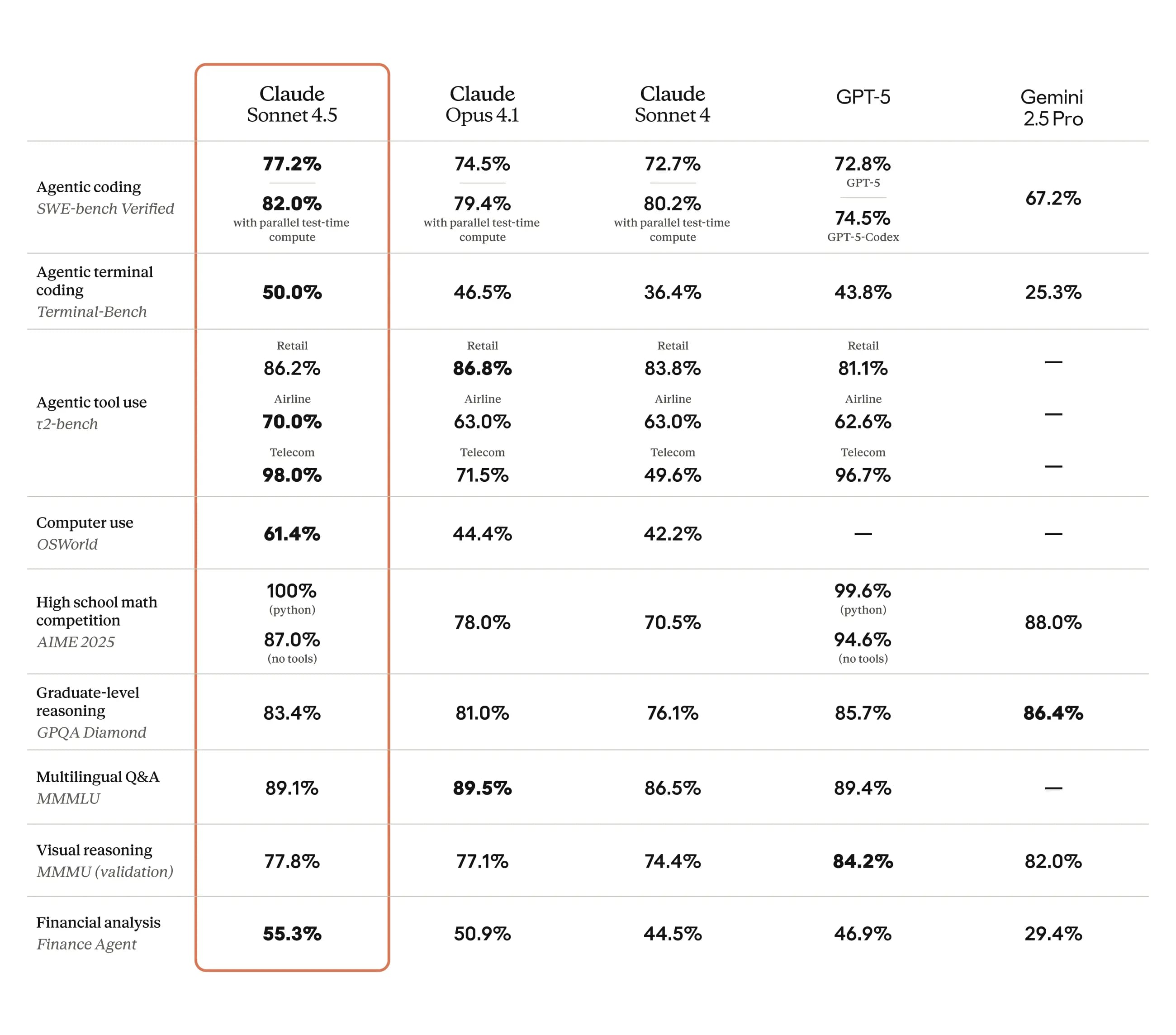
The model improves performance across a range of evaluations, including reasoning and mathematics. Experts in finance, law, medicine, and STEM fields found that Sonnet 4.5 offers dramatically better knowledge and reasoning in specific domains than older models, including Opus 4.1.
Experiences from early customers confirm these capabilities. For example, the team at Cursor praises its state-of-the-art coding performance, with significant improvements on long-running tasks. GitHub Copilot reports improvements in multi-stage reasoning and code understanding, enabling better handling of complex tasks across an entire codebase.
The Most Aligned Model Yet
Claude Sonnet 4.5 is not only the most powerful but also the most aligned frontier model. Improved capabilities and extensive safety training reduce problematic behaviors such as sycophancy, deception, power-seeking, or encouraging delusions. For agentic and computer-use capabilities, the model offers significantly stronger defenses against prompt injection attacks, one of the greatest risks to users.
Detailed safety and alignment evaluations, including tests using mechanistic interpretability techniques, are available in the Claude Sonnet 4.5 system card. The model is being released under AI Safety Level 3 protections according to Anthropic's framework, which links capabilities with appropriate safety measures. These include filters that detect potentially dangerous inputs and outputs, especially those related to chemical, biological, radiological, and nuclear weapons.
These filters occasionally flag normal content by mistake. Users can easily continue their conversations in Sonnet 4, which poses a lower risk. Anthropic has reduced false positives tenfold since the original description and by half since the release of Claude Opus 4 in May.
Claude Agent SDK for Building Agents
Anthropic spent more than six months improving Claude Code, so it understands what it means to build and design AI agents. It tackled difficult problems such as memory management across long-running tasks, permission systems that balance autonomy with user control, and coordinating subagents toward a shared goal.
Now it is sharing all of this. The Claude Agent SDK uses the same infrastructure as Claude Code but delivers benefits for a wide range of tasks, not just coding. Starting today, it can be used to build custom agents. Anthropic built Claude Code because such a tool did not yet exist. The Agent SDK provides the same foundation for solving any problem.
Bonus Research Preview
Alongside Claude Sonnet 4.5 comes a temporary research preview called Imagine with Claude. In this experiment, Claude generates software in real time. No functionality is predetermined, and no code is prewritten. You can watch Claude create instantly, respond, and adapt to requests during the interaction.
It is a fun demonstration of what Claude Sonnet 4.5 can do—combining a capable model with the right infrastructure. Imagine with Claude is available to Max subscribers for five days. You can try it at claude.ai/imagine.
Claude Code Improvements for Autonomous Work
Anthropic is bringing several improvements to Claude Code: a native extension for VS Code, version 2.0 of the terminal interface, and checkpoints for autonomous operations. Powered by Sonnet 4.5, Claude Code can now handle longer and more complex development tasks in the terminal and IDE.
The VS Code extension, available in beta, brings Claude Code directly into the IDE. Users can see changes in real time through a side panel with inline diffs. This provides a richer graphical environment for those who prefer IDEs over terminals.
The refreshed terminal interface offers better status visibility and searchable prompt history (Ctrl+r), making it easier to reuse or modify previous inputs.
For teams that want custom agentic experiences, the Claude Agent SDK provides access to the core tools, context management systems, and permission frameworks that power Claude Code. Support for subagents and hooks has been added, increasing customizability for specific workflows.
Checkpoints automatically save the state of the code before each change, and users can immediately revert by pressing Esc twice or using the /rewind command. When reverting, users can restore the code, the conversation, or both. Checkpoints apply to Claude's edits, not user changes or bash commands, and it is recommended to combine them with a version control system.
Subagents delegate specialized tasks, such as running a backend API while the main agent builds the frontend, enabling parallel development. Hooks trigger actions at specific points, such as running tests after code changes or linting before commits. Background tasks keep long-running processes, such as development servers, active without blocking progress.
These updates are available to Claude Code users. Sonnet 4.5 is the new default model and can be changed with the /model command. The VS Code extension can be downloaded from the VS Code Extension Marketplace. Terminal updates, including checkpoints, are available to everyone after updating their installation. Documentation for the Claude Agent SDK is available in the docs.
Context Management on the Claude Developer Platform
Anthropic is introducing new capabilities for managing agent context on the Claude Developer Platform: context editing and a memory tool. With the latest Claude Sonnet 4.5 model, these features allow developers to build AI agents that can handle long-running tasks with better performance without reaching context limits or losing key information.
Context windows have limits, but real-world work does not. As production agents process more complex tasks and generate more tool results, they often exhaust their effective context windows. Developers must then choose between shortening transcripts or accepting reduced performance. Context management addresses this in two ways: it ensures that only relevant data remains in context and that valuable insights persist across sessions.
Context editing automatically removes outdated tool calls and results from the context window as the token limit approaches. As an agent performs tasks and accumulates results, context editing removes old content while preserving the flow of the conversation. This effectively extends agent runtimes without manual intervention and improves model performance because Claude focuses only on relevant context.
The memory tool allows Claude to store and consult information outside the context window through a file system. Claude can create, read, update, and delete files in a dedicated memory directory stored in your infrastructure, which persists across conversations. This allows agents to build knowledge bases over time, maintain project state across sessions, and refer to previous insights without needing to keep everything in context.
The memory tool operates entirely client-side through tool calls. Developers manage the storage, giving them full control over the data. Claude Sonnet 4.5 improves both capabilities with built-in context awareness—it tracks available tokens across conversations for more efficient management.
Together, these updates improve agent performance: they enable longer conversations by removing old tool results, increase accuracy by storing key information in memory, and carry learning across sessions.
Claude Sonnet 4.5 is the best model for building agents. These features open up possibilities for long-running agents—processing entire codebases, analyzing hundreds of documents, or maintaining extensive histories of tool interactions. Context management builds on this by ensuring efficient use of expanded capacity in workflows that exceed fixed limits. Use cases include coding, where context editing removes old file reads and tests while memory preserves debugging insights; research, where memory stores key findings and editing removes old search results; or data processing, where agents store intermediate results in memory and editing removes raw data.
In an internal evaluation of agentic search, context management improved performance on complex, multi-stage tasks by 39% when memory and context editing were combined compared with the baseline. Context editing alone delivered a 29% improvement. In a 100-step web search evaluation, context editing made it possible to complete workflows that would otherwise have failed due to context exhaustion while reducing token consumption by 84%.
These capabilities are available in public beta on the Claude Developer Platform, both natively and in Amazon Bedrock and Google Cloud’s Vertex AI. Documentation is available for context editing and the memory tool, along with a cookbook containing additional information.