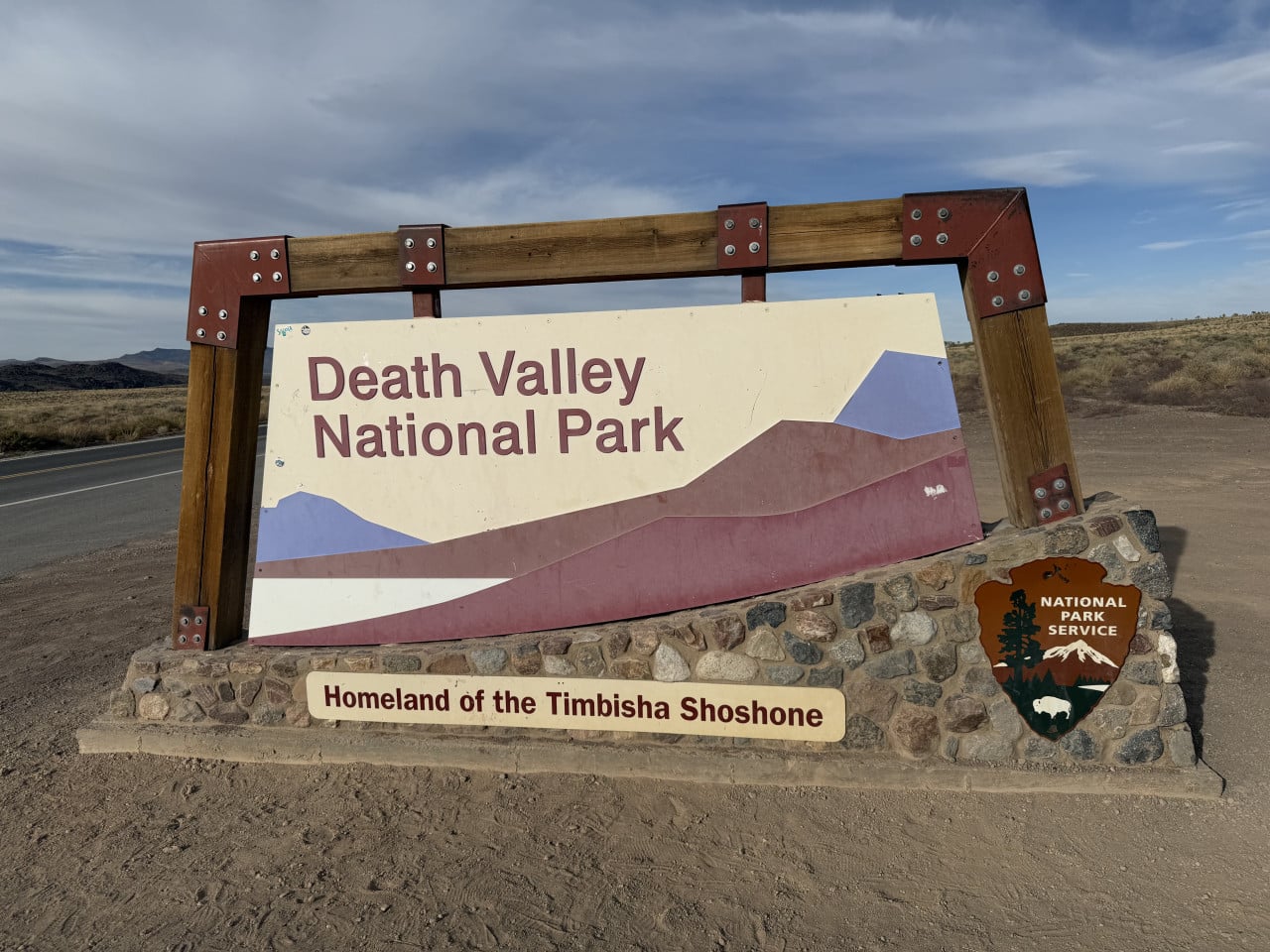
On the way from Death Valley, we stopped at Death Valley Junction. I had been looking forward to this moment more than anything else that day because this is where you’ll find the Amargosa Opera House – a hotel considered one of the most haunted in the entire United States.
I had always wanted to see it with my own eyes. A few years earlier, when I was in the area, I had originally planned to visit, but in the end I didn’t have time – I went somewhere else and ended up at Area 51. This time, I included it in the itinerary, so there was time for it and I wasn’t going to miss it.
What made it even more tempting was that the hotel had rooms available on Booking and could be reserved. I seriously considered staying there overnight because, according to reviews, visitors report all kinds of strange experiences. Apparently, cabinets move on their own at night, footsteps can be heard in empty hallways, and certain objects change position. These things interest me – not that I explicitly believe in ghosts, but I do believe there are things we don’t yet understand or are unable to perceive.
How the Amargosa Opera House came to be and why it is allegedly haunted
To explain why this place is so unusual, I have to start at the beginning.
Death Valley Junction was established as a mining town in the early 20th century. In 1914, the Pacific Coast Borax Company built a railway station here along the route from the mines in Death Valley, which transported borax – a mineral used in everything from cleaning products to cosmetics. Between 1923 and 1925, architect Alexander Hamilton McCulloch designed the entire complex of buildings in the Spanish Colonial style. It included a hotel with 23 rooms, offices, workers’ accommodations, a store, a dining hall, and a community hall named Corkhill Hall, where films were screened and dances, religious services, and funerals were held.
However, when borax mining declined in the 1960s, the town gradually became depopulated. The railway had stopped operating as early as 1940, the residents dispersed, and the buildings began to fall into disrepair. Death Valley Junction became a ghost town with only a handful of remaining residents.
And this was when the woman who saved the place entered the scene – Marta Becket.
Marta was born in New York in 1924. She had danced from a young age – performing as a ballerina at the legendary Radio City Music Hall and appearing on Broadway in musicals such as Show Boat and Wonderful Town. In the 1960s, she took her one-woman show on tour through rural America, performing in small theaters and school auditoriums.
Then came the fateful day – in March 1967, Marta and her husband were driving through the desert on their way to a performance in Los Angeles when they got a flat tire. They stopped in Death Valley Junction, where a gas station was still operating across from the main complex of buildings. While the car was being repaired, Marta explored the abandoned buildings and peered through a hole in the door of the old community hall. Inside, there was complete chaos – a wooden floor covered in mud from flooding and walls stained with rust from the leaking roof. But Marta later recalled that the building spoke to her. She immediately knew this was where she wanted to create.
She returned the next day, reached an agreement with the caretaker, and rented the hall for $45 a month on the condition that she would pay for all repairs herself. Together with her husband, she leveled the floor, expanded the stage, and painted the walls. The first performance took place on February 10, 1968 – exactly 12 people attended.
During the first few years, not many people visited Death Valley Junction, and Marta often danced in a completely empty hall. One day, after another flood had covered the floor with half a meter of mud, she looked at the bare walls and had the idea that would define the entire place: she would paint her own audience. She began on the back wall – a Spanish royal court, nobles, nuns, ladies-in-waiting, and cardinals. It took her four years to complete the walls and another two to finish the ceiling. In the meantime, her husband, who had started working at a nearby bar, found a girlfriend and left.
Marta stayed. Alone, in the middle of the desert, with her painted audience.
The turning point came in 1970, when journalists from National Geographic “discovered” her during a performance without a single audience member. An article in Life magazine followed, and suddenly the whole world knew about the Amargosa Opera House. Visitors began arriving from Europe, Japan, and Australia. Her audiences also included notable figures such as writer Ray Bradbury and comedian Red Skelton. A documentary about her life, Amargosa, won an Emmy Award in 2003.
Marta performed every Friday, Saturday, and Monday without exception – for more than forty years. She gave her final performance in February 2012, at the age of 87. She died on January 30, 2017, at the age of 92, in her home directly behind the opera house, surrounded by the stray cats she had rescued throughout her life.
And it was after her death that reports of paranormal activity in the hotel multiplied.
Then again, it was supposedly haunted long before that. The unrestored part of the hotel, nicknamed “Spooky Hollow” by the staff, was notorious for strange sounds and unexplained phenomena. Guests reported footsteps in empty hallways, the crying of invisible children, mysterious scents, and objects moving inside locked rooms. The ghost of Tom Willet – Marta’s life partner and fellow performer – is allegedly seen sitting in one of the chairs during performances. And, of course, there is also the mysterious cat reportedly seen by both audience members and staff, even though there is no living cat in the building at the time.
The Amargosa Opera House has also been investigated by television crews from paranormal shows – the team from Ghost Adventures filmed there in 2010, followed by The Dead Files in 2013. Both confirmed unusual activity.
The journey through the desert and first impressions
You can reach Death Valley Junction either from Death Valley or from the direction of Las Vegas – but whichever route you choose, there is absolutely nothing anywhere for a very long time. And I really mean nothing. No village, no gas station, no store. Just a straight road, the desert, and silence.
That day, we drove from Los Angeles, from Universal Studios and Hollywood, through the entire Death Valley National Park and all the way here. We spent 6.5 hours in the car that day and covered 604 kilometers – quite a journey. But since we had left in the morning, we had enough time to explore Death Valley at our leisure, and the girls got a sense of what the desert landscape looks like.
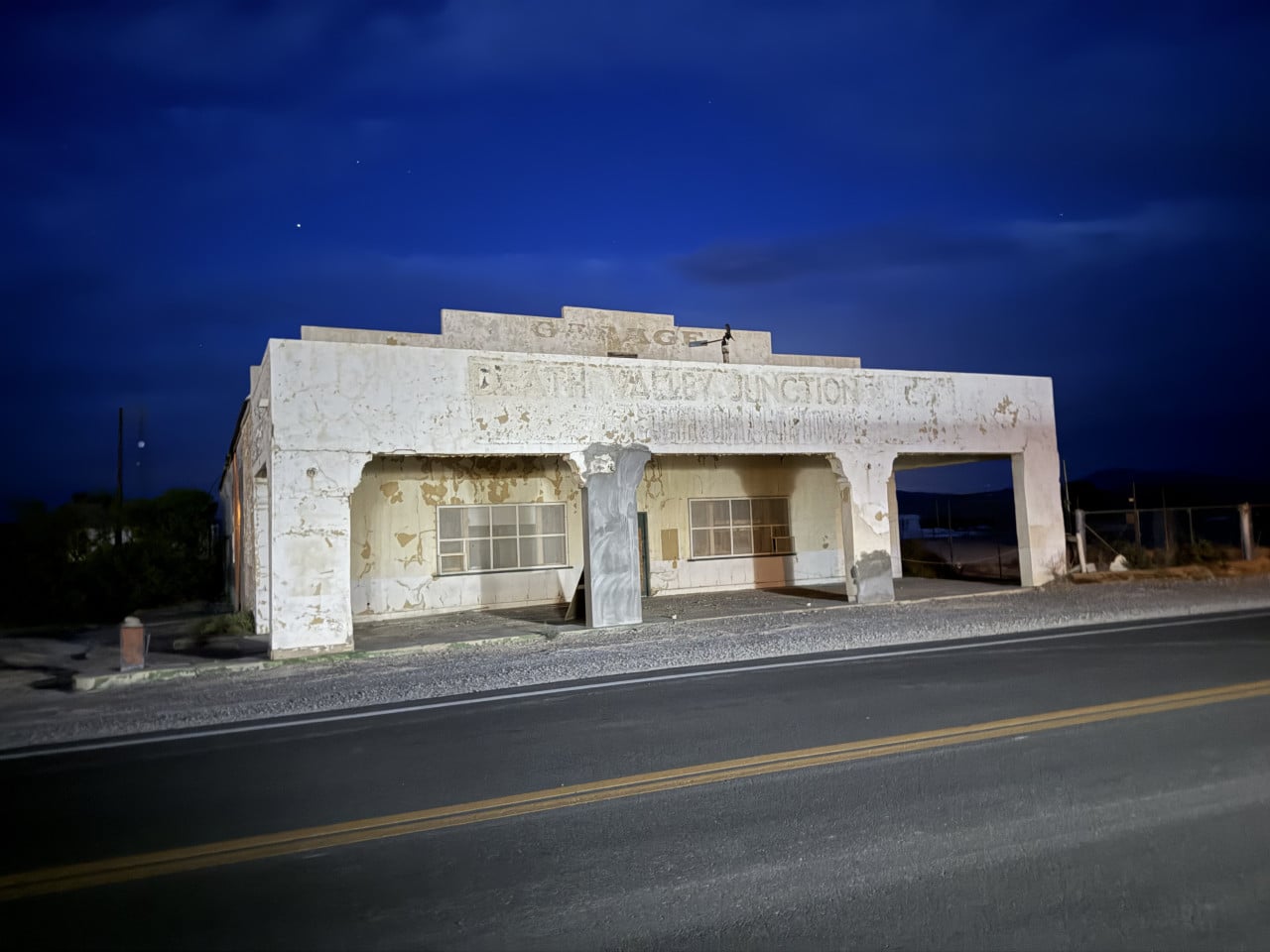
When we finally arrived at Death Valley Junction, there was practically nothing there apart from the Amargosa Hotel. Across the road stood an old abandoned building – I think it used to be a gas station or a store – but it was completely abandoned, completely deserted. And I believe there is absolutely nothing for dozens of miles around. Death Valley lies on one side, where it takes two hours to reach civilization, and it also took us a very long time to get to Vegas afterward.
Arriving in the evening and the atmosphere that captivated us
We arrived in the evening, and the hotel operates a little differently from what people are used to. The reception desk was already closed, but I knew in advance that we would need to call and make arrangements. I was prepared for that.
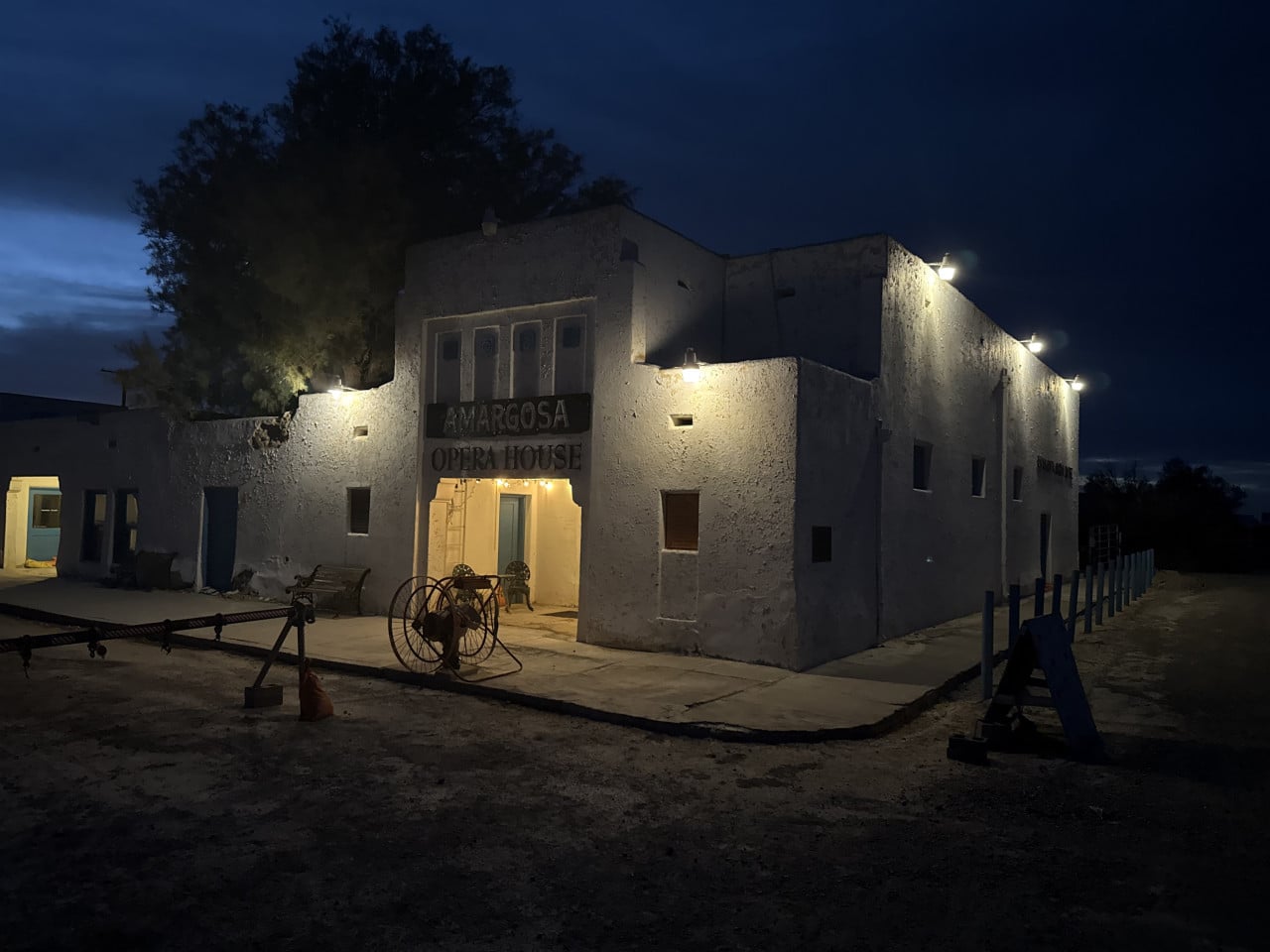
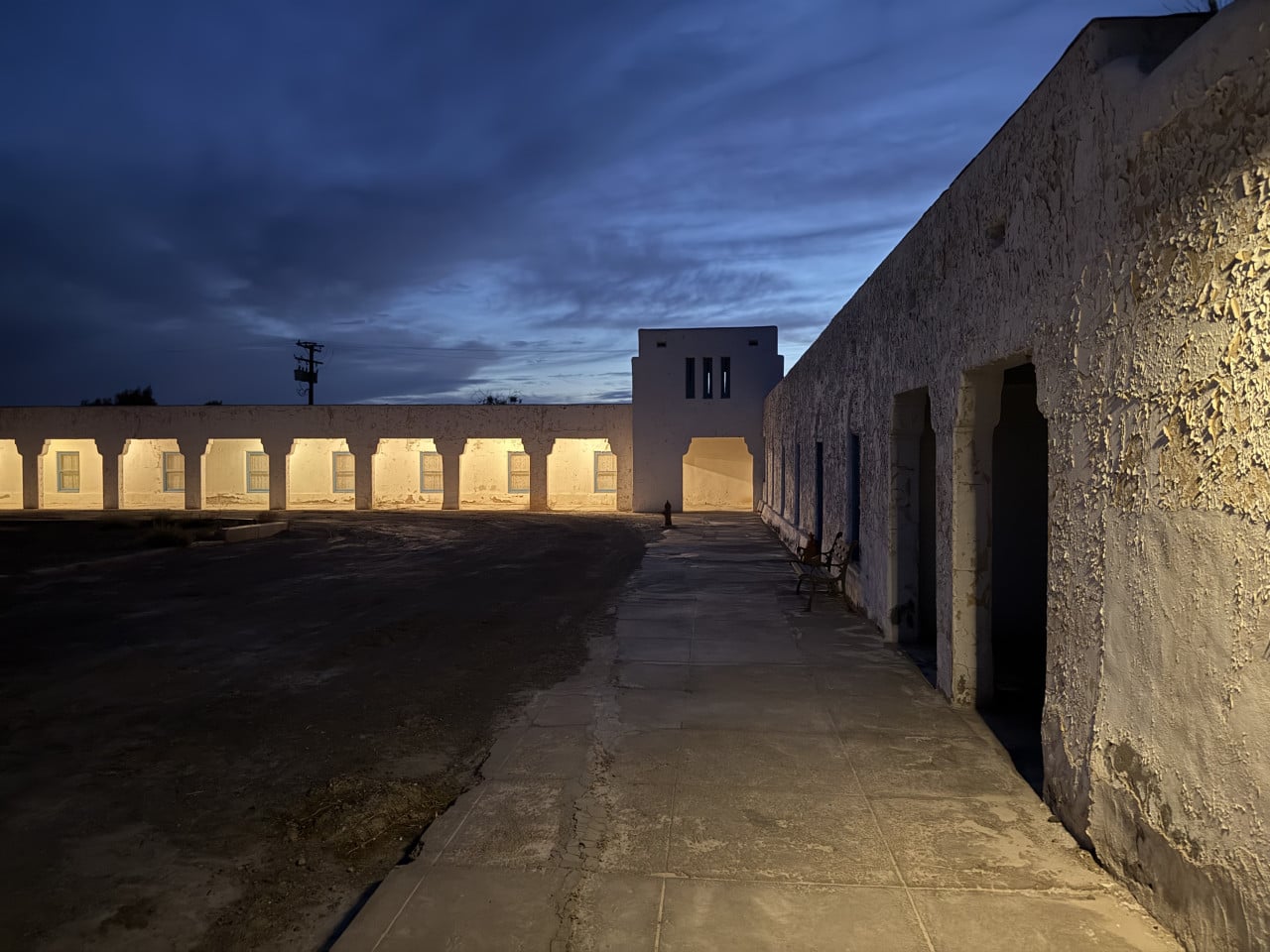
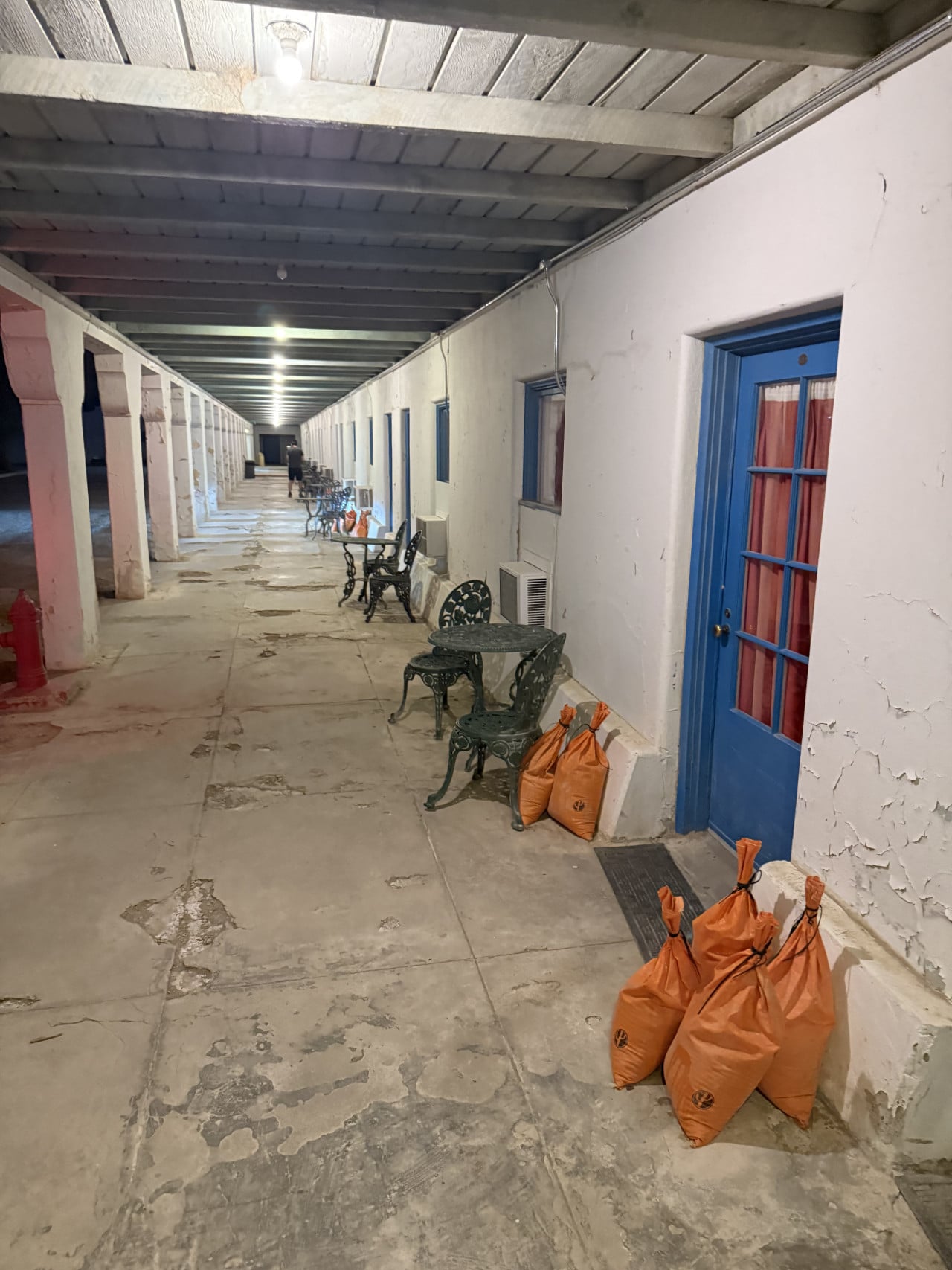
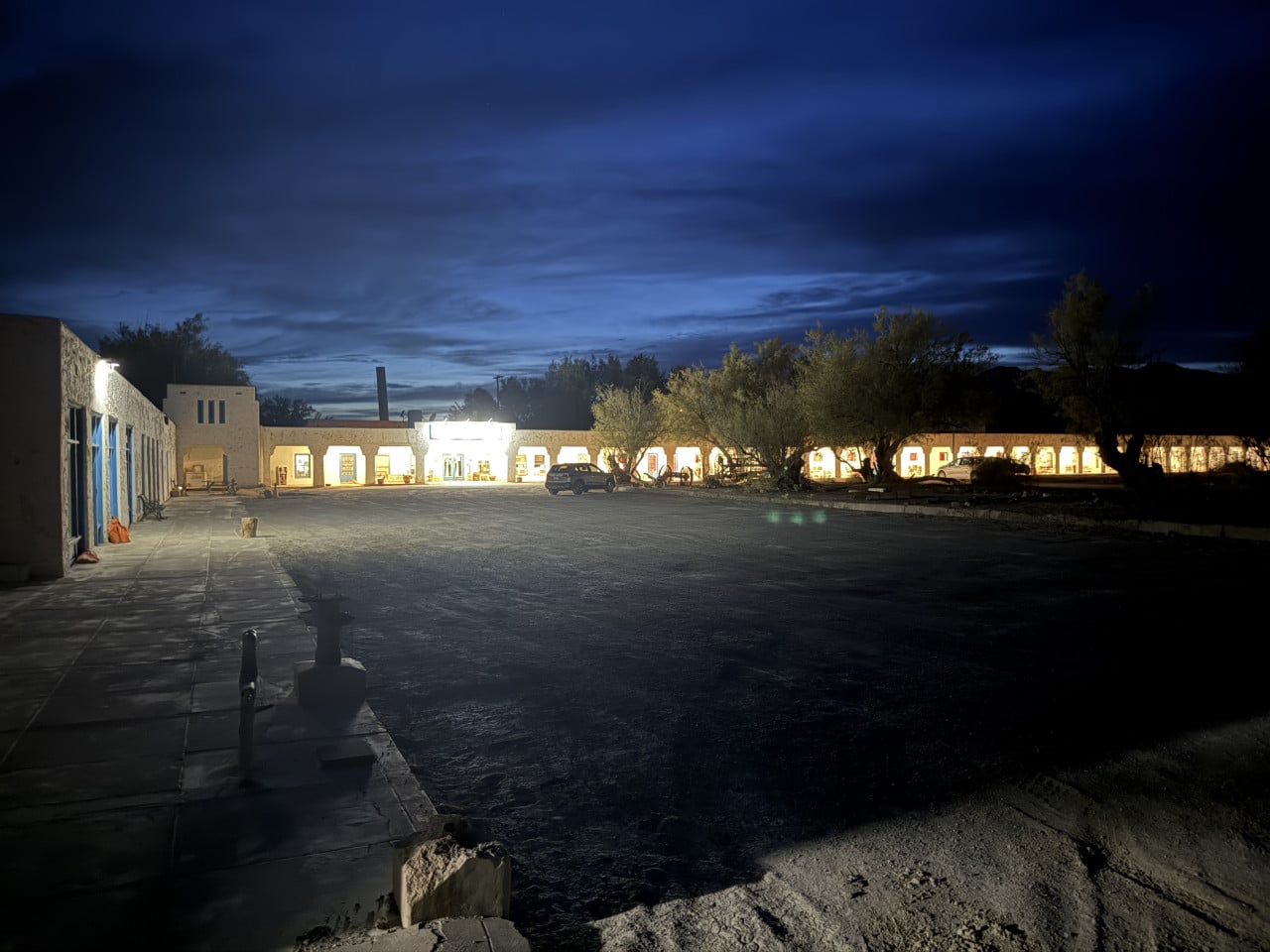
Even as we approached, the atmosphere began to affect me. And I have to say that I found it very creepy. Very interesting, but also deeply unsettling. White adobe buildings arranged in a U shape, illuminated by just a few light bulbs against the dark night sky, with complete silence and darkness all around.
When we got out of the car, my daughter burst into tears and said she wasn’t going to sleep there because it was too scary. And honestly, even the photos don’t capture the atmosphere as it really felt. But I’ll try to convey at least some of it.
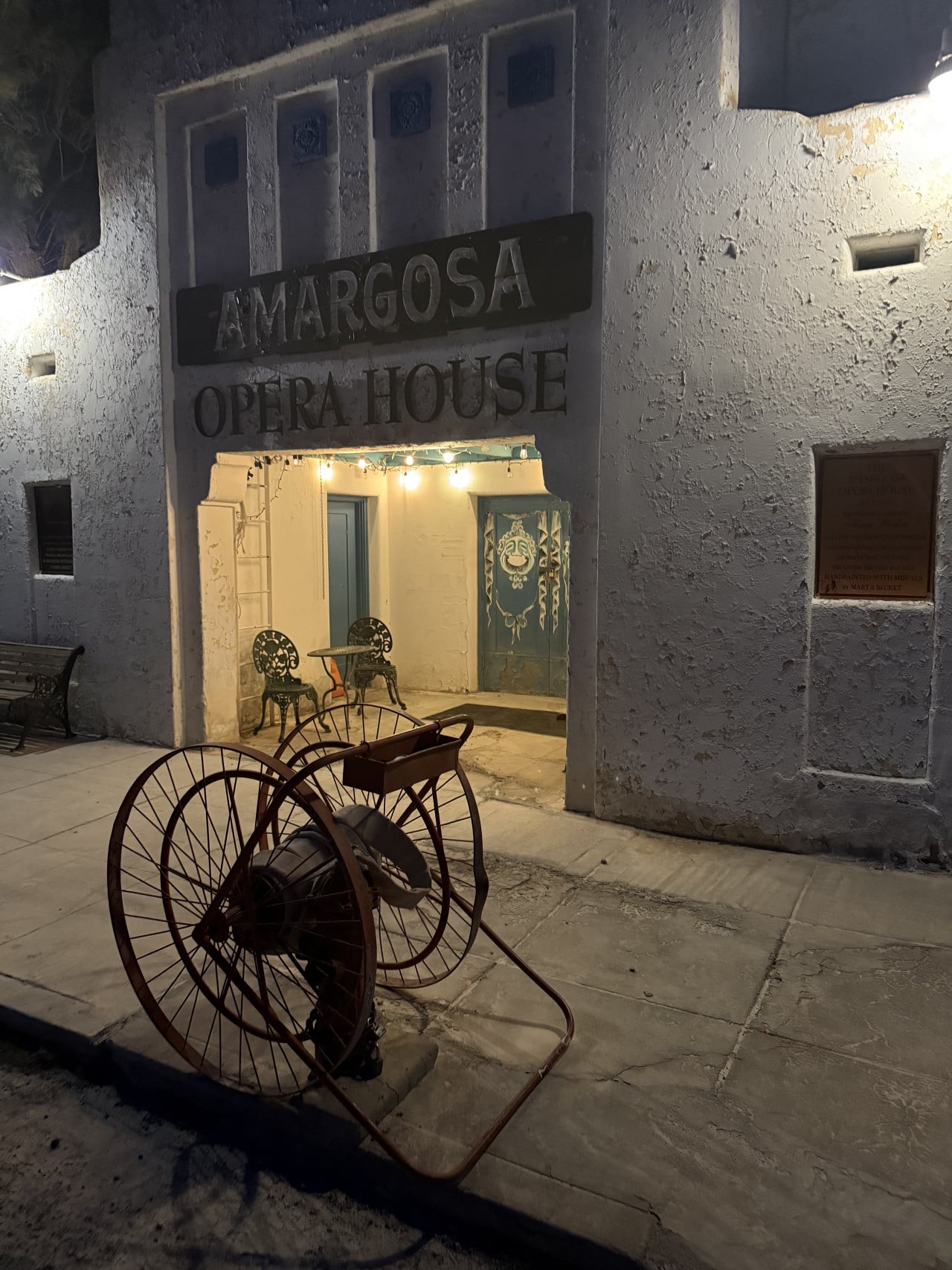
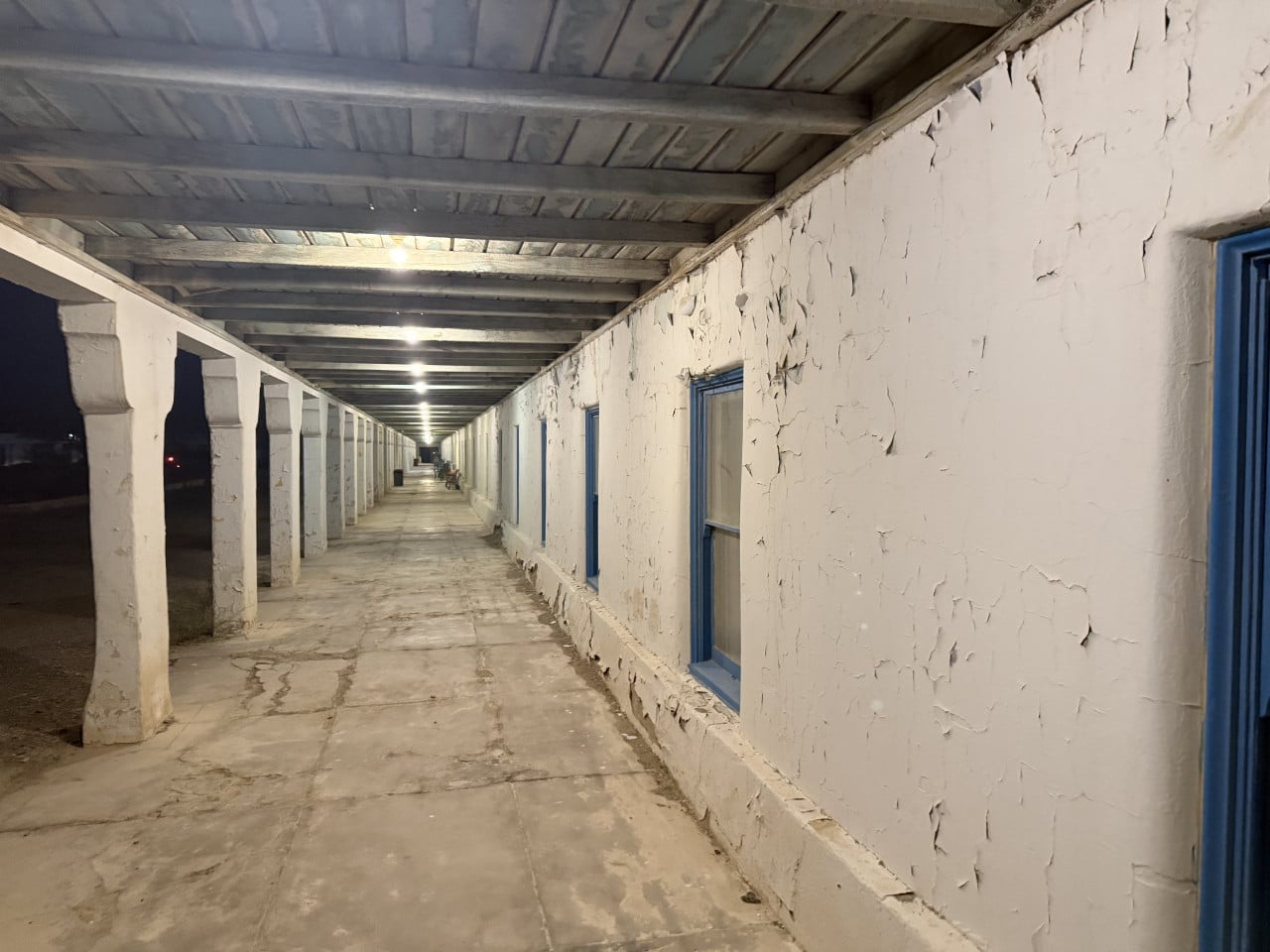
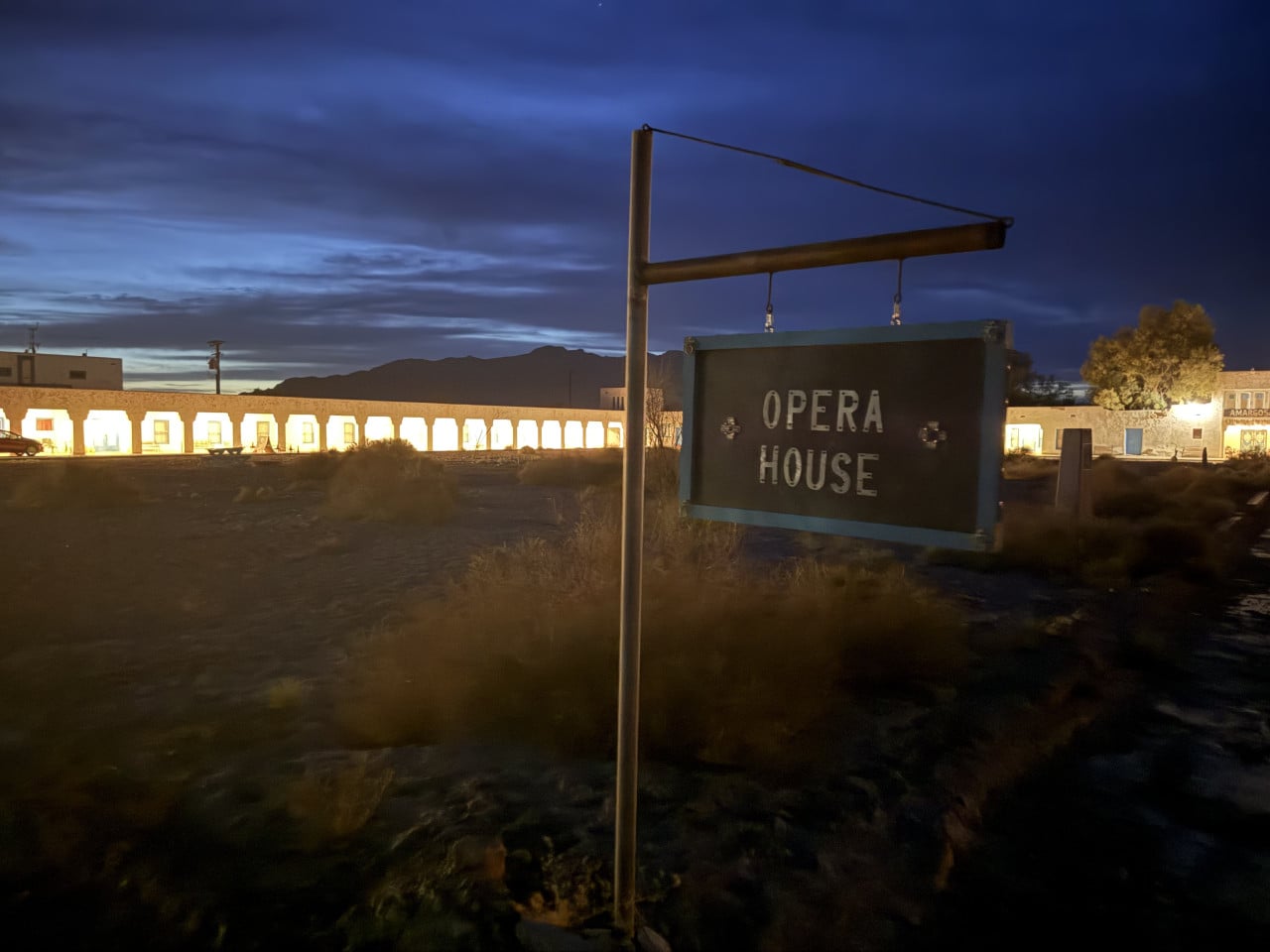
Right by the entrance, we were greeted by a large Amargosa Opera House sign, with old rusted wheels and mechanisms underneath – remnants from the days when a gas station for miners operated here. Next to the entrance to the opera house was a passage leading to the rooms, and the corridors running to the individual doors immediately reminded me of a scene from an American horror movie. Peeling walls, cracked plaster, long empty arcades illuminated only by dim light – and complete silence.
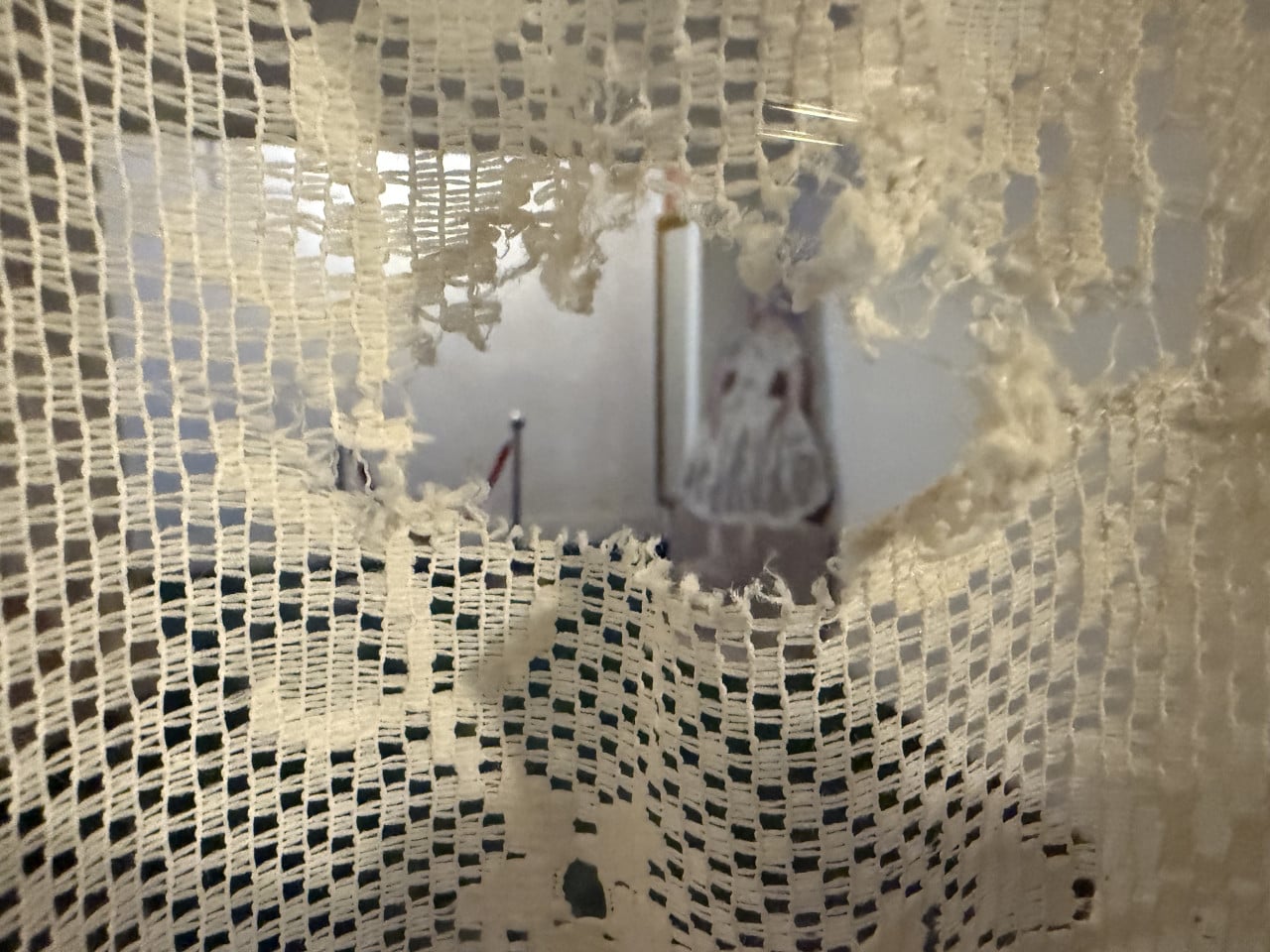
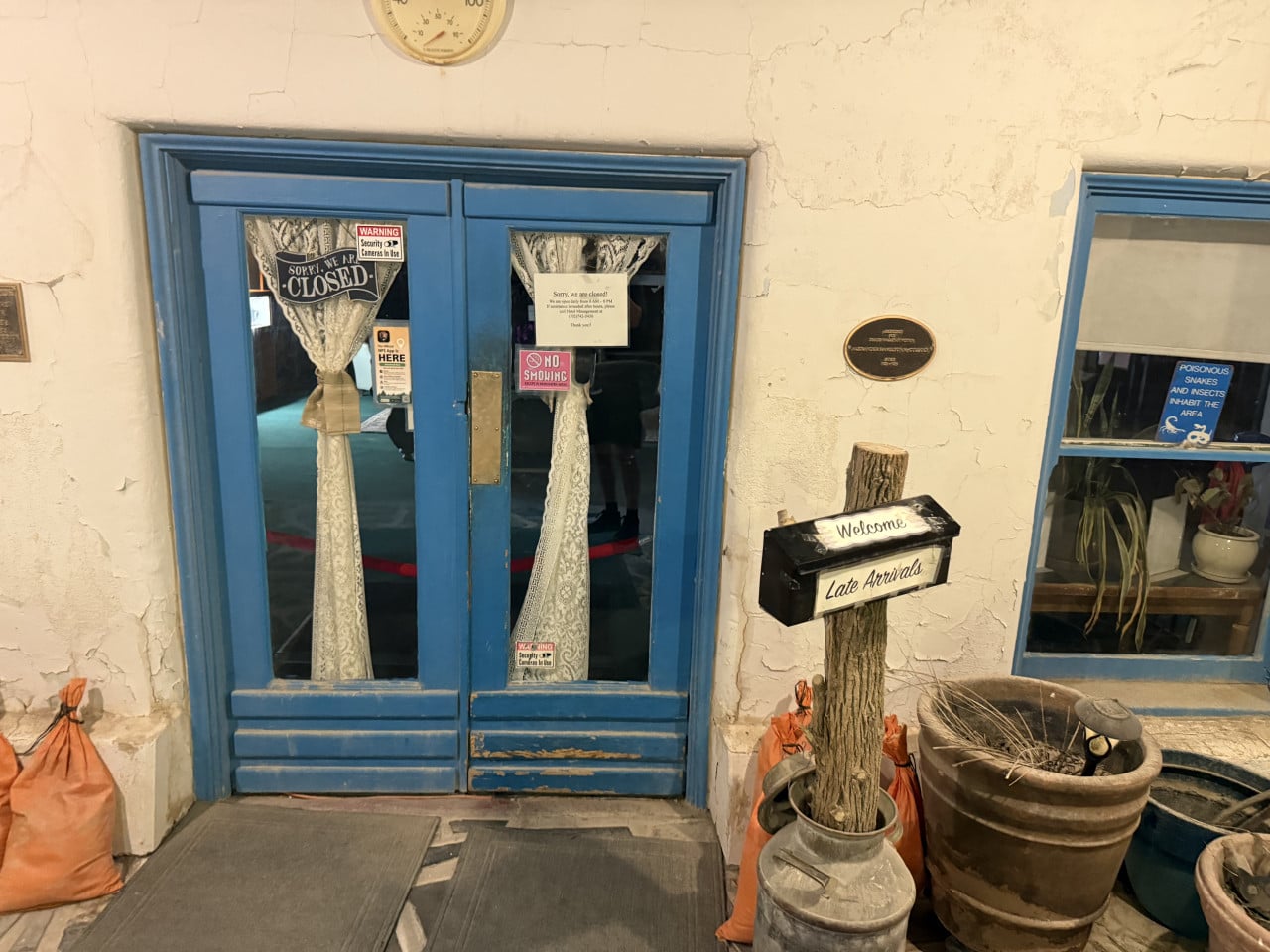
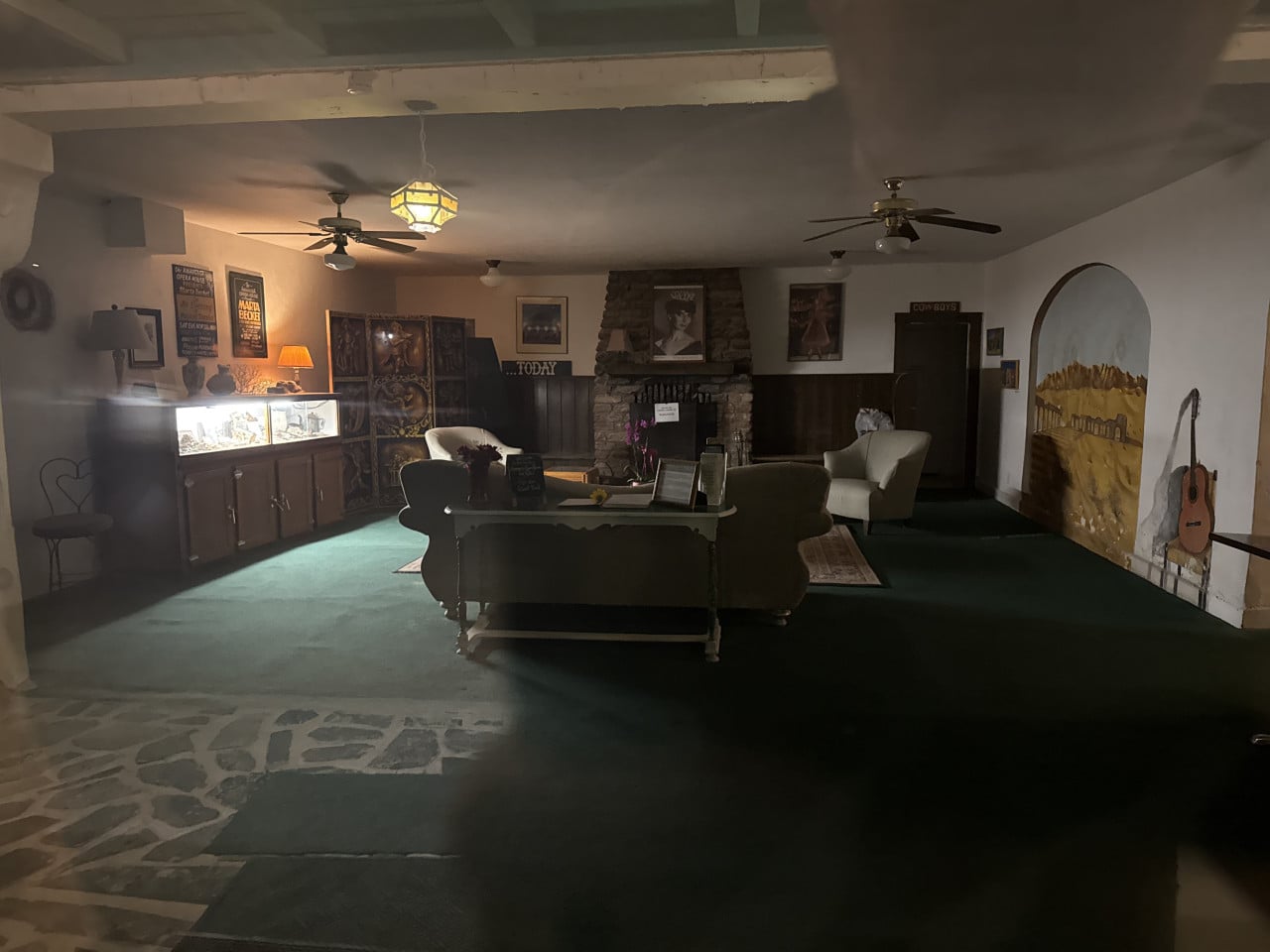
Unfortunately, we couldn’t get inside the opera house because we had arrived too late. But I peered through the windows and glass at everything that could be seen. Through a lace curtain with a hole in it, I spotted an old portrait of a woman inside the room – probably Marta Becket herself. At the reception desk, which I could see through the glass doors, there was old furniture, faded posters from the days of her performances, a green carpet, and a guitar leaning against the wall. Everything looked as though time had stopped sometime in the 1980s.
Props, skulls, and an abandoned café
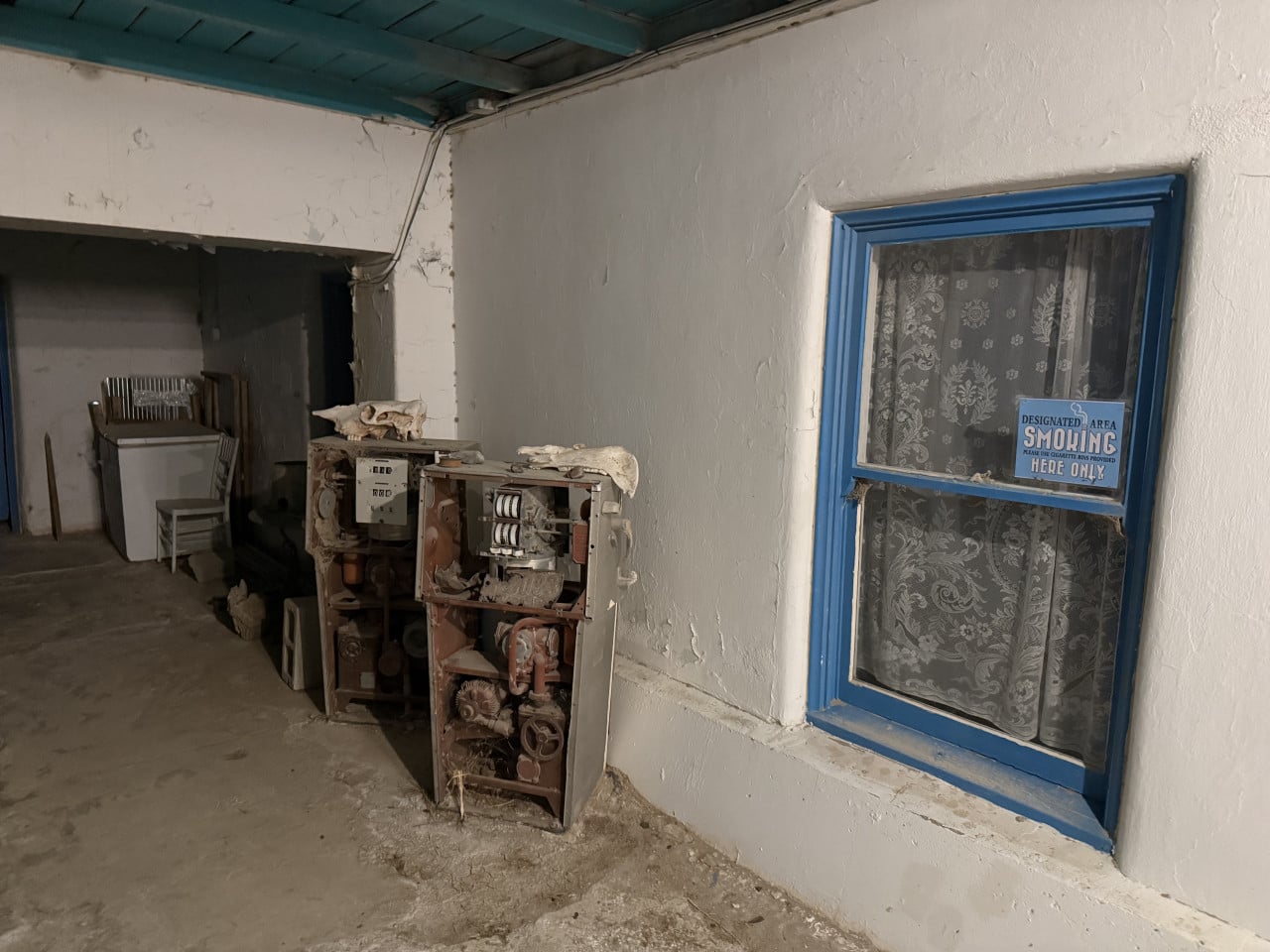
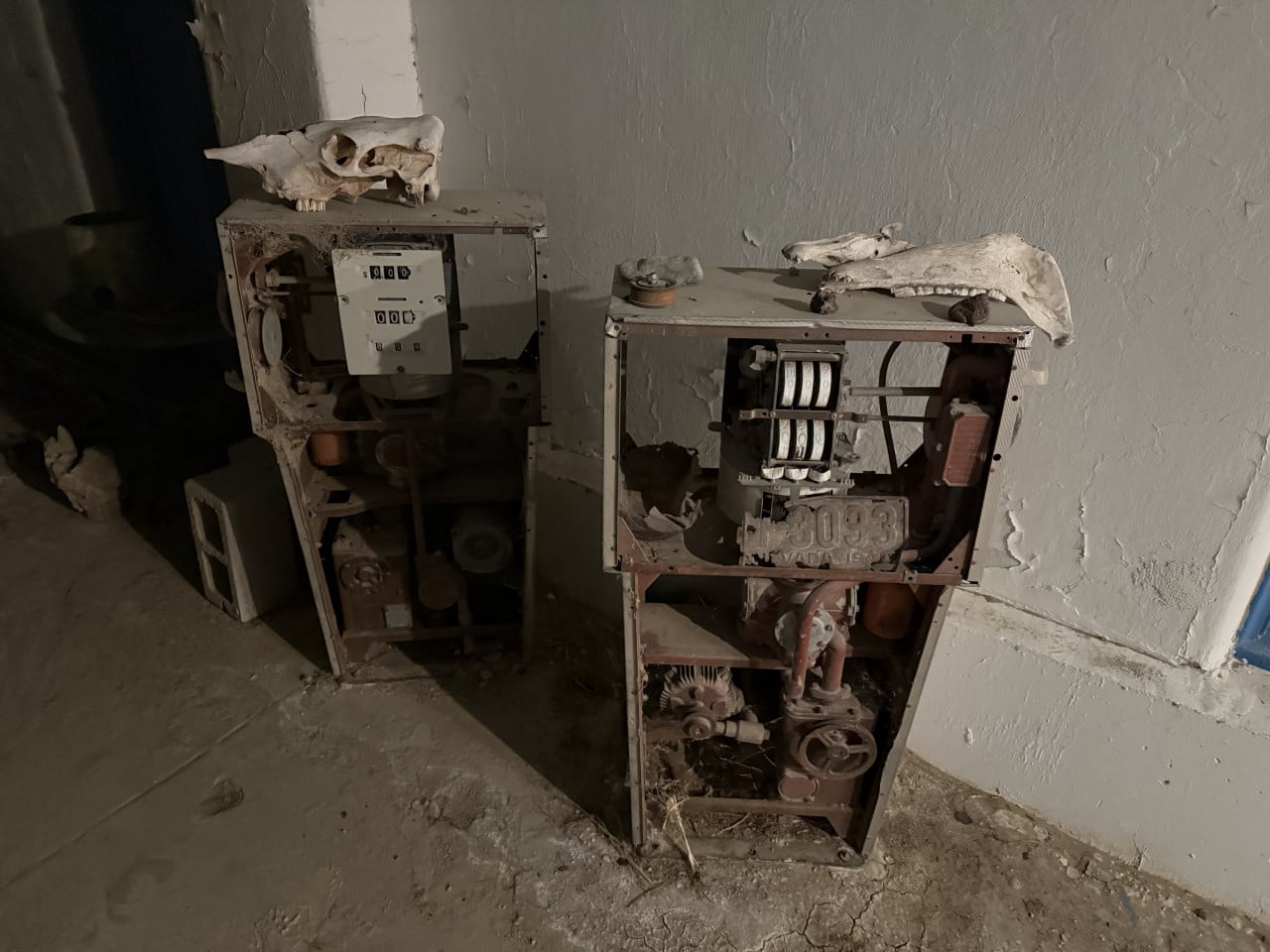
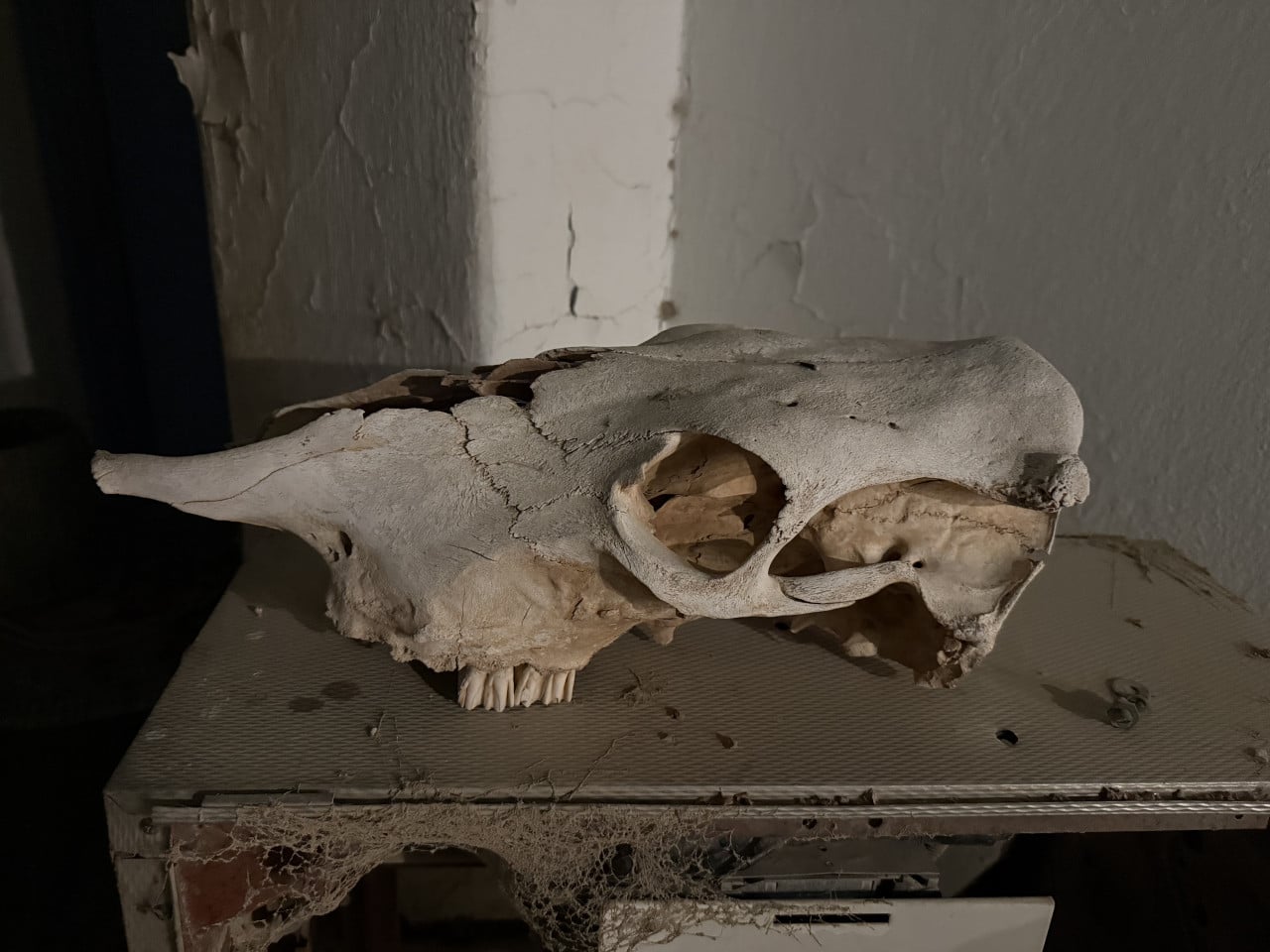
Various props and artifacts were scattered around the building. Old interiors of gas pumps with faded dials, topped with animal skulls – probably from cows or horses that once lived in the surrounding desert. Everything was covered in dust and cobwebs. It was that strange kind of mixture where you don’t know whether it was an intentional decoration or whether it had simply accumulated there over time.
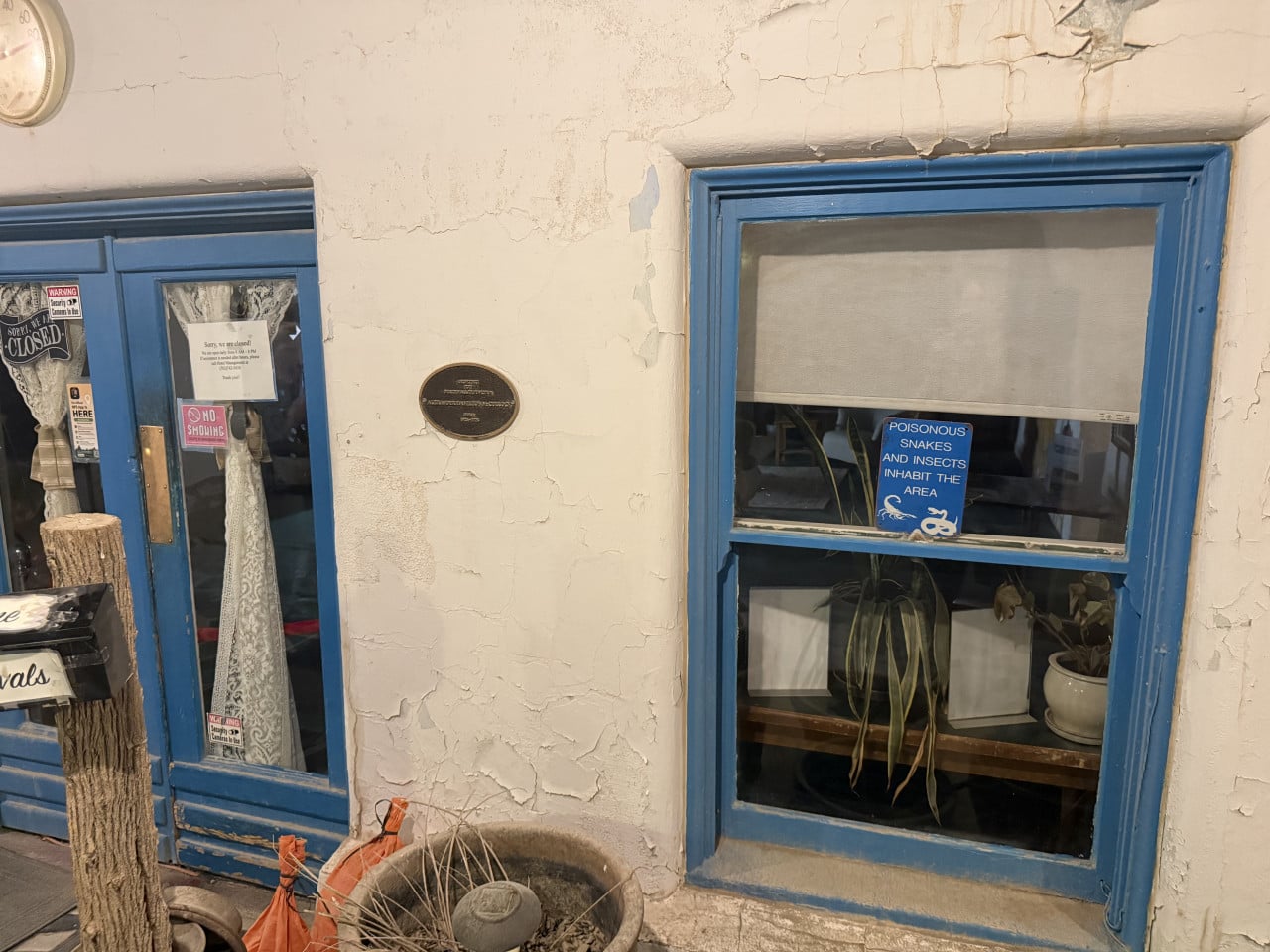
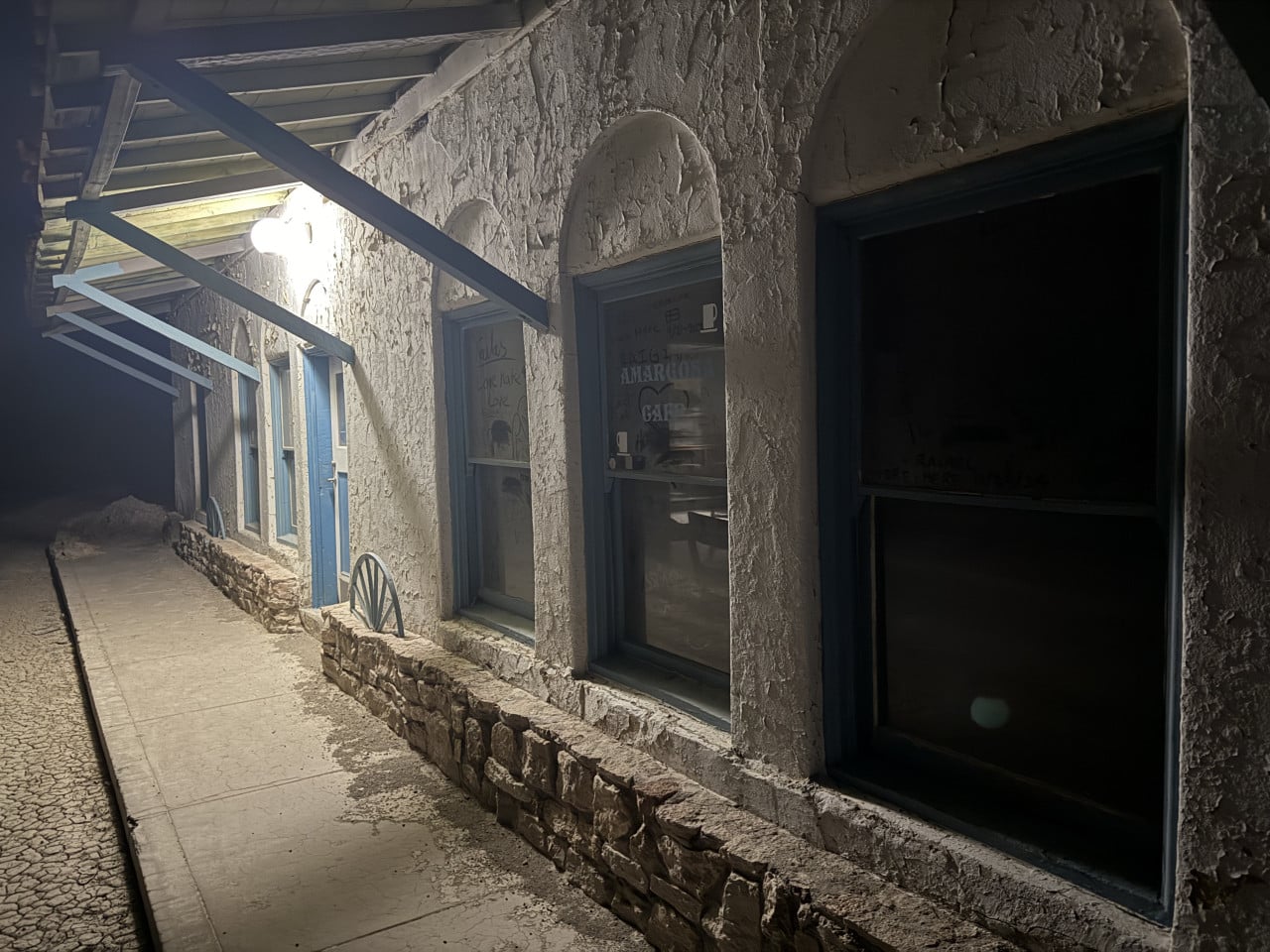
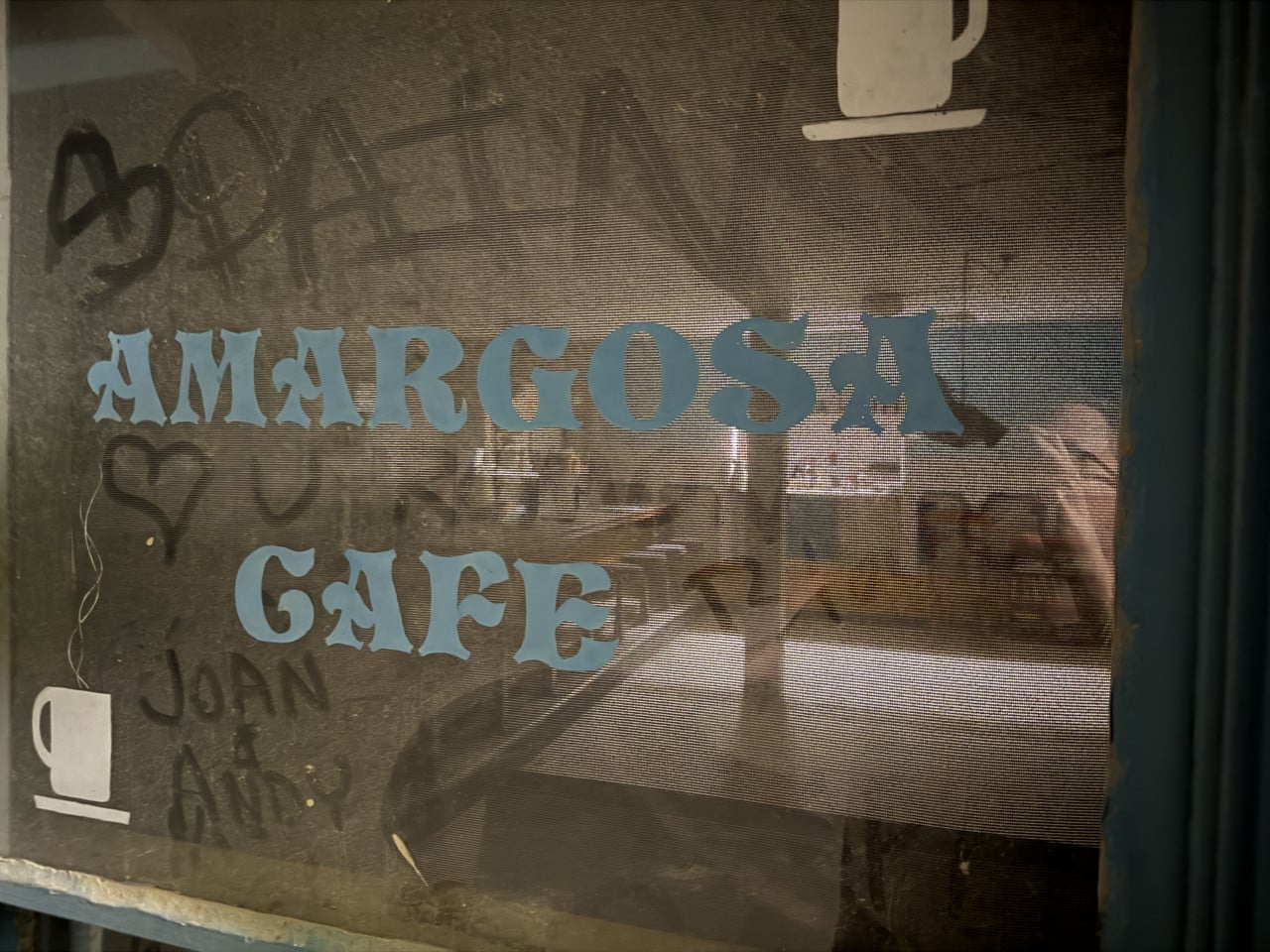
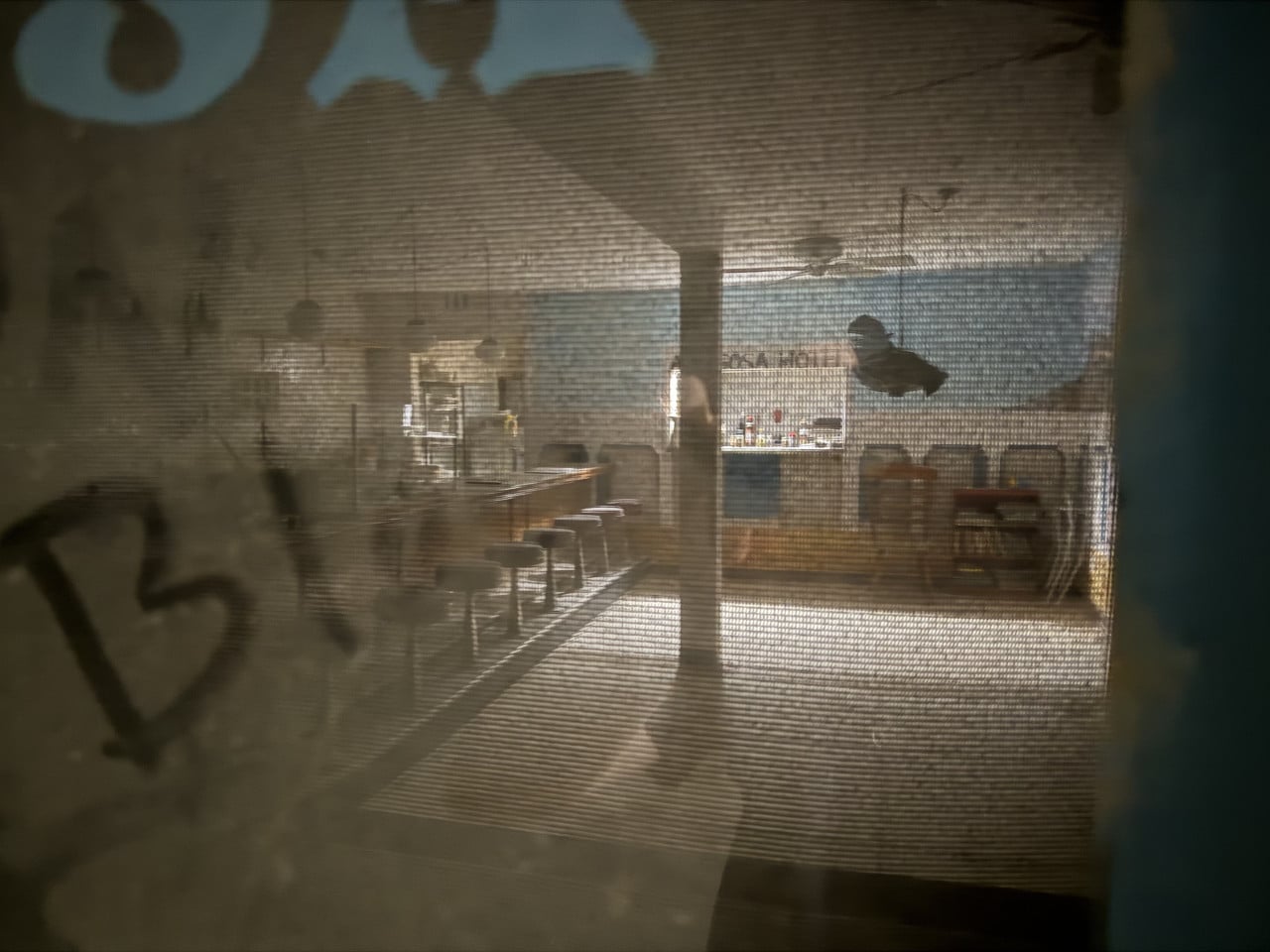
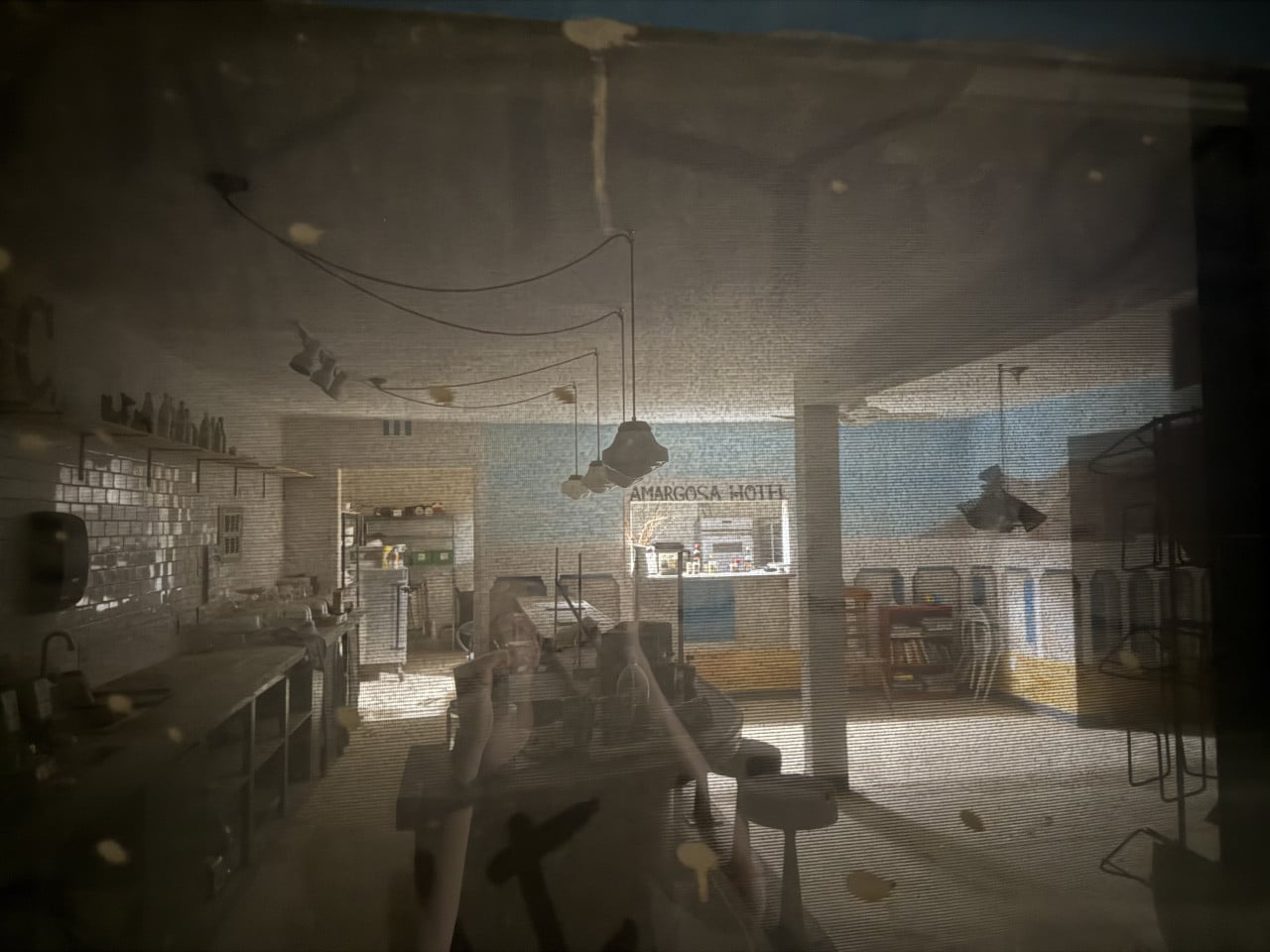
Behind the main building, I found the Amargosa Café. The café’s name was still displayed on the window, but when I looked inside, it was clear that it had not been operating for some time. There was dust everywhere, abandoned chairs, and old bottles standing on the bar. I think I read somewhere that the café closed during the COVID pandemic and has not reopened since. It’s a shame – the idea of having coffee in this setting is amazing.
Amargosa Hotel – this part is still operating
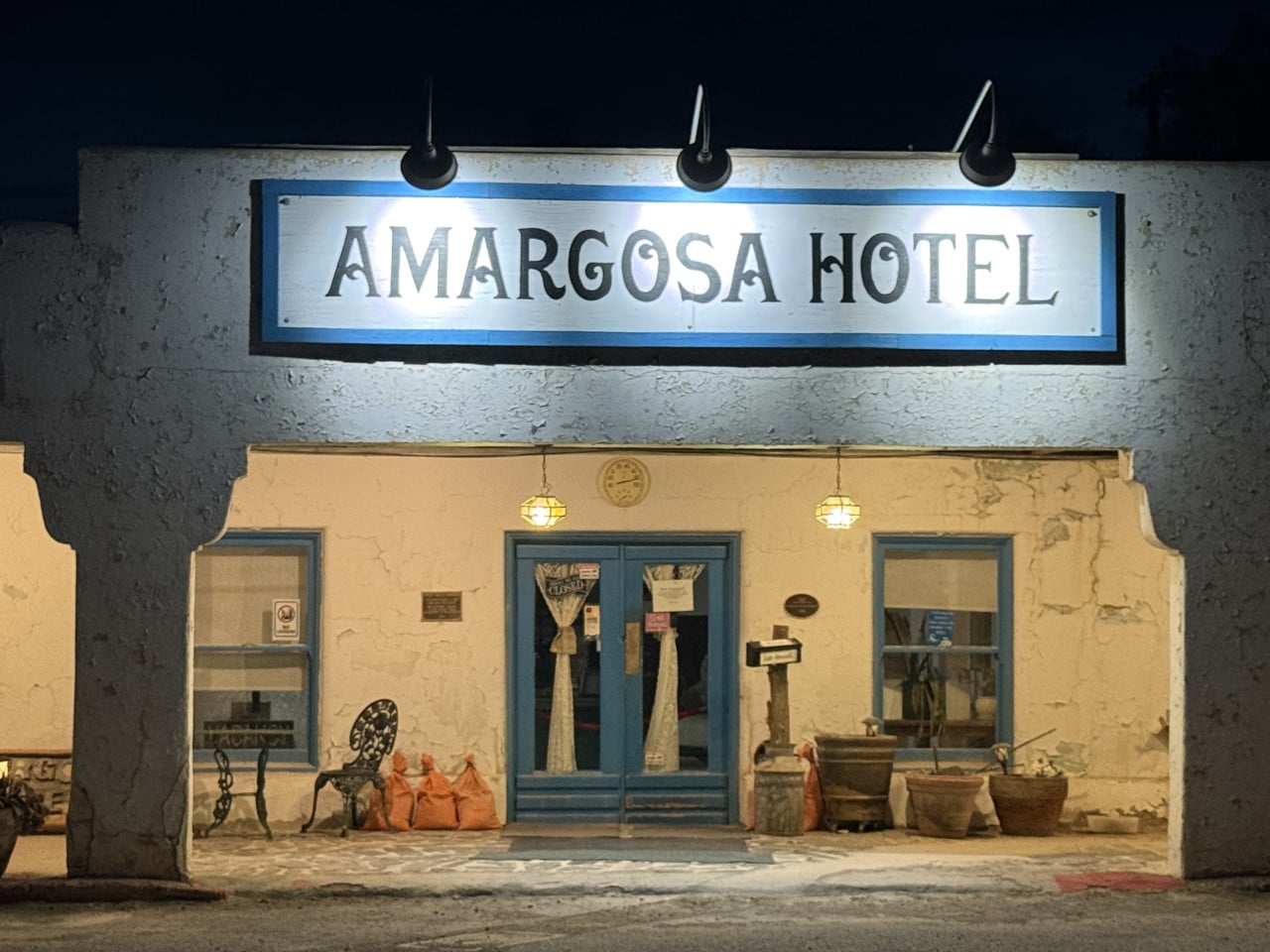
Despite all the abandonment and patina, the hotel itself is still operating. You could see guests’ cars parked outside, and lights were on in some of the windows. Of course, it isn’t a busy hotel – I would estimate that only a few people stay there each night, if any – but it is in operation.
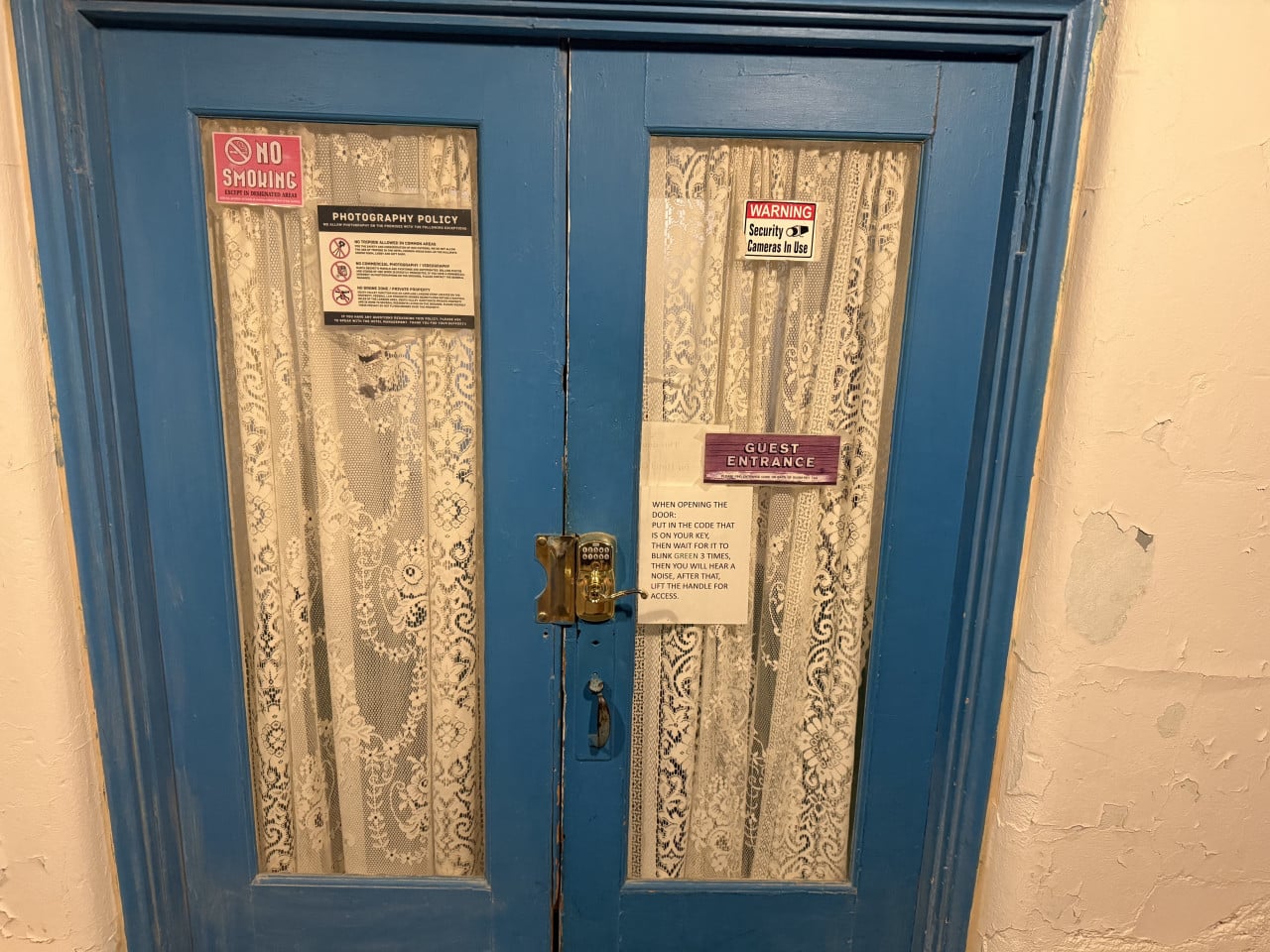
The hotel entrance looked beautiful in its own unique way. A large Amargosa Hotel sign, blue door frames, and lace curtains behind the glass. There was also a cold walk and code lock – a kind of self-service entrance that probably allows guests to open their rooms themselves if they have a reservation.
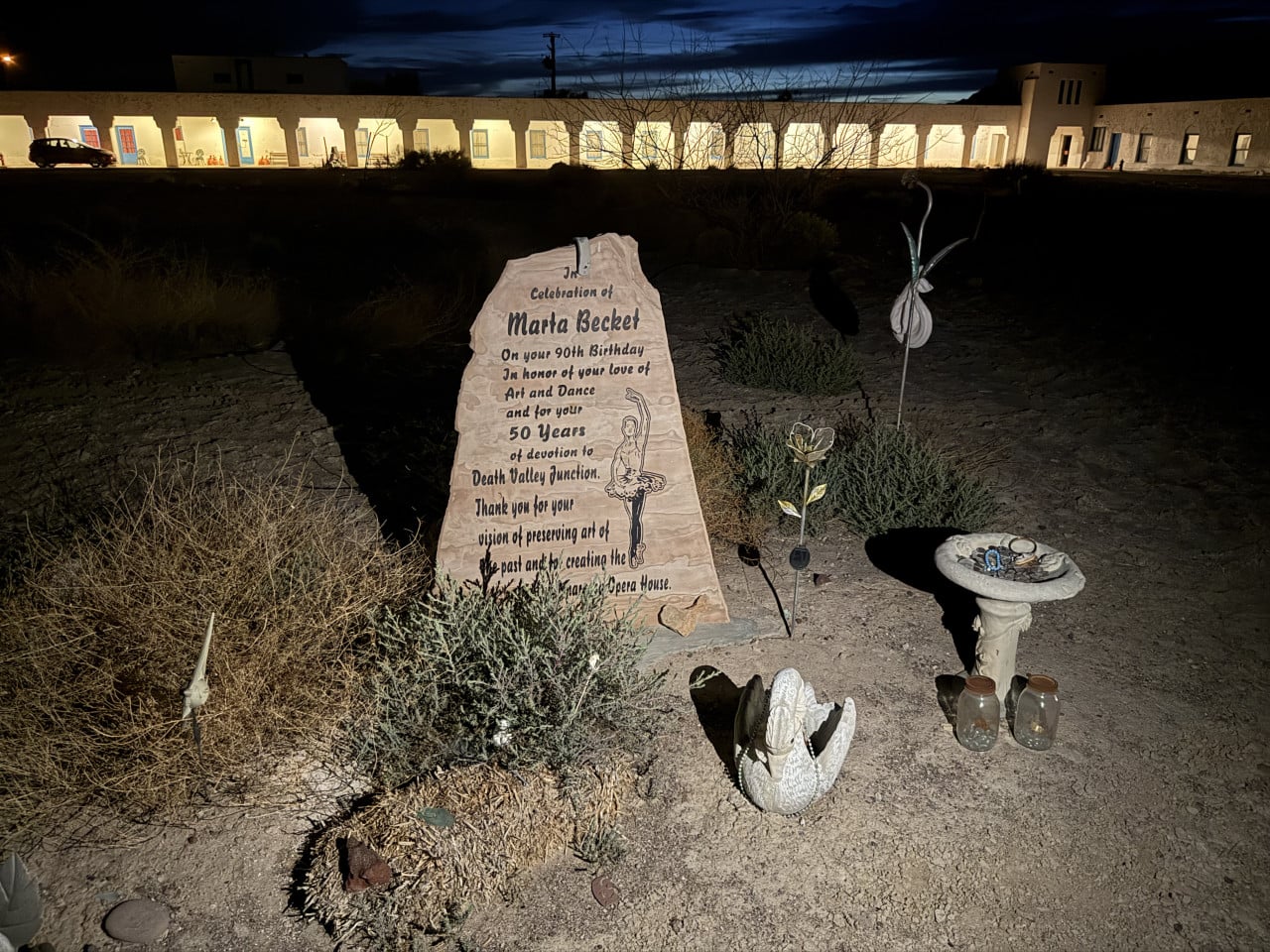
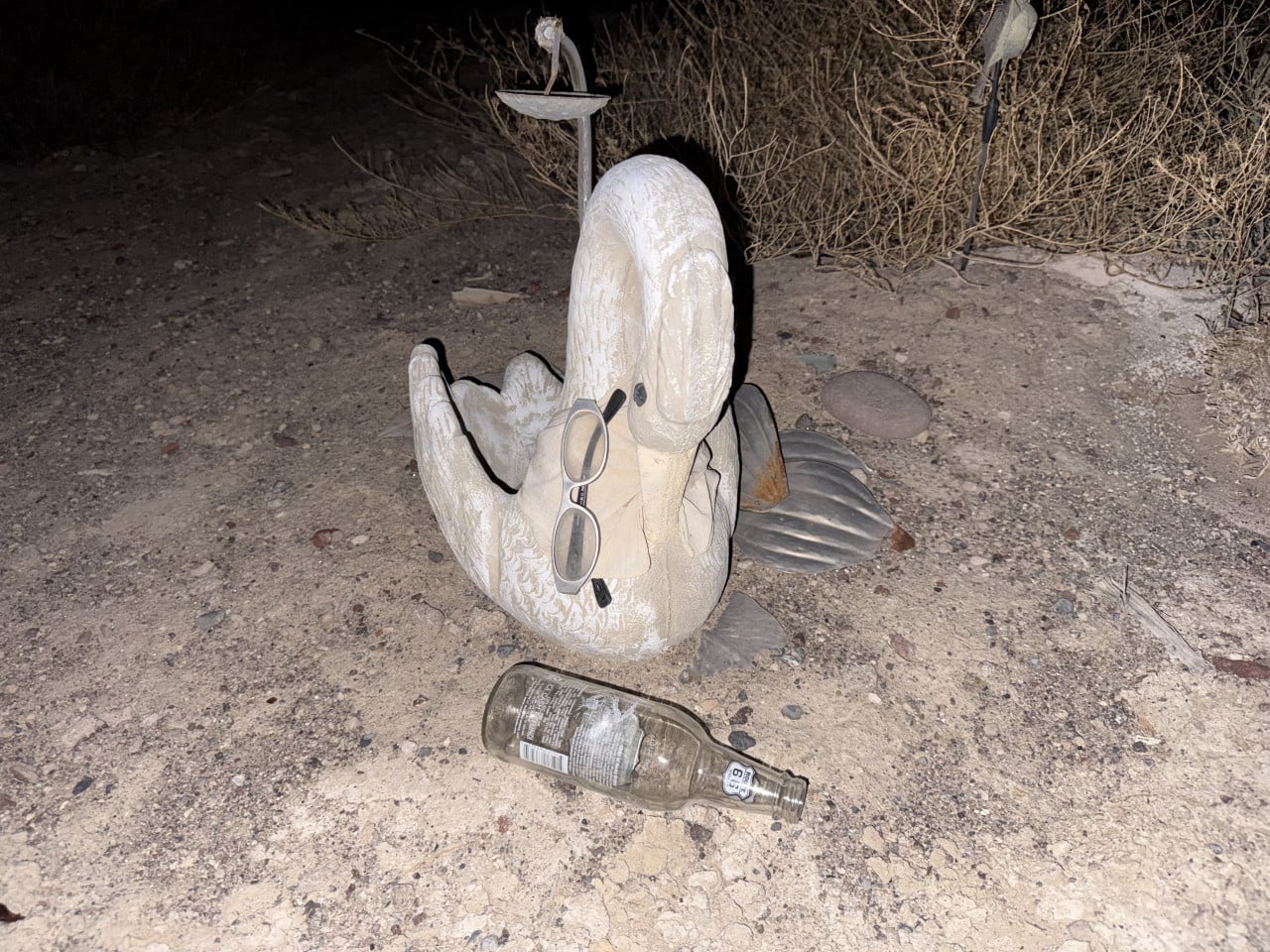
Outside the hotel, in a small sandy area, stands a memorial stone dedicated to Marta Becket – commemorating her 90th birthday and the fifty years she spent in Death Valley Junction. Old pointe shoes and small ornaments left by visitors as tributes lie beside the stone. The illuminated silhouette of the hotel rises in the background. It is a moving sight.
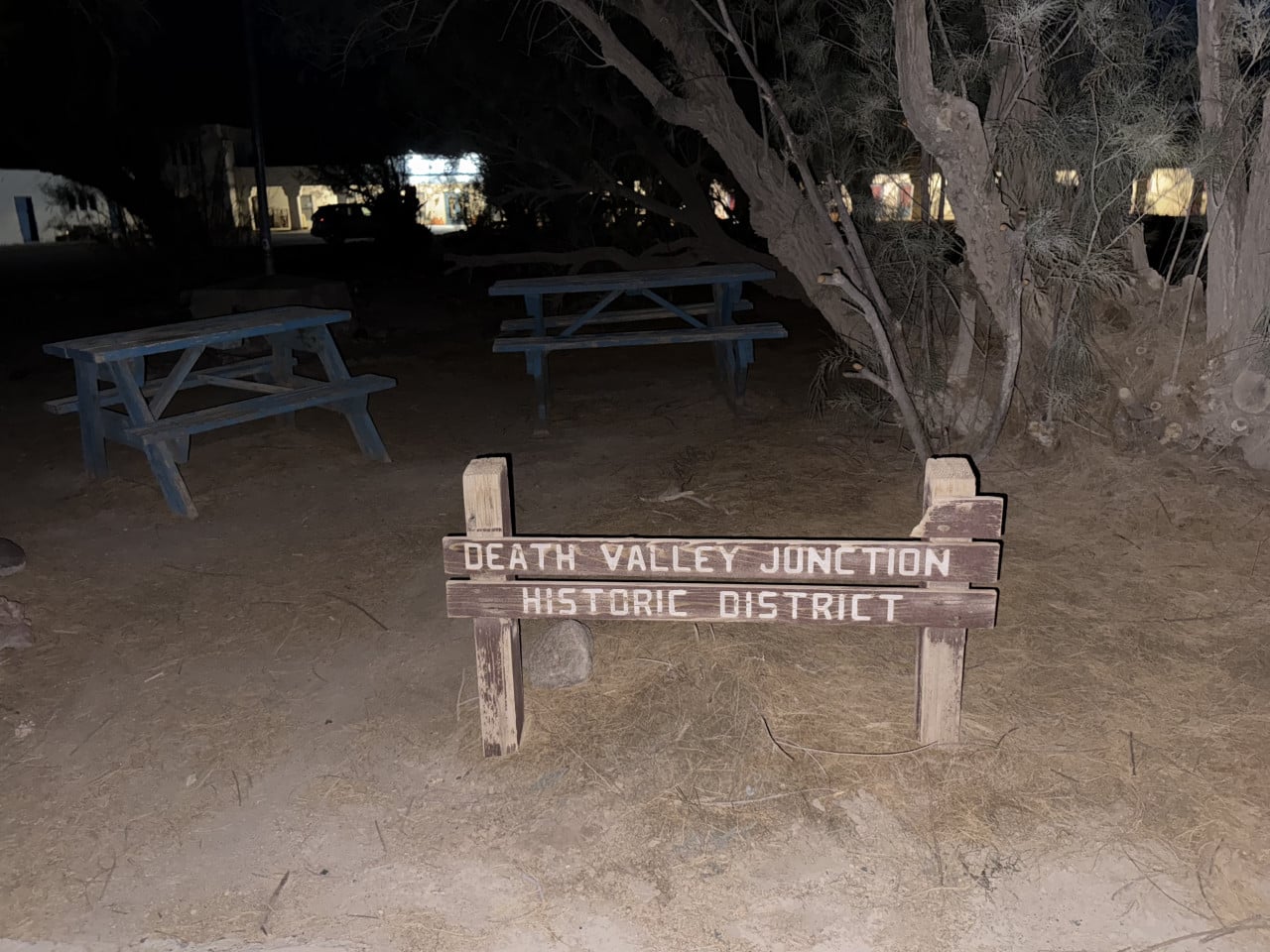
A little farther away stands a wooden Death Valley Junction Historic District sign – the entire complex has been listed on the National Register of Historic Places since 1981.
Why I want to stay there next time
Even though we ultimately didn’t stay overnight and continued toward Las Vegas, this place made an incredible impression on me. That combination of history, isolation from everything living, the artistic legacy of one extraordinary woman, and all those stories of paranormal phenomena – it is simply a unique experience you won’t find anywhere else.
The next time I go there, I will definitely book the hotel. I want to see the rooms from the inside, experience the nighttime atmosphere, and walk through those hallways when it is completely dark and there is no one around for dozens of miles. It won’t offer luxury or comfort – that much is clear. But that isn’t the point.
The point is that the Amargosa Opera House is a place with a soul. Both literally and figuratively.
And if you would like to visit – tours of the opera house are held daily at 9:00 a.m. and 6:00 p.m., with no reservation required. Admission is $15 for adults and $5 for children. The hotel can be booked through Booking or directly on the Amargosa Opera House website. Just bear in mind that there is no gas station or store nearby – so be sure to prepare in advance.