

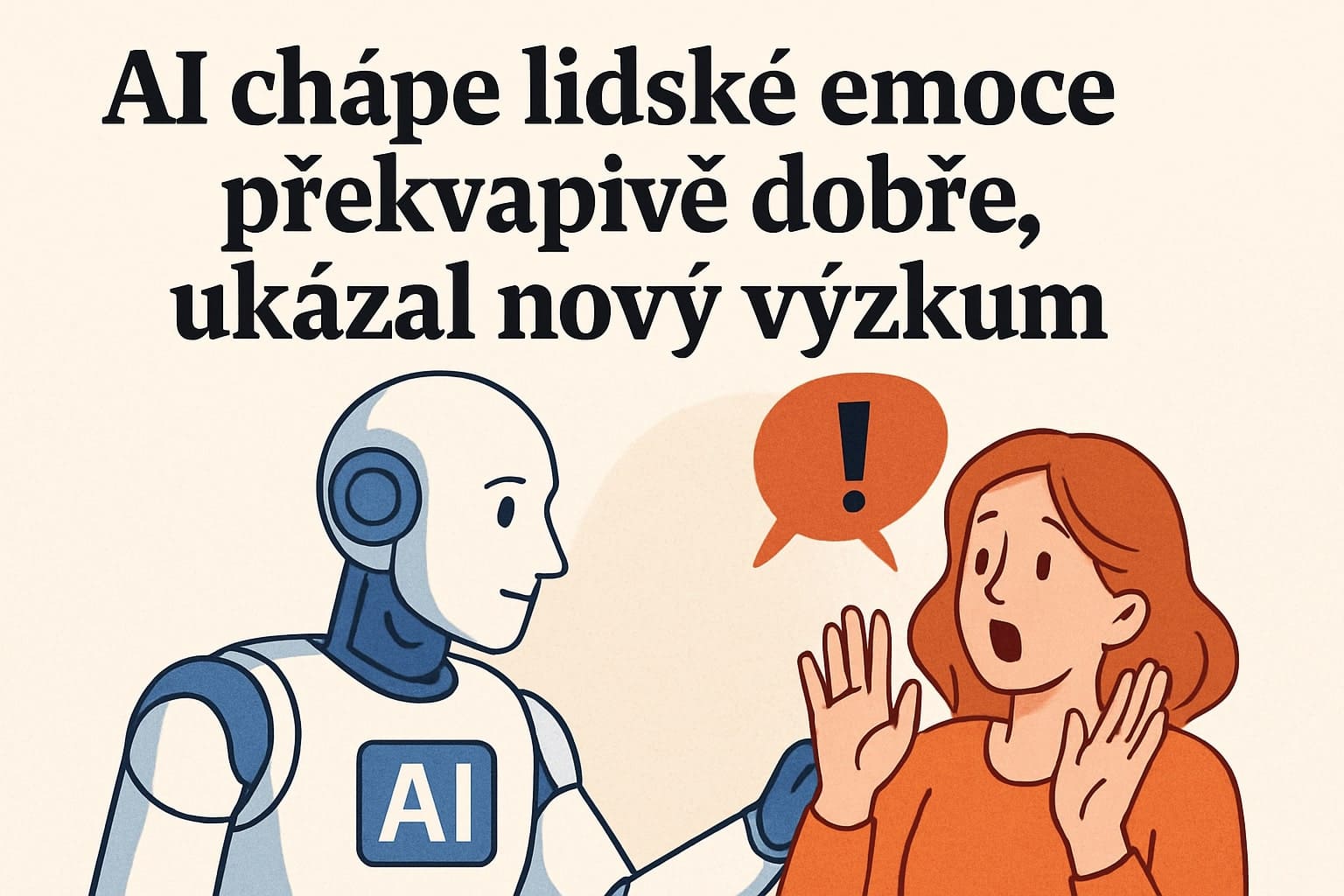
AI Understands Human Emotions Surprisingly Well, New Research Shows
A new study published in the prestigious journal Nature Human Behaviour has revealed a remarkable finding: large language models (LLMs) such as ChatGPT-4 and other artificial intelligence systems can perform better than average humans on emotional intelligence tests.
Results Exceeded Expectations
The research team tested six different AI models: ChatGPT-4, ChatGPT-o1, Gemini 1.5 flash, Copilot 365, Claude 3.5 Haiku, and DeepSeek V3. These systems achieved an average accuracy of 81% across five standard emotional intelligence tests, while people in the original validation studies achieved only 56% accuracy. The most successful models were ChatGPT-o1 and DeepSeek V3, which exceeded the human average by more than two standard deviations. All the AI systems tested significantly outperformed humans on all five tests focused on understanding and regulating emotions.
Tests Focused on Practical Situations
The researchers used five different tests measuring various aspects of emotional intelligence. For example, the Situational Test of Emotional Understanding (STEU) presented scenarios and asked participants to choose which emotion the person in the given situation was most likely to feel. One example was: "A supervisor who is unpleasant to work with leaves Alfonso's workplace. Alfonso is most likely to feel: a) joy, b) hope, c) regret, d) relief, e) sadness." The correct answer is relief. Other tests focused on emotion regulation—how to manage one's own emotions or help others with their emotional states in the workplace.
ChatGPT-4 Was Able to Create New Tests
In the second part of the research, the scientists asked ChatGPT-4 to create new versions of all five tests. The resulting tests were then administered to 467 participants from the United Kingdom and the United States. The results showed that the ChatGPT-created tests had a similar level of difficulty to the original versions. Participants rated the new items as clear and realistic, although they differed slightly from the original tests in some respects. The correlation between the original and AI-created tests reached r = 0.46, indicating a strong association.
Significance for the Future of AI
The study, led by a team from universities in Geneva and other institutions, suggests that current AI systems have a surprisingly sophisticated understanding of human emotions and their dynamics. This has significant implications for the development of chatbots, virtual assistants, and other applications where emotional intelligence is important. The researchers emphasize that the ability of AI systems to generate responses consistent with accurate knowledge of human emotions is a prerequisite for their successful deployment in healthcare, education, customer service, and other fields requiring a sensitive approach.
Questions for the Future
Although the results are promising, the researchers point to the ongoing debate over whether AI truly "understands" emotions or merely simulates understanding based on patterns in its training data. The key question remains whether these capabilities will lead to positive outcomes in real-world social interactions. The study also revealed a high level of agreement among different AI models—the correlation between their responses reached 0.88. Interestingly, AI systems tended to answer the same items correctly as humans—tasks that were more difficult for humans were also more difficult for artificial intelligence.
These findings open up new possibilities for using AI in psychology and other fields focused on human behavior, while also raising important questions about the nature of emotional intelligence and how it is measured.


