

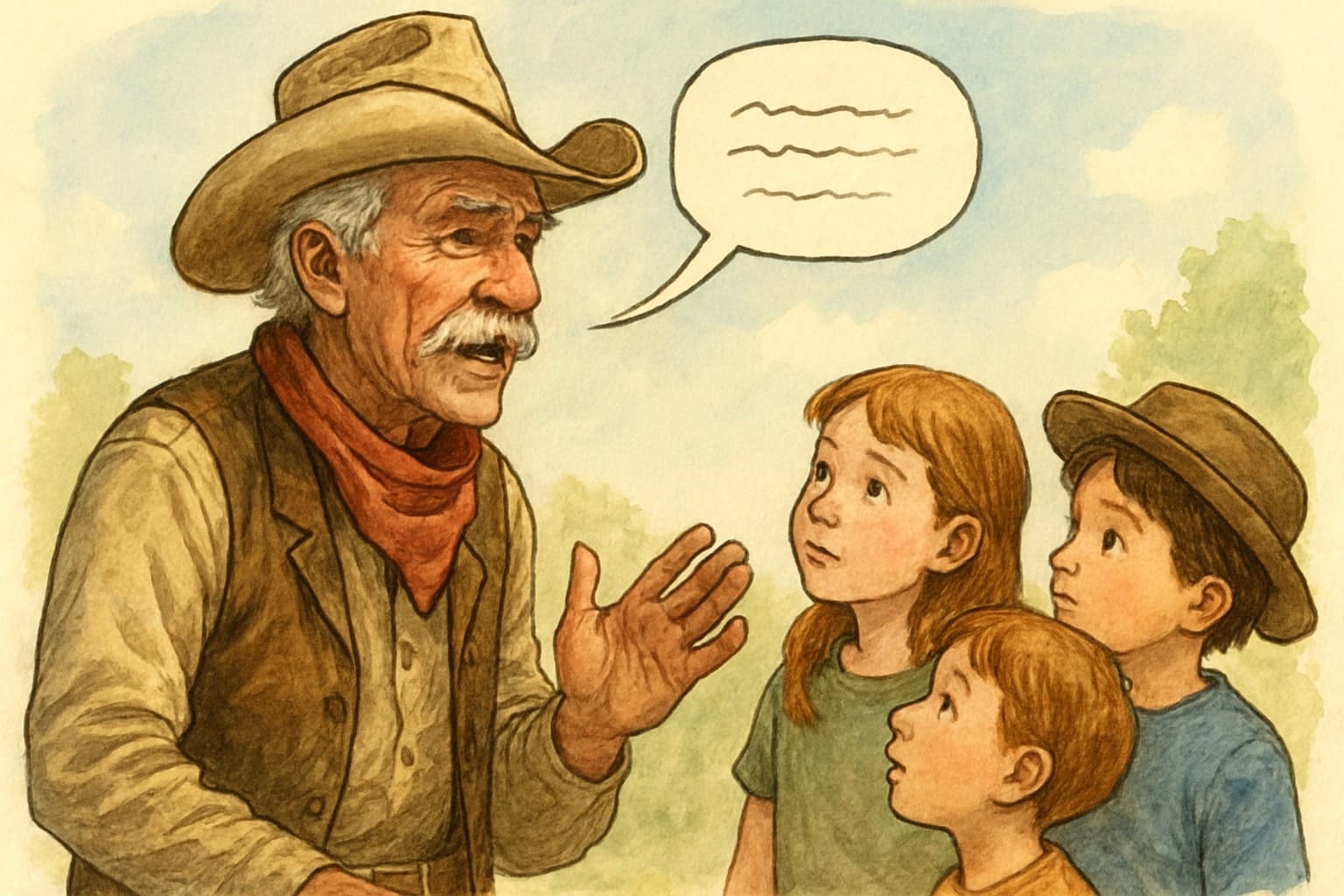
Let's Learn to Speak Texan: The Art of Squeezing Words into One
Whenever I hear someone say something like: "Y'all 'bout fixin' to head out?" (Are you all getting ready to leave?), I'm almost certain they're from Texas. In a single sentence, you have both "y'all" and "fixin' to".
Texans truly love their contractions - which, if you don't remember from your school days, are words squeezed together to form a single shorter word, with apostrophes standing in for the missing parts. And "y'all" is, of course, their most famous contraction - you hear it throughout the American South, but Texans have taken a particular liking to it, probably because of its extraordinary usefulness. After all, standard English inexplicably makes no distinction between the second-person singular and plural - both are simply "you".
Texans, however, have expanded its use by putting "all" in front of it to create "all y'all". It is generally understood that "y'all" describes two or more people, while "all y'all" can mean anywhere from five to five hundred people. "Y'all" may refer to your immediate family - that is, those who live in your house - while "all y'all" refers to the extended family, including grandparents, aunts, brothers, and so on. Or "y'all" may mean the group you came to the party with, while "all y'all" is used to address everyone attending the event.
Texans even use "y'all" possessively, as in "y'all's". I recently heard this sentence at a barbecue: "Y'all need to move all y'all's trucks so Carlos can leave." (You all need to move your trucks so Carlos can leave.)
Now that you've heard all this, I know you'll want to start practicing the possessive forms, but try to wait until the lesson is over. I'll let you go in two minutes.
The king of contractions, in my opinion, is "y'all'd've". It has three apostrophes in it. Three! You have to admire the power of this contraction: Y'all'd've means "You all would have". And this is how it's used: "Y'all'd've loved it if y'all'd've come." (You all would have enjoyed it if you had come.) Just stop for a moment and savor the beauty of this sentence. Twelve words shortened to six! That, ladies and gentlemen, is the very soul of linguistic efficiency.
The less spectacular relatives of "y'all'd've" are "she'd've" and "he'd've": I think she'd've married him if he hadn't been such a scoundrel. Or, in a more modern version: He'd've lost twenty pounds by now if he'd stuck to that low-carb diet.
Texans - especially older ones - may also use an interesting contraction for something owned by at least two people: "Whose dog is this?" "Oh, that Yorkie is our'n." "Our'n" may or may not be a contraction of the expression "our own". It dates back to Middle English and undoubtedly reached Texas via the Appalachian Mountains, where it faded more slowly than it did here, along with "his'n", "her'n", and "your'n". This expression is somewhat outdated - you might say it's on its last legs - but you can still hear it in Texas if you listen closely.
That's our linguistic lesson for today. Y'all'd've enjoyed it much more if you'd actually listened instead of repeating everything for your own amusement, but never mind. The important thing is that all y'all had fun.


