

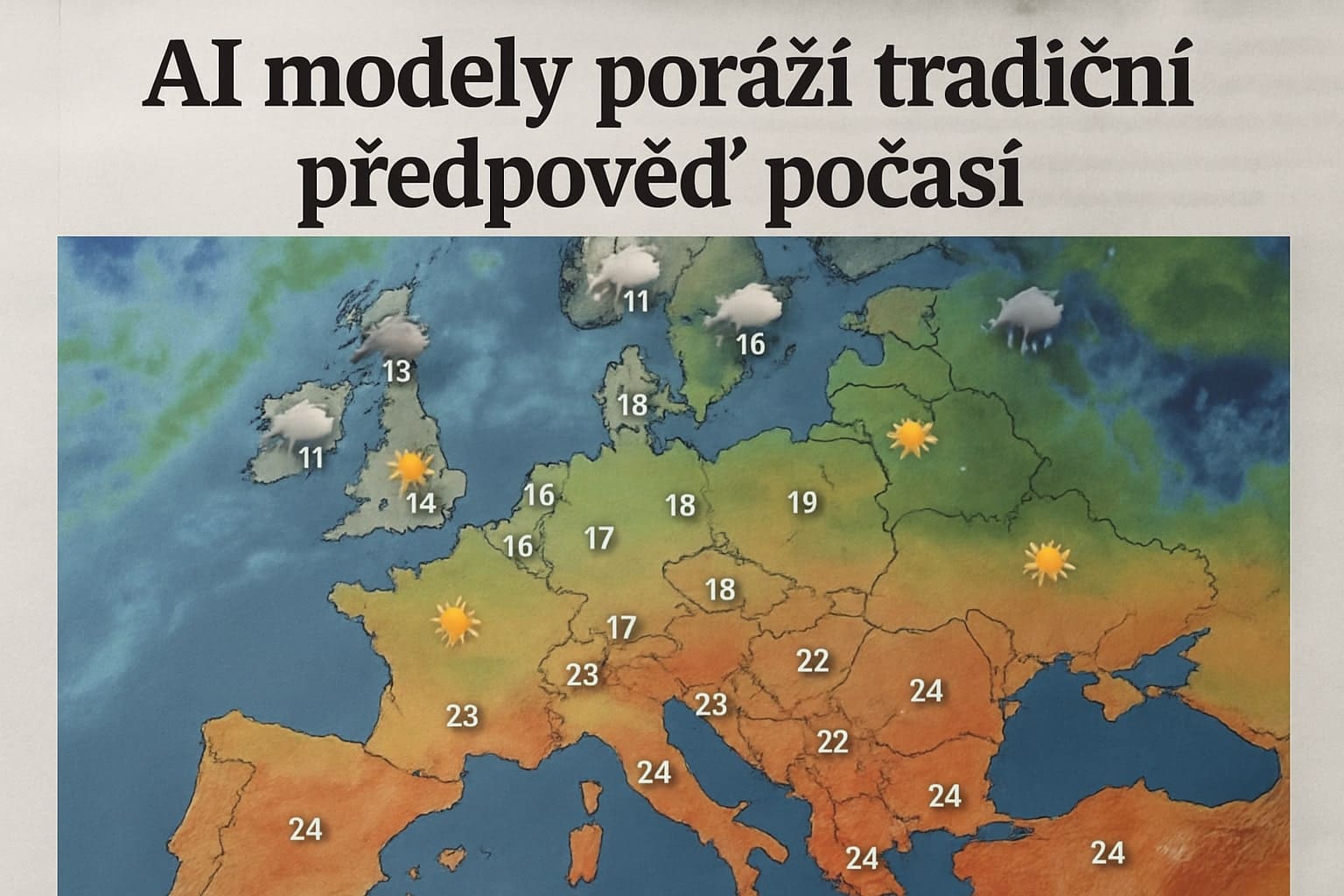
New AI Models Surpass Traditional Weather Centers
Meteorology is undergoing one of the most significant revolutions in its modern history. New artificial intelligence models for weather forecasting are achieving accuracy that surpasses traditional global forecasting centers, as demonstrated by studies published in the prestigious scientific journal Nature. This breakthrough represents a fundamental change in the approach to weather prediction, with purely data-driven methods becoming a competitive alternative to established physics-based numerical models.
Aurora: Microsoft’s Machine Learning-Based Model
The most remarkable of these new tools is the Aurora model, developed by researchers from Microsoft, the University of Pennsylvania, and other institutions. Unlike traditional numerical weather prediction systems based on the laws of physics, Aurora relies exclusively on machine learning techniques trained on vast amounts of historical geophysical data. This approach represents a radical departure from conventional methods, which for decades have relied on simulating physical equations describing atmospheric processes. In rigorous testing published in the journal Nature, Aurora outperformed seven major operational forecasting centers—including leading government agencies—in five-day forecasts of tropical cyclone tracks for all global cyclones during 2022–2023. This result is particularly significant because forecasting the movement of tropical storms is among the most challenging tasks in meteorology and is crucial for protecting populations and property in affected areas.
A specific example of Aurora’s performance can be demonstrated by the case of Typhoon Doksuri in July 2023. While Aurora accurately predicted the storm’s impact on the Philippines four days in advance, official forecasts incorrectly placed the storm near northern Taiwan. This difference in accuracy could have major consequences for evacuations and disaster preparedness in a real-world situation. Aurora’s achievements, however, are not limited to cyclone tracking. The model outperformed state-of-the-art numerical models on 92 percent of targets for ten-day global weather forecasts at a high spatial resolution of 0.1 degrees. This level of detail is comparable to the best current operational models, but Aurora achieves it significantly faster and more cheaply.
Next-Generation Speed and Cost Efficiency
One of Aurora’s key advantages is its speed and cost efficiency. The model can provide forecasts faster and more cheaply than traditional supercomputer-driven methods because it does not simulate physical equations directly but instead learns patterns from data. This approach enables forecasts to be generated in minutes rather than the hours or days required by conventional models. Aurora’s versatility is another significant characteristic. The model can be fine-tuned for various Earth system forecasts beyond weather—for example, air quality or ocean dynamics—even when direct observational data is limited. One example of a successful application is the prediction of a significant sandstorm in Iraq using minimal air-quality training data, demonstrating the model’s ability to adapt to new domains with relatively small amounts of domain-specific data.
Aardvark: Another Breakthrough AI System
In addition to Aurora, another significant AI system called Aardvark Weather has emerged, developed through a collaboration between the University of Cambridge, the Alan Turing Institute, Microsoft Research, and the ECMWF. Aardvark is unique in that it uses only observational inputs from a wide range of sources—from satellites to ground stations—without relying on any step involving traditional numerical modeling. Aardvark has demonstrated better performance than established models such as the U.S. Global Forecast System (GFS) for specific variables. The model can generate highly resolved local or global forecasts within minutes using modest computing resources, representing a dramatic improvement compared with the time and energy requirements of traditional systems.
A Fundamental Paradigm Shift
These breakthroughs mark a significant shift toward purely data-driven approaches that can match or surpass the accuracy of older systems while offering greater speed and adaptability. Traditional numerical models rely on observations combined with physical equations, whereas new AI models such as Aurora and Aardvark use only observational data. While the computational costs of traditional models are high and their speed is measured in hours to days, new AI models offer lower costs and speeds measured in minutes. Flexibility represents another key advantage of the new systems. While traditional models are constrained by physical coding, AI models can be easily fine-tuned across different domains. This adaptability opens up new possibilities for applications in areas where traditional meteorological models reach their limits.
The Future of Meteorology
These technological advances build on decades of fundamental research conducted by traditional meteorological science. Experts point out that continued integration between traditional and AI approaches could bring even greater improvements in the future. Combining physical understanding of atmospheric processes with the capabilities of machine learning could lead to the creation of hybrid systems that leverage the strengths of both approaches. The revolution in meteorology represented by models such as Aurora and Aardvark is not merely a technological advance but a fundamental change in the way we understand and predict the weather. These systems demonstrate that artificial intelligence can not only compete with but, in some areas, surpass traditional scientific methods based on the laws of physics. For the future of meteorology, this means a period of rapid change in which the performance, speed, and accessibility of forecasts will improve dramatically, with far-reaching impacts on many sectors of society that depend on accurate meteorological information.


