

Scientists at the University of Washington conducted a study in which artificial intelligence (AI) was able to learn cultural values by observing human behavior. This approach mimics how children absorb values from their surroundings. The research, published in the journal PLOS One, focused on altruism—behavior in which a person helps others at their own expense. The study's authors tested AI using data from an online game.
The study builds on previous research that found that 19-month-old children from Latin American and Asian households are more prone to altruism than children from other cultures. The scientists wanted to determine whether AI could similarly learn values through observation. They therefore recruited 190 adults who identified as White and 110 who identified as Latino. Each group was assigned an AI agent that learned from their behavior.
The Test Used the Game Overcooked
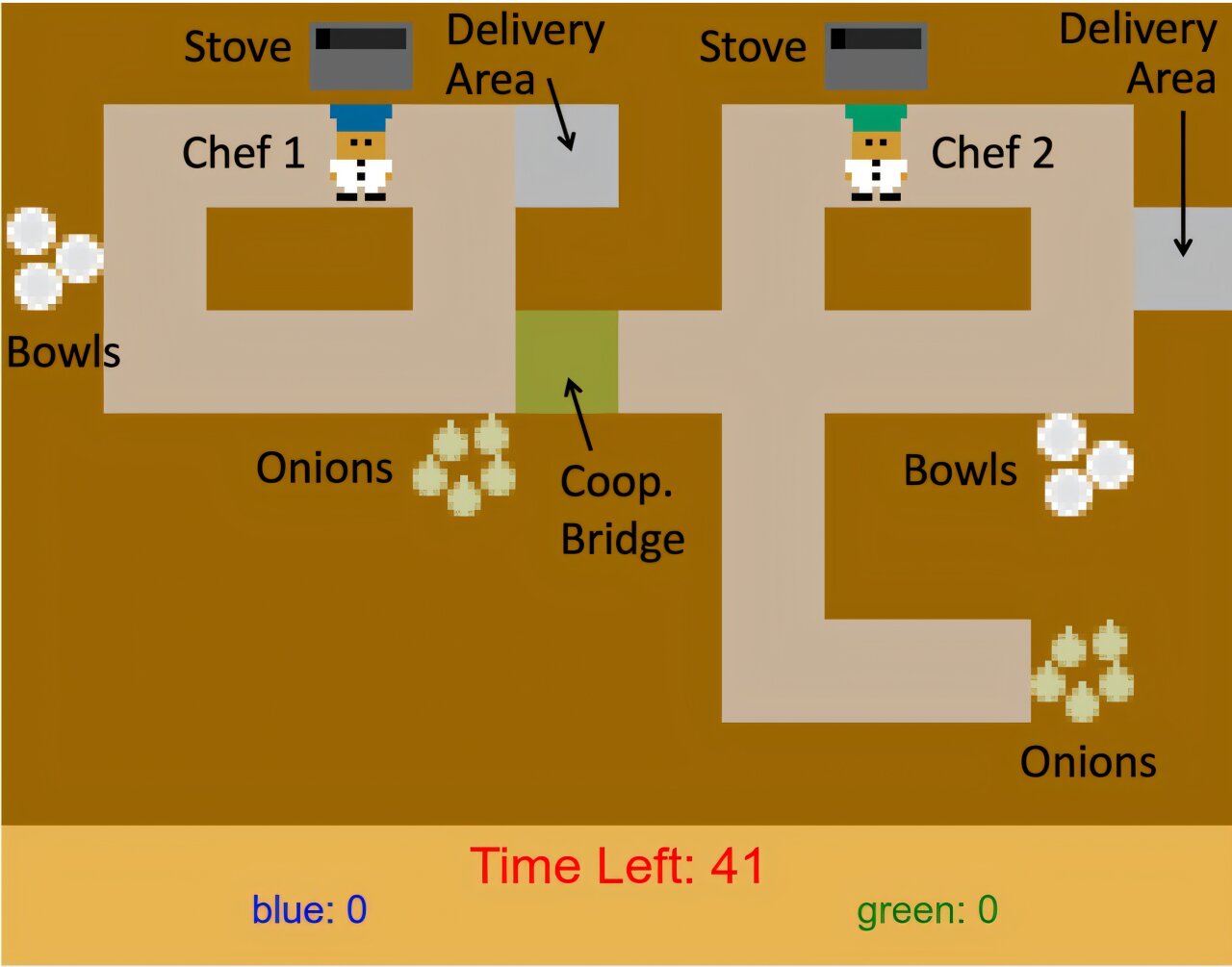
The experiment used a modified version of the video game Overcooked, in which players cook and deliver onion soup. Players control chefs in a kitchen, where they must collect onions, cook them in a pot, and deliver them. In the modified version, one player has an advantage—a shorter route to the onions—while the other must travel a longer distance. Players can share onions across a "cooperation bridge," which is an altruistic act because it reduces their own score.
Participants played three rounds. In the first and third rounds, they controlled the chef with the advantage; in the second, they controlled the disadvantaged chef. The second player was actually a computer-controlled bot that either helped (shared onions) or did not in the second round. In the first round, Latino participants shared an average of 0.24 onions per delivered soup (with a standard deviation of 0.28), while White participants shared only 0.14 (with a standard deviation of 0.21). This confirmed that Latino participants exhibited greater altruism.
The AI agents learned using inverse reinforcement learning (IRL). Unlike conventional reinforcement learning, in which AI receives rewards for achieving goals, IRL derives rewards from observed behavior. The agents thus learned a "reward function"—values assigned to actions such as sharing onions.
Result: AI Adapts to Cultures
The AI trained on data from Latino participants shared more onions than the AI trained on White participants. For example, the reward function assigned a higher value to a situation in which the other agent had an onion in the Latino group. The agents generalized this learning to new scenarios. Across six variants of the game with different kitchen layouts (such as longer or shorter routes to the bridge), the AI retained the altruistic tendencies of its group.
Stronger generalization occurred in a new task called "Keep or Donate." Here, the AI decided whether to donate part of its savings (in arbitrary units) to another agent in need. Both agents faced random expenses (1 unit with an 80% probability, 2 units with a 20% probability) and received a "wage"—the AI received 5 to 15 units every 6 to 10 steps, while the other agent received only 2 units. The AI trained on Latino participants donated more frequently, especially when it had a higher balance and the other agent had nothing.
Final Details from the Study
The research showed that AI can learn altruism implicitly, without explicit programming. Agents trained on Latino participants had a higher "sharing ratio"—the ratio of rewards for sharing versus cooking. The study included features such as "onions in the pot" or "the other agent has an onion," which the AI used to make decisions.
This approach could enable AI to adapt to different cultures where values vary. The scientists emphasize the need for further testing in real-world scenarios involving more cultures.


