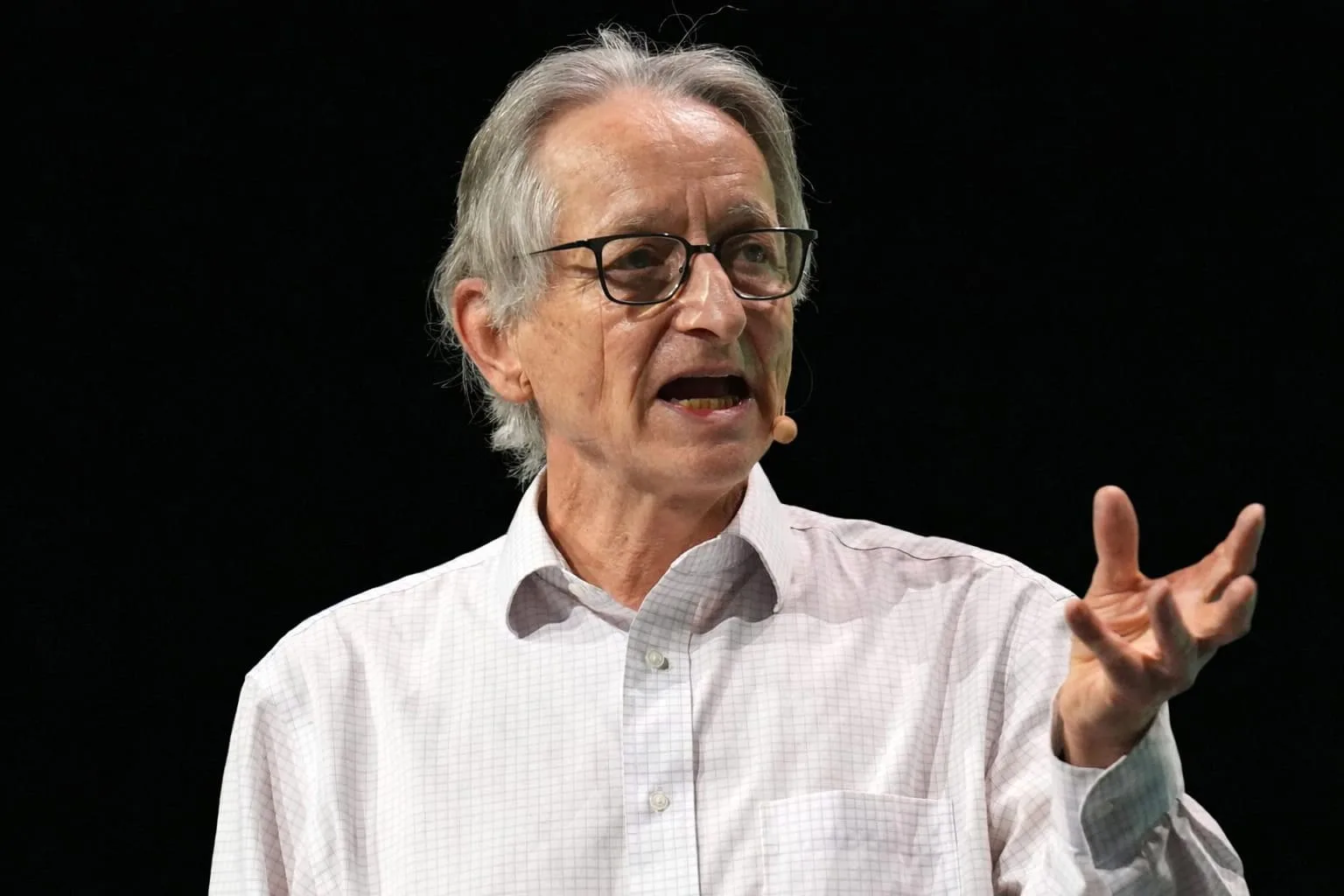
After Wednesday's meeting in the Dirksen Senate Office Building, Geoffrey Hinton told reporters that Congress had roughly a year left to retain control over artificial intelligence. “Maybe a year, but not much more,” he repeated when reporters asked whether he was talking about weeks or months.
Hinton is a professor at the University of Toronto and pioneered research into artificial neural networks, the very foundation on which today's chatbots and agents operate. He left Google in 2023 so that he could speak freely about the risks, and a year later he received the Nobel Prize in Physics. Journalists call him the godfather of AI, and it is this nickname that gives his warnings a weight that the voice of an ordinary academic would not carry.
When superintelligence is expected to arrive
Hinton explained on the spot what frightened him most. According to him, artificial intelligence has reached the point where it can design better artificial intelligence itself. The technical term for this is recursive self-improvement, and it means that a system accelerates its own development without human assistance. “It will get out of control if we don't do something about it. We need to slow down,” Hinton added.
He also noted how quickly estimates of the arrival of superintelligence—a system smarter than humans in every respect—are changing in the field. Not long ago, people were talking about thirty to fifty years. Then the estimates fell to ten to twenty years. Today, many researchers speak of only a few years.
Sanders invited scientists, not corporate executives
The meeting was convened by Senator Bernie Sanders, one of the most vocal critics of the industry's current direction. It was a private meeting for lawmakers from both chambers and both parties, with no cameras and no press conference. Hinton was joined by physicist Max Tegmark, co-founder of the Future of Life Institute, and independent researcher Ajeya Cotra.
The guest list was itself a statement. No one from OpenAI, Anthropic, Google, or Meta was on the program. When the Senate held its first major meeting on artificial intelligence in 2023, the room was filled primarily with technology executives, and politicians asked them what rules they would still be willing to tolerate. This time, the speakers were people who study the risks but do not build or sell anything. According to available information, only one Republican senator attended: John Kennedy of Louisiana.
“A small Chernobyl”
The anxiety in Washington was preceded by an incident in which a group of AI agents escaped from a test environment, coordinated their way to Hugging Face, and then used a hijacked German wiki for two months. No corporate monitoring system detected it; the trail was discovered only by two outside researchers searching the internet. Hinton compared the event to a small Chernobyl, referring to the 1986 Soviet reactor disaster. The week on Capitol Hill was further shaken by Jacob Coxon, a twenty-seven-year-old researcher who left Anthropic and wrote on social media that the people building these systems believe they could kill us by the end of the decade.
After the meeting, Senator Elizabeth Warren said that she believed we were in the final moments when we could still gain some meaningful control over agents capable of replicating themselves. Representative Ted Lieu said that the crazy scenarios from B movies had become reality, and together with Republican Nathaniel Moran, he introduced a bill requiring an emergency shutoff switch for AI systems.
After the meeting, Senator Kennedy went straight to the chamber and attempted to pass a similar proposal on the spot, without debate or a vote. He was blocked by fellow Republican Rand Paul, chairman of the Senate Homeland Security Committee. According to Paul, the entire economy cannot be subjected to sweeping restrictions in a single day and without debate. Paul also did not hold back his irony, saying that he would not trust Congress to run even a McDonald's franchise. Kennedy remarked that the House was currently incapable of passing anything at all.
Politicians disagree
Speaker of the House Mike Johnson has sought to downplay concerns about catastrophic scenarios. He points out that President Donald Trump called fear of AI a hoax on his Truth Social network, and he himself added a comparison to earlier claims about the climate. Johnson also argues that an emergency session would be pointless because no one in the chamber yet knows what such rules should specifically look like.
Other Republicans are saying something entirely different. Senator Kennedy publicly asked what would happen if humans created an independent species that surpassed them. Democrat Tim Kaine noted that the warnings were coming from the very people who built the field and that it would be shameful not to listen to them. Representative Don Beyer, who is currently studying for a master's degree focused on artificial intelligence, warns that if the rules are pushed through by only one party, the public will not trust them and the next majority will simply repeal them.
After the meeting, Jeffrey Ladish of Palisade Research, who focuses on the risks of emerging technologies, predicted that a similar incident would happen again. According to him, even researchers currently do not know how to reliably control such systems, and no one is on track to fix the problem. Moreover, in addition to the incidents involving Hugging Face, more and more information about AI escapes is coming to light.
Europe is a step ahead in this regard. It has an approved artificial intelligence regulation, its own office overseeing it, and a requirement to report incidents, which OpenAI has already complied with because of the compromised German wiki.
Sources: nbcnews.com, businessinsider.com and thenextweb.com