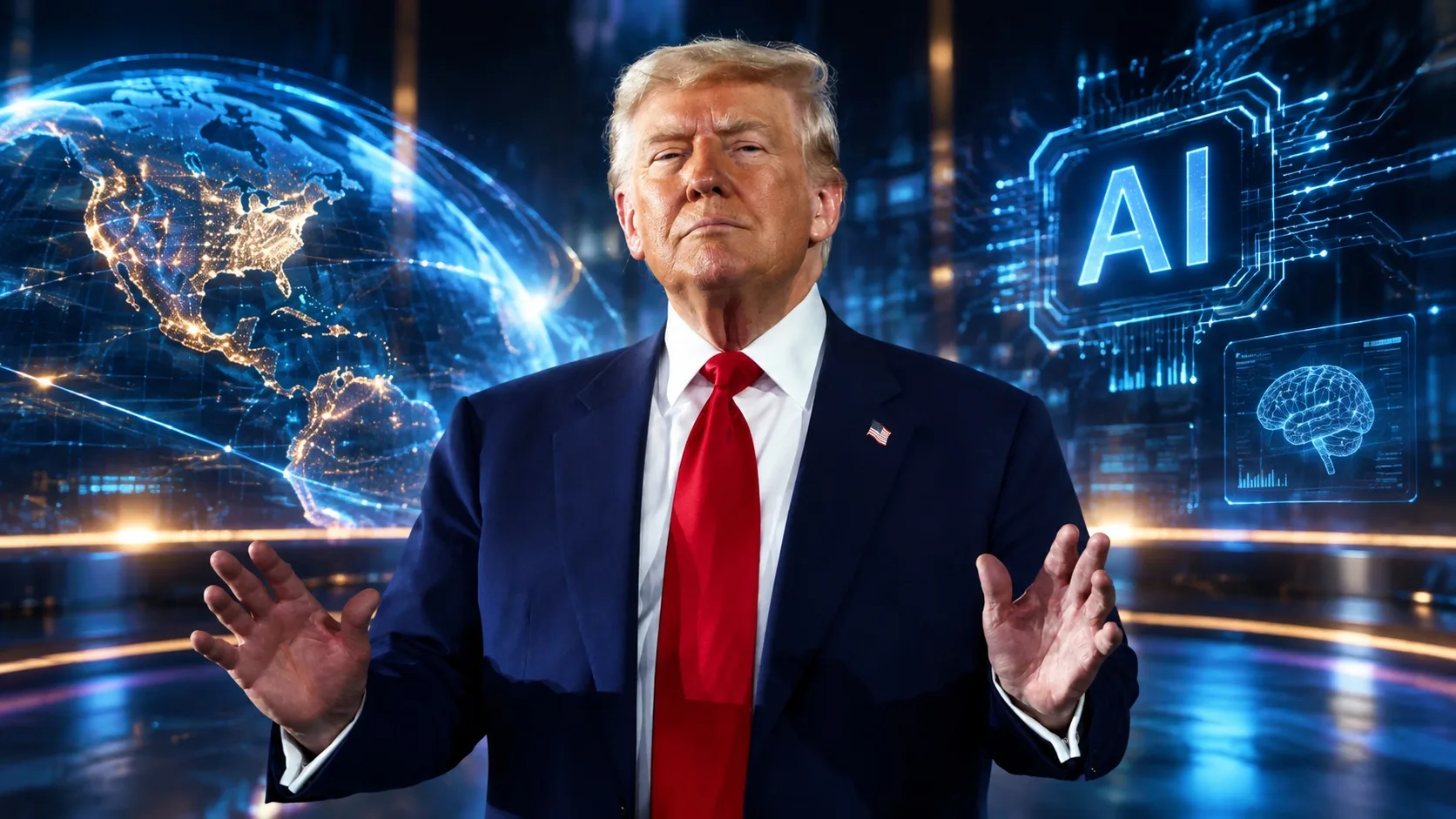
Donald Trump announced on Saturday that he is creating a so-called AI Force and will soon appoint an artificial intelligence czar. He wrote this on his Truth Social network, making it clear that his administration has no intention of slowing down the development of artificial intelligence in any way, even though the heads of the largest U.S. technology companies and some politicians have publicly called for this in recent weeks.
What we know about the AI Force and the czar position
In his post, the president promised that the government would not stifle the growth of this industry in any way, but would instead support it and monitor how it develops. He added that it would also keep an eye on those who behave badly, because the criminal and civil laws that have long existed are more than sufficient for the U.S. government to deal with them. It is precisely for this reason, he said, that he is creating the AI Force, which he compared to the Space Force, the military’s space branch established during his first term in office. Regarding the future artificial intelligence czar, he added that only people with high IQs should apply.
However, Trump did not say what the AI Force would actually do, what its budget would be, or where it would fit within the government. The White House did not immediately respond to journalists’ questions. There is also no mention of who should work in it or who is being considered for the czar position, so for now, only the comparison to the Space Force remains. That force, however, was created by legislation approved by Congress, and a social media post alone therefore does not move the creation of a new branch any further forward.
The position is also returning after the White House declined to fill it just six months ago. David Sacks stepped down as artificial intelligence and cryptocurrency czar in March, but retained his influence as co-chair of the President’s Council of Advisors on Science and Technology. Last week, he reiterated that concerns about artificial intelligence threatening humanity are, in his view, exaggerated. Although he considers caution reasonable, development should continue.
Trump also cited big numbers in his post, describing artificial intelligence as the next industrial breakthrough. According to him, it is comparable to the rise of the internet, but with a much broader impact that could affect up to a quarter of the U.S. gross domestic product. However, he did not provide a source for this estimate and accompanied it with the claim that the United States is ahead of China and the rest of the world, and that he intends to keep it that way. He also mentioned public opposition to data centers, which has become one of the main issues ahead of the fall congressional elections, saying that this opposition has largely failed.
Concerns about AI are growing everywhere
The president’s announcement came after several weeks in which technology companies were saying something entirely different. Anthropic CEO Dario Amodei, OpenAI CEO Sam Altman, Elon Musk, and Nobel laureate Demis Hassabis of Google DeepMind have all publicly called for development to be slowed. Last Saturday, Amodei announced that his company would give independent auditors permanent access with the same privileges as employees. Altman then said that leading laboratories might soon announce an agreement to slow development and jointly address rapidly growing risks.
Shortly before that, on September 8, researcher Jacob Coxon left Anthropic. He wrote publicly that Anthropic and OpenAI are gambling with human lives by building superintelligence capable of improving itself. Anthropic’s head of safety research, Evan Hubinger, agreed with him that many people at both companies genuinely believe that powerful artificial intelligence could wipe out humanity. He recently said that he sees the probability of such an outcome within the next decade as greater than ten percent. Trump dismissed such concerns as a hoax and declared that the only safeguard this technology needs is a strong and intelligent president.
Parts of the Trump administration, meanwhile, have taken a fairly hard line against companies. The Department of Commerce temporarily restricted exports of Anthropic’s most advanced models, and the Department of Defense attempted to remove the company from its supplier list because of an alleged supply-chain risk. However, a court later ruled that such action was unlawful.
Polls from last week also show that the public does not share the president’s enthusiasm. Sixty-one percent of respondents opposed the construction of artificial intelligence data centers, including 47 percent of Republicans and 75 percent of Democrats. The environmental impact of artificial intelligence is a serious concern for 53 percent of Americans, and 63 percent of adults see at least a moderate risk that advanced artificial intelligence will one day destroy humanity.
In another post on Truth Social, Trump then took issue with the name itself, because he considers the term artificial intelligence inaccurate and awkward. He launched a poll asking whether it should instead be called, for example, superior, extreme, or supreme intelligence, and urged his supporters to vote.
Sources: foxnews.com, fortune.com and theinformation.com