An Oregon company whose bipedal robots carry totes around warehouses is heading to Wall Street. Agility Robotics has announced a merger with an investment company that values it at $2.5 billion. This will make it the first publicly traded company fully dedicated to manufacturing and selling humanoid robots.
Flagship Robot Digit
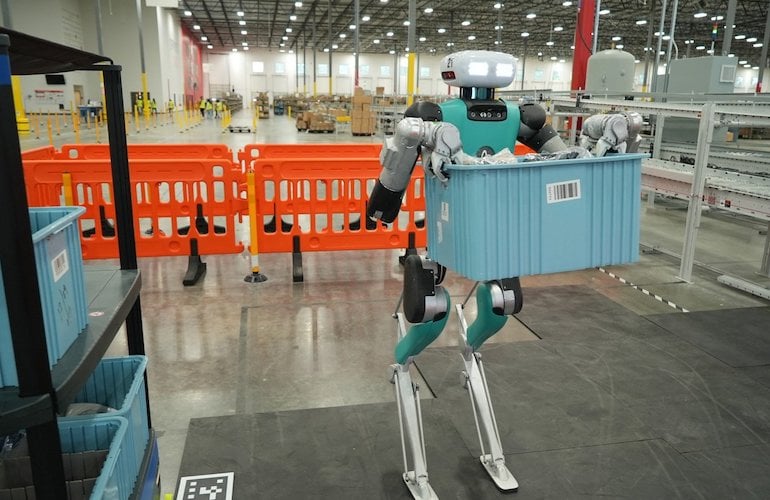
The company’s flagship product is a robot named Digit. It stands approximately 175 centimeters tall, walks on two legs, and has a head with glowing eyes. It was built to move through spaces designed for people. It can lift loads weighing nearly sixteen kilograms and perform repetitive tasks. It carries totes, operates machinery, and transfers goods from conveyors. And it can do so for as many as twenty hours a day.
Michael Klein, co-founder and chairman of Churchill Capital Group, described it as the first humanoid robot ever to be employed and commercially deployed in warehouses and industrial facilities. Digit has already logged more than 65,000 hours across nine customer sites. Its customers include Amazon, Toyota, industrial parts supplier Schaeffler, and Latin American e-commerce giant Mercado Libre.
Every one of those working hours delivers value. The robots collect data from real-world operations, which then helps improve both their behavior and the underlying artificial intelligence. All competitors agree that this kind of data is difficult to obtain.
The Beginnings of Agility Robotics
The company’s origins date back to 2015. That was when Jonathan Hurst, Damion Shelton, and Mikhail Jones founded Agility Robotics as a spin-off from Oregon State University’s Dynamic Robotics Laboratory. Hurst, an engineer and university professor, still works at the company under the title of “chief robot officer.”
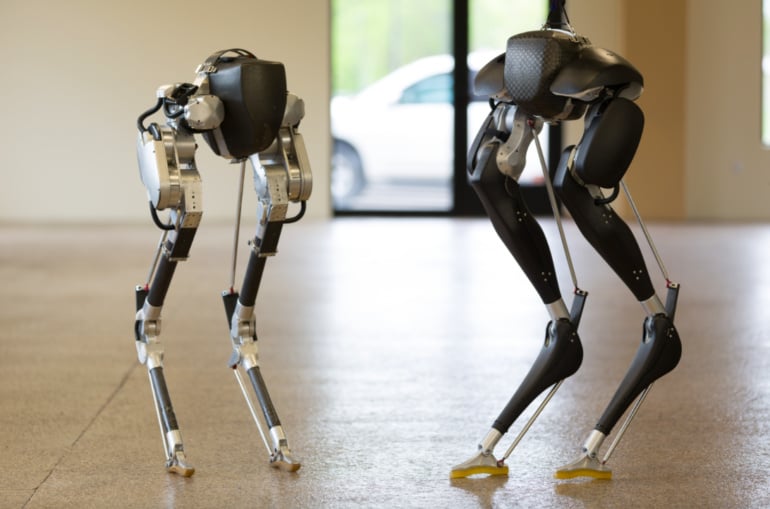
Before Digit came the bipedal research platform Cassie. From there, the company gradually worked its way toward the humanoid robot it now deploys directly at customer sites. More than a decade of development has made Agility one of the few companies with years of real-world experience operating humanoid robots.
This is where something few others can replicate comes into play. In 2024, Agility opened RoboFab, which it describes as the first full-scale factory for the mass production of commercial humanoid robots. The facility covers around 70,000 square feet and is located in Salem, Oregon, just a few dozen kilometers from the company’s engineering center.
It has the capacity to produce up to 10,000 robots per year. There is another interesting detail as well. Approximately 75 percent of the nearly 6,000 parts that make up Digit come from U.S. sources. The company aims to prevent supply disruptions and deliver to customers on time. Digit even works in the factory itself. It helps manufacture its own successors, transferring and carrying totes just as it does at customer sites.
Digit v5 and Robots Without Fences
Previous generations of industrial robots were so large and fast that they had to be separated from people by fences and cages. That is about to change. The upcoming fifth generation, Digit v5, is designed to operate directly among people in warehouses and manufacturing facilities.
The new version can do more. It can carry more than 22 kilograms, reach higher, and work for up to 22 hours a day. It also features interchangeable hands and, most importantly, safety systems designed to enable barrier-free work alongside employees. Agility describes it as the first humanoid robot capable of safely collaborating with people.
According to Hurst, workplace safety and collaboration are the decisive factors that will pave the way for the mass deployment of humanoid robots. And in the future? Hurst does not rule out similar robots eventually appearing in hospitality, domestic services, or elder care.
The Company Is Heading to the Stock Market
The company will merge with a SPAC, Churchill Capital Corp XI, led by financier Michael Klein. This route offers faster access to the stock market and less stringent disclosure requirements. The combined company is expected to trade under the ticker AGLT, and the deal should close by the end of the year. Agility is expected to receive more than $620 million from the transaction. Around $420 million of that comes from funds Churchill raised from investors, while another approximately $200 million is being contributed by a group led by Taiwanese electronics manufacturer Foxconn.
Caution is warranted because the initial transaction documents do not disclose the company’s revenue and indicate that Agility is not yet profitable. Operating expenses increased to approximately $111 million in 2025 from the previous $71 million. The company burned through around $100 million in cash during the year. It describes these figures as preliminary and unaudited.
Another enticing figure also deserves attention. Agility boasts more than $300 million in orders for Digit v5. However, a closer reading of the fine print reveals that this is not revenue. The total depends on certain contractual conditions being met and comes from a single three-year contract for 1,000 robots with a customer whose name the company has not disclosed. It represents real demand, and no company in the industry has yet announced an order volume on this scale. Investors should nevertheless understand what the figure means.
In addition to Foxconn, Agility’s prominent investors include Amazon, Nvidia, and SoftBank. The company plans to use the proceeds to fulfill existing orders, expand deployments at customer sites, and, above all, launch mass production of the Digit v5 model.
Sources: usnews.com, apnews.com and abcnews.com