

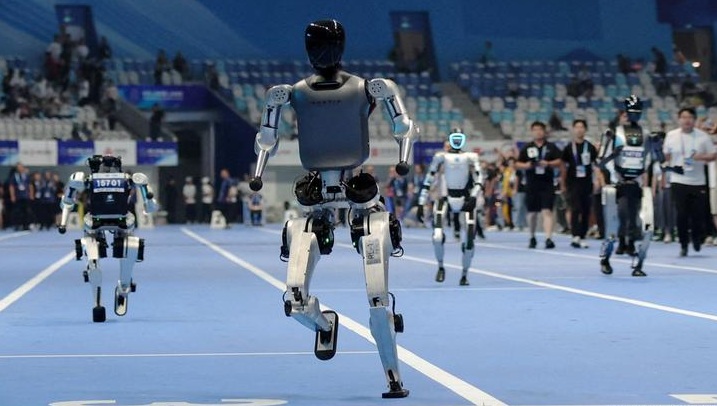
World Robot Games in Beijing: Robots Box, Run, and Clean!
In August 2025, an event that attracted worldwide attention took place in Beijing. It was the inaugural World Humanoid Robot Games, where around 280 teams competed with more than 500 humanoid robots. These machines, designed to mimic human movements, competed in 26 different disciplines, ranging from physically demanding combat to practical tasks. The event ran from August 8 to 12 and included participants from 16 countries. People gathered to watch the robots demonstrate their abilities, while videos of these performances flooded social media. The event was not only entertaining but also showcased the rapid progress in artificial intelligence (AI) and robotics, which China is supporting through massive government investment.
Diverse, Action-Packed Competitions
The competitions were designed to test various aspects of the robots—from strength and speed to precision and coordination. In kickboxing, for example, robots designed by Unitree Robotics faced off in the ring, where points were awarded for clean strikes. Some matches ended in knockouts, thrilling the spectators. The robots were controlled remotely but relied on advanced AI-powered motion-control algorithms. Another discipline was soccer, where robots played in teams and attempted to kick the ball into the goal, requiring quick decision-making and teamwork.
In athletics, there was a 400-meter race in which the robots demonstrated their endurance and stability. Other disciplines included martial arts, dancing, and practical tasks such as cleaning and sorting medication. These disciplines demonstrated how robots can assist in everyday life, for example in homes or healthcare. A total of 26 events attracted curious members of the public as well as international media, which emphasized how these games are helping to narrow the technological gap between China and the United States.
A Combination of AI and Human Control
Sophisticated technology lies behind the robots’ success. Many of them used artificial intelligence for autonomous movement, but in some competitions, such as kickboxing, remote control by humans was necessary. This shows that despite advances, a human touch is still needed for complex tasks. Unitree Robotics, which designed some of the combat robots, focused on algorithms that enable natural, human-like movements. The entire event served to promote Chinese investment in robotics, which has ambitious goals—according to research by Morgan Stanley, China could have as many as 300 million humanoid robots by 2050. This could transform industry, healthcare, and entertainment.


