

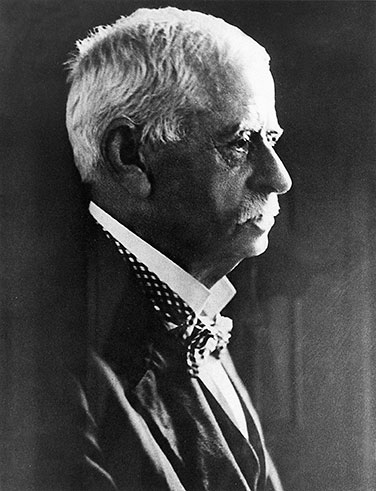
Great Texans: William McDonald - The Man Who Gave Us the Stars
A few Christmases ago, I reflected on the great gifts, including money and property, that have been donated to the state of Texas over the years. I will tell you about three such gifts that led to a fourth, priceless one.
In 1926, an unmarried banker died in Paris, Texas—and a wealthy unmarried banker at that. His estate was worth about $1.2 million. Today, that would be roughly $17 million. In his will, the banker left most of his money to the University of Texas to purchase a telescope and build an observatory.
The banker's name was William Johnson McDonald. He had no connection to the McDonald's hamburger chain.
As you might expect, Mr. McDonald's relatives were not thrilled that he had left all that money for a telescope. In their view, anyone who would do such a thing had to be a little crazy. So they sued.
Fortunately, Mr. McDonald's long-standing interest in science was well known—while in his fifties, he attended summer school at Harvard to study botany. He even shared his dream of a giant telescope with his barber. He said that astronomy was a young science with great potential if given proper funding; he hoped that one day a telescope would be built that would allow astronomers to see the gold-paved streets of heaven.
The university prevailed and, after the court case, received about $800,000 (still $11 million in today's money).
Once the university had the money, it had to begin searching for a mountain on which to build the observatory. That must have been fun. Mountain shopping is something a person experiences only once or twice in a lifetime. Fortunately for the university, it is located in a state that includes West Texas, with the best stargazing conditions in North America. After traveling several thousand miles across the region, examining various sites for elevation, dark skies, cloudless nights, and a low probability of rain, they found what they were looking for near Fort Davis. The mountain had no official name, but locals called it Flat Top Mountain. It was part of a ranch with the perfect name for the area: the U Up and U Down Ranch.
University president Harry Benedict wrote a letter to the mountain's owner, Mrs. Violet McIvor. He told her about McDonald's gift and the university's great need to find a mountain for the observatory. Benedict wrote that her mountain was ideally suited for such an observatory because “the optical tests that have already been conducted have shown that the Davis Mountains area is the best in Texas, perhaps the best in the United States, for astronomical purposes.” He asked whether she would consider donating her mountain to science.
I think Mrs. McIvor surprised him by actually doing so. She donated the entire mountaintop, 200 acres, to the university, as well as land for building a road to the summit. The resulting road, Spur 78, has the highest elevation of any road in Texas.
The university built the observatory and named it after William Johnson McDonald. The mountain was officially named Mt. Locke after Violet McIvor's grandfather, G. S. Locke, from whom she had inherited it. She wrote to the university that she was delighted “that her grandfather's name would be preserved in the Davis Mountains.” She said, “He would be pleased to leave his name among the mountains he knew and loved for so long.”
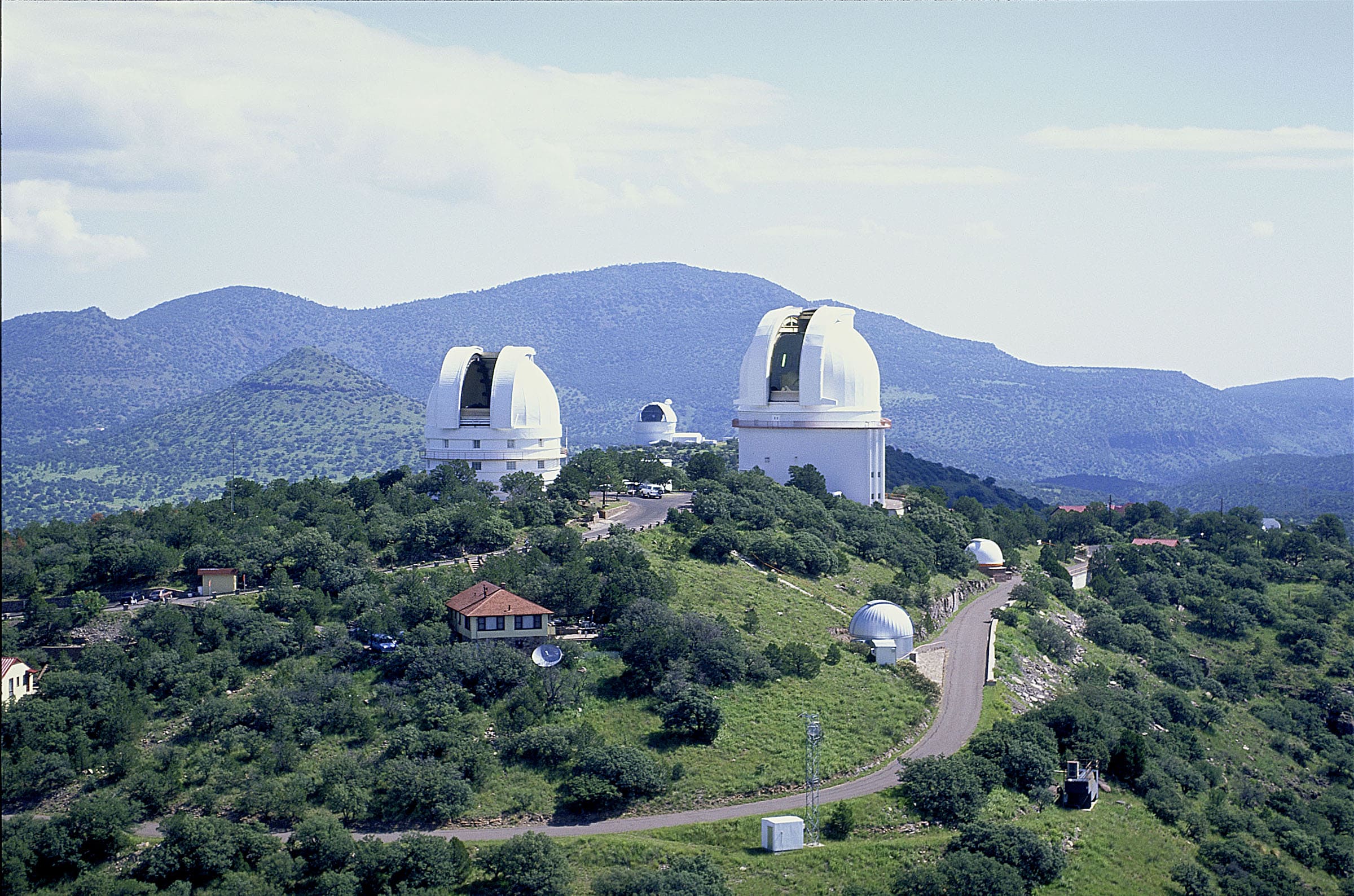
I asked Mrs. Julie McIvor, who still lives on and operates the U Up and U Down Ranch with her husband Scott, why her grandmother-in-law would simply donate such a valuable piece of real estate, one that would be worth millions today.
“That generation was different,” she said. “They believed in giving back. They were building a great state and a great country. She loved being able to contribute to a better future for Texas—and America.”
As gifts inspire further gifts, just five months after Mrs. McIvor donated the summit of her mountain to the university, the estate of longtime Fort Davis judge Edwin H. Fowlkes donated the neighboring mountain known as Little Flat Top. The Fowlkes estate donated a total of 200 acres, and the mountain was formally named Mt. Fowlkes in his honor. Mrs. Sheri Eppenauer, who is Judge Fowlkes's daughter-in-law, told me that he was a civic-minded man who always did what he believed was best for the people of Fort Davis and the region.
Three gifts to Texas: an observatory and two mountains. Together, they gave us a fourth gift—one of the world's leading centers for astronomical research. In fact, just as McDonald predicted, these gifts gave us the heavens themselves.


