

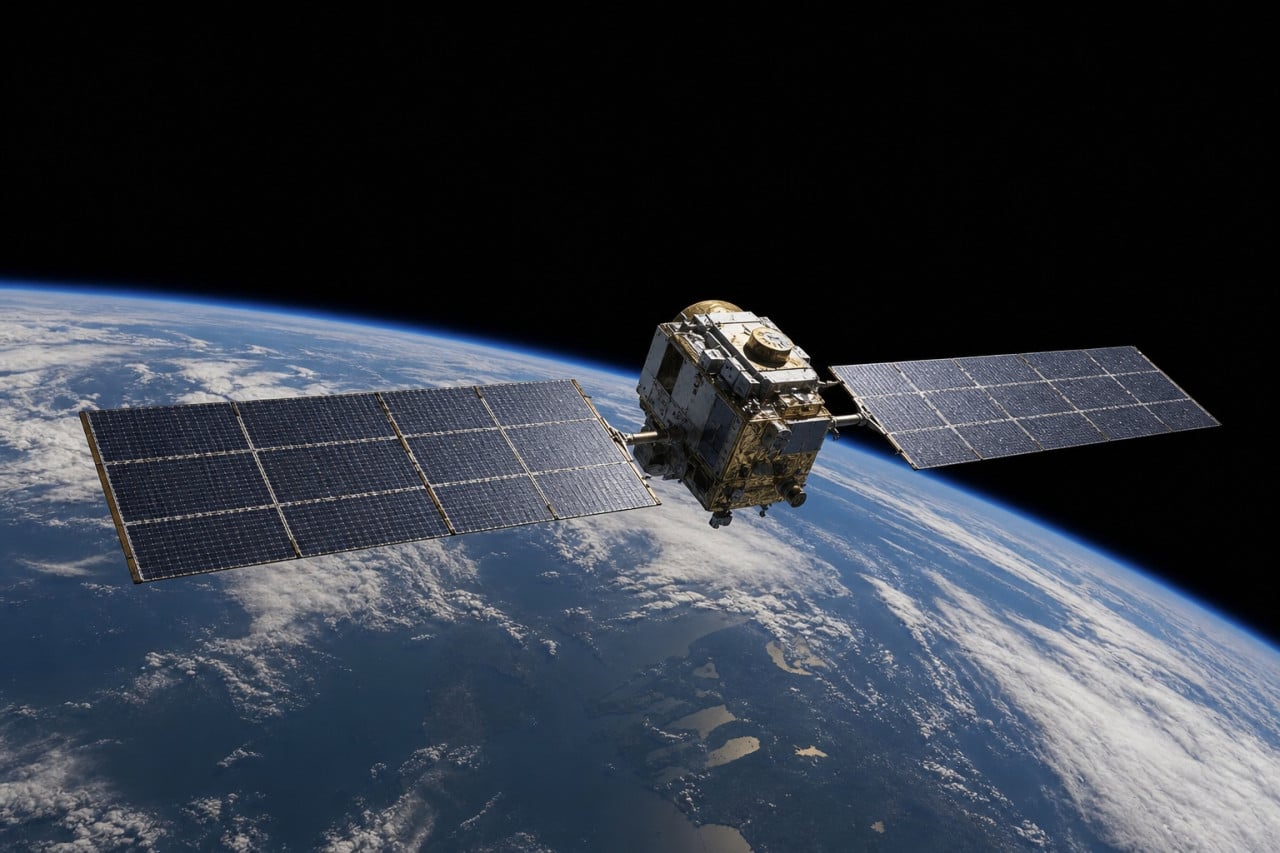
Artificial intelligence consumes so much electricity and water that Earth is no longer enough for it. Data centers are straining power grids, draining local resources, and residents are protesting ever more loudly against their construction. Some technology companies have therefore come up with an answer that, just a few years ago, belonged to the realm of science fiction. What if we moved computing power to where the Sun shines virtually nonstop and cooling is provided by the vacuum?
That is exactly what Elon Musk's SpaceX, Jeff Bezos's Blue Origin, Google, and smaller companies such as Starcloud and Lonestar are now trying to do. Each of them is taking a different approach. Let's look at them one by one.
SpaceX and xAI: a million satellites and a factory the size of a city
Elon Musk and his company SpaceX have filed an application with the U.S. Federal Communications Commission (FCC) to launch up to one million satellites intended to function as orbital data centers. For comparison, roughly 15,000 active satellites currently orbit Earth, most of them Musk's Starlink satellites.
The satellites are intended to fly at altitudes of 500 to 2,000 kilometers and communicate with one another via optical laser links. Inference requests, meaning queries sent to running artificial intelligence models, would be transmitted between orbit and Earth by the existing Starlink network. Power will be provided by a Sun-synchronous orbit, in which the satellites move along the boundary between day and night, allowing sunlight to strike their solar panels almost continuously.
SpaceX is already building the enormous Gigasat factory in Bastrop, Texas, covering more than one million square meters and more than ten times larger than the company's current largest manufacturing complex. First-generation satellites designated AI1 are expected to begin rolling off its production lines at the end of 2027. They will be behemoths with a span of around 70 meters, wider than a Boeing aircraft, with bodies consisting mainly of solar panels and double-sided radiators. The computing core at the center of each satellite will deliver 150 kilowatts of power. By the end of 2027, SpaceX wants to place the equivalent of one gigawatt into orbit, which means launching more than 6,000 of these machines in a single year. Two prototypes are expected to fly as early as the beginning of 2027.
In its application, the company describes the project as the “first step toward a Type II civilization on the Kardashev scale," meaning a civilization capable of harnessing the full energy output of its star. Experts, however, point out that the figure of one million satellites is most likely a negotiating tactic. SpaceX used the same approach with Starlink. Even a fraction of the stated number, however, would represent a major increase in the number of objects in orbit and a higher risk of collisions.
Blue Origin: Project Sunrise with 51,600 satellites
Jeff Bezos did not leave Musk's move unanswered. His company Blue Origin filed an application for a constellation called Project Sunrise, which is intended to include up to 51,600 satellites in Sun-synchronous orbits at altitudes of 500 to 1,800 kilometers. Each orbital plane will accommodate 300 to 1,000 satellites.
At the heart of the entire system is expected to be the TeraWave network, which Blue Origin announced at the beginning of the year. It is a separate constellation of 5,408 communications satellites with optical links, capable of data transfers of up to 6 terabits per second and connecting orbital data centers both to one another and to Earth. Musk, incidentally, could not resist taking a jab, saying that future Starlink laser links would surpass this speed.
In its application, the company argues that moving computing into orbit will ease the burden on American communities and natural resources, which are being drained by energy- and water-intensive data centers. The heavy-lift New Glenn rocket is intended to launch the satellites. The catch is that Blue Origin has yet to launch a single TeraWave satellite, and New Glenn has flown only twice. The company wants to place the first satellites of the communications network into orbit by the end of 2027.
Google: Project Suncatcher and TPU chips in a particle accelerator
Google is proceeding more cautiously. Its Project Suncatcher research initiative envisions constellations of solar-powered satellites equipped with TPU chips, processors that Google designs specifically for artificial intelligence computations and that currently power its models on Earth.
Company CEO Sundar Pichai noted that the Sun emits more than one hundred trillion times as much power as humanity generates in electricity. A solar panel in a suitable orbit is also up to eight times more productive than one on Earth. In collaboration with Planet, Google will therefore launch two prototype satellites equipped with Trillium-generation chips at the beginning of 2027 to test their behavior in low Earth orbit.
The company has already completed its first tests. The Trillium chips underwent a simulation of cosmic radiation in a particle accelerator and survived a dose equivalent to a five-year mission without permanent damage. In a published study, Google also describes the target design of the system: a cluster of 81 satellites flying in a tight formation with a radius of one kilometer at an altitude of around 650 kilometers, interconnected by optical links. Pichai admits, however, that heat dissipation and the reliability of the entire system remain major obstacles. After all, no one can replace a faulty chip in orbit as they would in a server rack.
Starcloud: the small company already computing in orbit
While the giants draw up plans, Redmond-based startup Starcloud already has functioning hardware in space. In November 2025, it launched the Starcloud-1 satellite aboard a Falcon 9 rocket, a 60-kilogram box roughly the size of a refrigerator, with Nvidia H100 graphics processors on board. It was the first cutting-edge data-center GPU ever to leave the atmosphere, with one hundred times more computing power than anything previously in orbit.
And the satellite has not been idle. In December, it became the first satellite to run a language model from the Gemini family, as well as the first machine to train its own model in space, specifically Andrej Karpathy's nanoGPT.
Company CEO Philip Johnston claims that energy in orbit is ten times cheaper than on Earth, even after accounting for launch costs. The long-term plan is to build a 5-gigawatt orbital data center with solar and cooling arrays measuring approximately four by four kilometers. The company has filed an application for a constellation of up to 88,000 satellites. A larger Starcloud-2, featuring a GPU cluster and its own storage, is expected to fly later this year. “In ten years, almost all new data centers will be built in space," Johnston believes.
Lonestar: data backups as far away as the Moon
Florida-based Lonestar Data Holdings is taking a completely different direction. It is not interested in computing power for artificial intelligence, but in ultra-secure off-planet data storage. On Earth, data is threatened by cyberattacks, wars, natural disasters, and even ordinary human error. None of these pose a threat on the Moon.
The company first tested the concept on the International Space Station, and in February 2024 its software flew aboard the Odysseus lander. A year later, it sent physical hardware on Intuitive Machines' Athena mission, an 8TB SSD with an FPGA chip, thereby deploying the first-ever data center on the lunar surface. In the future, it is considering full-scale data centers hidden in lunar tunnels, which would serve as backups of terrestrial data in the event of a disaster.
This year, the company unveiled the commercial StarVault platform. The first module is being built by Sidus Space and is scheduled to head into orbit aboard the LizzieSat-4 satellite, with a second module to follow next year. “Demand for off-planet data security has exceeded expectations," says company CEO Stephen Eisele.
Skeptics warn about physics and economics
Not everyone shares the enthusiasm. Experts contacted by the BBC point out that rocket launches remain expensive and that the infrastructure required to protect, cool, and power satellites is immensely complex. Others warn of the growing risk of collisions in low Earth orbit, which could damage other spacecraft or result in debris falling to Earth. Questions also remain about cooling graphics chips in a vacuum and their resistance to cosmic radiation. Wall Street analysts, meanwhile, doubt the economic viability of the entire undertaking.
Supporters, however, have a strong argument. Orbital data centers do not consume a single drop of water, radiate heat directly into the vacuum, and harness solar energy without clouds, nighttime, or atmospheric losses. According to Nvidia, a space-based data center could save ten times as much carbon dioxide emissions over its lifetime compared with terrestrial operations.
Sources: pctuning.cz, dc-nn.com, chip.cz, dc-nn.com, and pctuning.cz


